 |
|
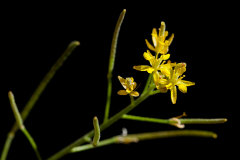
Patrick Alexander from Las Cruces, NM. Creative Commons Zero, Public Domain Dedication |
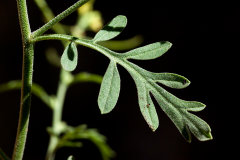 |
| Patrick Alexander from Las Cruces, NM. Creative Commons Zero, Public Domain Dedication |
Translate this page:
Summary
Desert tansymustard is a native southwestern annual that bridges desert and upland habitats more than its name suggests. It is not restricted to the hottest low deserts, and it can occur in sandy soils, dry washes, disturbed sites, and open forests at mid elevations. Although it was not sampled in the source fieldwork you provided, it shares the broad tansymustard pattern of edible leaves and seeds, long availability, and strong practical value where abundant. It is a plant of opportunity, producing food in places where cultivation is difficult and where other edible annuals may be sparse.
Physical Characteristics

 Descurainia obtusa is a BIENNIAL growing to 1 m (3ft 3in) by 0.5 m (1ft 8in) at a fast rate.
See above for USDA hardiness. It is hardy to UK zone 6. The flowers are pollinated by Bees, Insects.
It is noted for attracting wildlife.
Suitable for: light (sandy) and medium (loamy) soils, prefers well-drained soil and can grow in nutritionally poor soil. Suitable pH: mildly acid, neutral and basic (mildly alkaline) soils. It cannot grow in the shade. It prefers dry or moist soil and can tolerate drought.
UK Hardiness Map
US Hardiness Map
Synonyms
Homotypic Synonyms: Descurainia obtusa subsp. typica Detling. Sisymbrium obtusum (Greene) A.Nelson & J.F.Macbr. Sophia obtusa Greene.
Plant Habitats
Edible Uses
The edible parts are the leaves and seeds. As with the other tansymustards, the leaves are best treated as a cooked green, while the seeds are generally the more durable and useful long-term resource [2-3]. Edible Uses & Rating. Desert tansymustard should be regarded as a potentially good wild food, especially in sandy and arid landscapes where food options are often limited. Because the species was not directly sampled by us, its practical culinary rating is best inferred from close relatives: likely fair to good for leaves when cooked, and good for seeds when mature and properly processed. Taste, Processing & Kitchen Notes. Although species-specific tasting notes were not provided, the safest inference from the genus is that the leaves will be spicy, mustardy, and at least somewhat hairy or coarse when raw, improving considerably with boiling. The seeds are likely to be the better resource, especially if toasted. In tansymustards generally, toasting reduces harsh spicy notes and creates a more agreeable crunchy seed with light charred complexity. Boiling seeds may reduce pungency but often produces less attractive results than toasting. Seasonality (Phenology). Desert tansymustard blooms from approximately May to September, which gives it one of the longest collection windows among the southwestern annual mustards. This makes it potentially valuable as both a leaf and seed plant across much of the growing season. Safety & Cautions (Food Use). As with all tansymustards, the main caution is mineral accumulation from certain soils. Avoid gathering from contaminated or geologically suspect sites, especially mining districts, industrial margins, and selenium-rich soils. The leaves are likely best cooked because of pungency and possible digestive harshness if eaten in quantity raw. Harvest & Processing Workflow. Young leaves should be gathered before flowering stalks become coarse, then washed and boiled, with a second water change if necessary. Seeds should be collected as pods mature and before widespread shattering. Dry the seed heads, thresh, clean carefully, then toast for the best eating quality [2-3]. Cultivar/Selection Notes. No cultivars are known. This is a wild annual and would be selected in practice only by habitat and abundance. Look-Alikes & Confusion Risks. It can be confused with other Descurainia species and with other finely divided annual mustards. The blunt leaf segments and habitat preference can help, but species-level confirmation often depends on pods and hair details. Traditional/Indigenous Use Summary. It belongs to a genus with substantial Indigenous food use and likely shared in that broader utility where locally abundant [2-3].
References More on Edible Uses
Medicinal Uses
Plants For A Future can not take any responsibility for any adverse effects from the use of plants. Always seek advice from a professional before using a plant medicinally.
Descurainia obtusa (commonly known as blunt tansymustard) is a member of the Brassicaceae family, similar to Descurainia sophia (Flixweed), which is well-documented for its medicinal properties in traditional medicine. While D. sophia is the species extensively studied in literature (often referred to as Ting Li Zi in traditional Chinese medicine), the genus Descurainia as a whole is generally recognized for containing bioactive compounds with potential health benefits (Europe PMC). Potential Medicinal Uses and Properties of Descurainia Species: Based on studies related to Descurainia sophia, which is a close relative, the following medicinal uses and properties are commonly associated with the genus: Respiratory Support: Seeds are used to treat cough, asthma, and bronchitis. Gastrointestinal Health: Used as a remedy for constipation and hemorrhoids, acting as a stool softener. Cardiovascular Support: Used as a cardiotonic to improve heart function and reduce edema. Anti-inflammatory and Analgesic: Extracts have shown anti-inflammatory and analgesic properties. Antioxidant: The seeds contain phenolic compounds that act as free-radical scavengers. (National Institutes of Health (NIH)) Common Forms and Applications: Seed Decoctions: Used for treating respiratory and gastrointestinal issues. Syrups: Used for cooling in traditional Persian medicine. Poultices: Applied for skin conditions or inflammation. Note: It is important to distinguish between species, as specific clinical studies on D. obtusa are limited compared to D. sophia. Consult with a healthcare professional before using any wild herb for medicinal purposes.
References More on Medicinal Uses
The Bookshop: Edible Plant Books
Our Latest books on Perennial Plants For Food Forests and Permaculture Gardens in paperback or digital formats.
Edible Tropical Plants
Food Forest Plants for Hotter Conditions: 250+ Plants For Tropical Food Forests & Permaculture Gardens.
More
Edible Temperate Plants
Plants for Your Food Forest: 500 Plants for Temperate Food Forests & Permaculture Gardens.
More
More Books
PFAF have eight books available in paperback and digital formats. Browse the shop for more information.
Shop Now
Other Uses
Desert tansymustard is a rangy annual rather than a tidy ornamental. In naturalistic or restoration plantings it could contribute seasonal cover and texture, though it is not generally cultivated for aesthetic reasons. It provides seasonal nectar and pollen to generalist insects and contributes seed to dryland food webs. In difficult sandy habitats it may play an important role as an opportunistic annual cover plant.
Special Uses
References More on Other Uses
Cultivation details
Desert tansymustard is a long-season native mustard with promising leaf and seed value, especially in sandy and difficult ground. It is best treated as a useful regional member of a highly important food genus rather than as an individually famous wild edible. Growing Conditions. This species favors sandy soils, dry washes, open disturbed ground, and open forest settings at mid elevations. It appears to do best where there is enough seasonal moisture to support spring and summer growth without prolonged waterlogging. Habitat & Range. It occurs primarily in Arizona and New Mexico and is associated with sandy soils, dry washes, disturbed places, and open upland habitats. Despite the name, it is not strictly a low-desert specialist. Size & Landscape Performance. Desert tansymustard is a rangy annual rather than a tidy ornamental. In naturalistic or restoration plantings, it could contribute seasonal cover and texture, though it is not generally cultivated for aesthetic reasons. Cultivation (Horticulture). This species is not commonly grown intentionally, but it could likely be direct-sown into sandy, disturbed, sunny ground. It would probably perform best with minimal competition and seasonal moisture. Pests & Problems. The greatest issues are likely to be drought, competition, and site chemistry. Like other annual mustards, it probably establishes quickly in favorable years but can disappear or remain sparse in poor seasons. Identification & Habit. Desert tansymustard is an annual with branched hairs, canescent, finely divided leaves, yellow four-petaled flowers, and narrow fusiform seedpods. The lower leaves are one- to three-times pinnate, and the segments are notably blunt or obtuse. Pollinators. The flowers are likely visited by small bees, flies, and other generalist mustard pollinators. The small yellow flowers are typical of broad-access Brassicaceae insect pollination.
References Carbon Farming Information and Carbon Sequestration Information
Temperature Converter
Type a value in the Celsius field to convert the value to Fahrenheit:
Fahrenheit:
The PFAF Bookshop
Plants For A Future have a number of books available in paperback and digital form. Book titles include Edible Plants, Edible Perennials, Edible Trees,Edible Shrubs, Woodland Gardening, and Temperate Food Forest Plants. Our new book is Food Forest Plants For Hotter Conditions (Tropical and Sub-Tropical).
Shop Now
Plant Propagation
Propagation is by seed, with successful germination depending heavily on seasonal moisture.
Other Names
If available other names are mentioned here
Desert tansymustard and blunt tansymustard.
Native Range
US. USA. Arizona, Mexico Northwest, Nevada, New Mexico.
Weed Potential
Right plant wrong place. We are currently updating this section.
Please note that a plant may be invasive in one area but may not in your area so it's worth checking.
Low to moderate. It is a disturbance-adapted annual but does not appear to be among the more aggressive invasive mustards.
Conservation Status
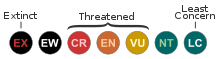
IUCN Red List of Threatened Plants Status : Not listed.
Growth: S = slow M = medium F = fast. Soil: L = light (sandy) M = medium H = heavy (clay). pH: A = acid N = neutral B = basic (alkaline). Shade: F = full shade S = semi-shade N = no shade. Moisture: D = dry M = Moist We = wet Wa = water.
Now available:
Food Forest Plants for Mediterranean Conditions
350+ Perennial Plants For Mediterranean and Drier Food Forests and Permaculture Gardens.
[Paperback and eBook]
This is the third in Plants For A Future's series of plant guides for food forests tailored to
specific climate zones. Following volumes on temperate and tropical ecosystems, this book focuses
on species suited to Mediterranean conditions—regions with hot, dry summers and cool, wet winters,
often facing the added challenge of climate change.
Read More
Expert comment
Author
(Greene) O.E.Schulz
Botanical References
Links / References
For a list of references used on this page please go here
Readers comment
| Add a comment |
|
If you have important information about this plant that may help other users please add a comment or link below. Only comments or links that are felt to be directly relevant to a plant will be included. If you think a comment/link or information contained on this page is inaccurate or misleading we would welcome your feedback at [email protected]. If you have questions about a plant please use the Forum on this website as we do not have the resources to answer questions ourselves.
* Please note: the comments by website users are not necessarily those held by PFAF and may give misleading or inaccurate information.
|
Subject : Descurainia obtusa
|
|
|
|