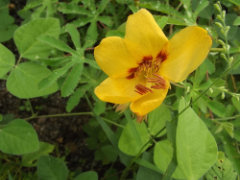
 |
|
(c) J. Fernando Pío León, some rights reserved (CC BY-NC) |
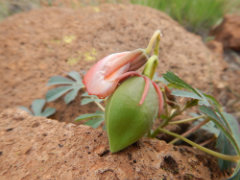 |
| (c) Brenda Edén Pérez Pardo, some rights reserved (CC BY-NC) |
Translate this page:
Summary
Amoreuxia palmatifida is a remarkable desert perennial historically used as a food plant by Indigenous peoples of Mexico and the U.S. Southwest. The roots, with their mild parsnip-like flavor, are the most important edible part, but the leaves, flowers, young fruits, and seeds also provide food value. Its seasonal cycle, emerging after summer rains and persisting into autumn, made it a dependable resource in arid lands. While rare in the United States, it remains more abundant in Mexico, where its role in traditional diets is well remembered. Amoreuxia palmatifida DC. is a synonym of Cochlospermum palmatifidum
Physical Characteristics

 Cochlospermum palmatifidum is a PERENNIAL growing to 0.6 m (2ft) by 0.8 m (2ft 7in) at a medium rate.
See above for USDA hardiness. It is hardy to UK zone 9 and is not frost tender. The flowers are pollinated by Bees, Insects.
It is noted for attracting wildlife.
Suitable for: light (sandy) and medium (loamy) soils, prefers well-drained soil and can grow in nutritionally poor soil. Suitable pH: mildly acid, neutral and basic (mildly alkaline) soils. It cannot grow in the shade. It prefers dry or moist soil and can tolerate drought.
UK Hardiness Map
US Hardiness Map
Synonyms
Homotypic Synonyms: Amoreuxia palmatifida DC.
Plant Habitats
Edible Uses
Arizona yellowshow is a traditional food plant of the Seri and other native peoples of northwestern Mexico. Almost every part of the plant can be used, including the roots, leaves, flowers, immature fruits, and seeds [2-3]. The roots are the most important edible part, forming a substantial and reliable food source. They are thick, white, and covered with thin, weakly attached brown skins. Their flavor is mild and pleasantly earthy, reminiscent of parsnips with a unique yellow show character. The roots are fully chewable, even when older, and produce a sweet, aromatic broth when simmered, making them ideal for soups or stews. Roots can be gathered any time the aboveground parts are visible, from early summer to late autumn [2-3]. The leaves can be eaten fresh, but are better cooked as potherbs. They have a spinach-like taste with a slightly mucilaginous texture, which becomes more appealing when boiled. The cooking water produces a thick, mildly flavorful broth. Leafstalks and stems are tough and fibrous, but the blades are tender and easily chewable. Leaves appear early in summer after rains and persist into late autumn [2-3]. The flowers are among the best-tasting parts of the plant. Bright orange-yellow, they add color and a touch of sweetness to salads. Unlike the leaves, they are low in mucilage and free of harsh flavors. Blooming mainly between July and September, the flowers close by midday to avoid heat damage [2-3]. The fruits are hollow, balloon-like capsules. Young fruits, gathered before drying, have a mild flavor reminiscent of green beans with a fruity, incense-like accent. They are best used in stir-fries or as a cooked vegetable. Mature fruits become papery and are suitable only for seed harvest [2-3]. The seeds are initially white and tender but become reddish- to blackish-brown and shiny as they mature in autumn. While the seeds were not sampled directly for this reference, they were used traditionally as food. Care should be taken not to confuse the elongated seeds of A. palmatifida with the spherical seeds of Amoreuxia gonzalezii (Santa Rita yellowshow), which should not be harvested [2-3]. Edibility Rating: 4/5 – A versatile desert wild food, with particularly valuable roots and flowers, though the plant is uncommon in the U.S. and more significant in Mexico.
References More on Edible Uses
Medicinal Uses
Plants For A Future can not take any responsibility for any adverse effects from the use of plants. Always seek advice from a professional before using a plant medicinally.
None Known
References More on Medicinal Uses
The Bookshop: Edible Plant Books
Our Latest books on Perennial Plants For Food Forests and Permaculture Gardens in paperback or digital formats.
Edible Tropical Plants
Food Forest Plants for Hotter Conditions: 250+ Plants For Tropical Food Forests & Permaculture Gardens.
More
Edible Temperate Plants
Plants for Your Food Forest: 500 Plants for Temperate Food Forests & Permaculture Gardens.
More
More Books
PFAF have eight books available in paperback and digital formats. Browse the shop for more information.
Shop Now
Other Uses
References More on Other Uses
Cultivation details
Cochlospermum palmatifidum (Mexican yellowshow; often treated in Cochlospermum or closely allied) grows as a herbaceous perennial from a tuberous root, usually about 30–80 cm tall with a similar or slightly greater spread when established; foliage dies back in winter and returns with warmth and rain. Its large, bright yellow flowers are adapted for insect pollination, especially native bees: they’re showy, open, and nectar/pollen rich, and are visited by medium to large bees (and sometimes other insects) which act as the primary pollinators rather than wind. Growing Conditions: Sun: Requires full sun. Soil: Prefers sandy or rocky soils with good drainage. Moisture: Drought-adapted; emerges after summer rains and thrives with seasonal moisture. Growth Habit: Herbaceous perennial arising from large underground roots; aboveground growth is seasonal. Habitat: Found primarily in northwestern Mexico and barely extending into southern Arizona. Common in sandy soils, washes, and desert slopes. Growth is strongly tied to the summer monsoon cycle.
References Carbon Farming Information and Carbon Sequestration Information
Temperature Converter
Type a value in the Celsius field to convert the value to Fahrenheit:
Fahrenheit:
The PFAF Bookshop
Plants For A Future have a number of books available in paperback and digital form. Book titles include Edible Plants, Edible Perennials, Edible Trees,Edible Shrubs, Woodland Gardening, and Temperate Food Forest Plants. Our new book is Food Forest Plants For Hotter Conditions (Tropical and Sub-Tropical).
Shop Now
Plant Propagation
Seed.
Other Names
If available other names are mentioned here
Arizona yellowshow, Mexican yellowshow, saiya, or zaya (Amoreuxia palmatifida Moc. & Sessé ex DC.).
Native Range
Arizona, Colombia, Costa Rica, El Salvador, Guatemala, Honduras, Mexico Central, Mexico Gulf, Mexico Northeast, Mexico Northwest, Mexico Southeast, Mexico Southwest, New Mexico, Nicaragua
Weed Potential
Right plant wrong place. We are currently updating this section.
Please note that a plant may be invasive in one area but may not in your area so it's worth checking.
Low weed potential. Arizona yellowshow is localized to arid and semi-arid regions of the U.S. Southwest and Mexico. It forms seasonal stands but is not invasive or aggressive.
Conservation Status
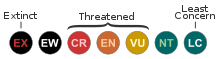
IUCN Red List of Threatened Plants Status : Predicted extinction risk: not threatened. Confidence: confident
Growth: S = slow M = medium F = fast. Soil: L = light (sandy) M = medium H = heavy (clay). pH: A = acid N = neutral B = basic (alkaline). Shade: F = full shade S = semi-shade N = no shade. Moisture: D = dry M = Moist We = wet Wa = water.
Now available:
Food Forest Plants for Mediterranean Conditions
350+ Perennial Plants For Mediterranean and Drier Food Forests and Permaculture Gardens.
[Paperback and eBook]
This is the third in Plants For A Future's series of plant guides for food forests tailored to
specific climate zones. Following volumes on temperate and tropical ecosystems, this book focuses
on species suited to Mediterranean conditions—regions with hot, dry summers and cool, wet winters,
often facing the added challenge of climate change.
Read More
Expert comment
Author
(DC.) Byng & Christenh.
Botanical References
Links / References
For a list of references used on this page please go here
Readers comment
| Add a comment |
|
If you have important information about this plant that may help other users please add a comment or link below. Only comments or links that are felt to be directly relevant to a plant will be included. If you think a comment/link or information contained on this page is inaccurate or misleading we would welcome your feedback at [email protected]. If you have questions about a plant please use the Forum on this website as we do not have the resources to answer questions ourselves.
* Please note: the comments by website users are not necessarily those held by PFAF and may give misleading or inaccurate information.
|
Subject : Cochlospermum palmatifidum
|
|
|
|