 |
|
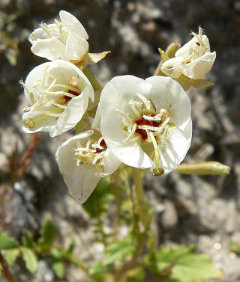
Stan Shebs. Creative Commons Attribution-Share Alike 3.0 |
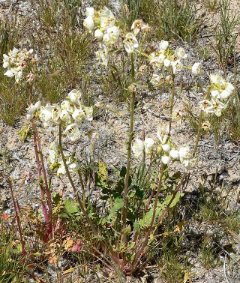 |
| Stan Shebs. Creative Commons Attribution-Share Alike 3.0 |
Translate this page:
Summary
Brown eyes is a common desert annual that can create striking seasonal displays, often carpeting open ground with pale flowers marked by darker centers. Its documented food use is primarily the leaves, which are technically edible but often unpleasant because of an acrid, stinging sensation. Small amounts may be used raw, but larger quantities generally require cooking to be tolerable. Seeds are not commonly reported as an edible resource, even though they may appear flavorful when sampled; practical harvesting is complicated by the plant’s papery capsules, seed fall, and rapid removal by ants. Overall, brown eyes is abundant and easy to find, but it is not one of the better desert foods unless used carefully and in moderation.
Physical Characteristics

 Chylismia claviformis is a ANNUAL growing to 0.5 m (1ft 8in) by 0.2 m (0ft 8in) at a fast rate.
See above for USDA hardiness. It is hardy to UK zone 7. The flowers are pollinated by Insects.
It is noted for attracting wildlife.
Suitable for: light (sandy) and medium (loamy) soils, prefers well-drained soil and can grow in nutritionally poor soil. Suitable pH: neutral and basic (mildly alkaline) soils. It cannot grow in the shade. It prefers dry or moist soil and can tolerate drought.
UK Hardiness Map
US Hardiness Map
Synonyms
Camissonia claviformis (Torr. & Frém.) P.H.Raven. C. claviformis var. typica D.A.Johans. C. scapoidea var. claviformis (Torr. & Frém.) Small. Oenothera claviformis Torr. & Frém. Oenothera claviformis var. typica Munz. Oenothera scapoidea var. aurantiaca S.Watson. Oenothera scapoidea var. claviformis (Torr. & Frém.) S.Watson.
Plant Habitats
Edible Uses
Leaves are edible fresh in small amounts or cooked in larger portions, but the acrid stinging quality makes this a low-preference green. Treat as a minor supplement rather than a primary wild food [2-3]. Edible Uses & Rating: The edible part recorded here is the leaf, eaten fresh in small amounts or cooked for larger portions. However, the leaf’s acrid sting and generally unappealing profile place it in the low-to-moderate category as a usable wild green. Despite its abundance, it is not a top-tier food because its palatability limits how much most people will want to eat [2-3]. Taste, Processing & Kitchen Notes: Leaves have an acrid, stinging sensation that can make them unpleasant, especially in larger quantities. In small amounts, they can function as salad material, but their sting tends to accumulate with repeated bites, and cooking is the more realistic approach for meal-size use. Cooking reduces the sharpness and makes the flavor more manageable, though it does not transform the leaves into a truly mild green. The flavor profile is not described as sweet or delicate; it is more of a “tolerable green” than a desirable one. Although seeds are sometimes tempting because they taste oily and hearty when sampled, they are not a recommended food. Their practical availability is also limited by rapid seed loss and ant harvesting once pods open [2-3]. Seasonality (Phenology): Brown eyes commonly appears as a winter annual in deserts, with flowering often beginning in late winter and continuing into spring, and in some regions extending later depending on rainfall. Your description indicates a broad bloom period from February into summer in parts of its range. Seed release follows as capsules dry, and seeds often fall quickly, shortening the harvest window. Safety & Cautions (Food Use): The acrid, stinging sensation suggests that large raw servings may cause digestive discomfort for some people. Cooking is the safer, more tolerable approach for any meaningful quantity. As with all desert annual greens, avoid harvesting from contaminated sites and wash carefully to remove dust and grit. Harvest & Processing Workflow: For greens, harvest young leaves early in the season when plants are fresh and still actively growing. Use small quantities raw only if the sting is mild; otherwise blanch or boil briefly and discard the first water if needed to reduce harshness. For any experimentation with seeds, the most practical window is as capsules dry but before most seeds fall; however, since seeds are not a documented recommended food, use caution and treat any seed use as experimental rather than standard. Cultivar/Selection Notes: No cultivars are standard for food use. Natural populations show strong variation in flower tint, spotting, and plant size, largely driven by genetics and site conditions. Look-Alikes & Confusion Risks: Confusion is common across desert evening primroses because taxonomy and genus placement have shifted between Chylismia, Camissonia, and Oenothera. Many species share similar leaf shapes and nodding flowers. Brown eyes is best confirmed by its typical pale flowers with darker spotting or centers, its vespertine habit, and its capsule shape, which tends to be narrowly cylindrical to club-shaped and splits four ways. When identification is uncertain, rely on multiple characters rather than flower color alone, which is variable. Traditional / Indigenous Use Summary: Documentation of food use appears infrequent. Leaves are the recorded edible part here, but the plant does not appear to have been an important staple. The lack of robust documentation may reflect either limited use or gaps in recording [2-3].
References More on Edible Uses
Medicinal Uses
Plants For A Future can not take any responsibility for any adverse effects from the use of plants. Always seek advice from a professional before using a plant medicinally.
None Known
References More on Medicinal Uses
The Bookshop: Edible Plant Books
Our Latest books on Perennial Plants For Food Forests and Permaculture Gardens in paperback or digital formats.
Edible Tropical Plants
Food Forest Plants for Hotter Conditions: 250+ Plants For Tropical Food Forests & Permaculture Gardens.
More
Edible Temperate Plants
Plants for Your Food Forest: 500 Plants for Temperate Food Forests & Permaculture Gardens.
More
More Books
PFAF have eight books available in paperback and digital formats. Browse the shop for more information.
Shop Now
Other Uses
Brown eyes is sometimes grown or encouraged as a desert wildflower in restoration and native landscaping settings. If cultivated, it typically prefers open soil and low competition and responds best to natural rainfall patterns rather than heavy irrigation. Ecology & Wildlife: Mass flowering provides seasonal resources for pollinating insects in late winter and spring. Seeds that reach the ground are quickly incorporated into desert food webs, including strong removal by ants. Dense seasonal growth can also temporarily stabilize soil surfaces in open desert patches.
Special Uses
References More on Other Uses
Cultivation details
Brown eyes is abundant, beautiful, and easy to find, but it is not a top desert food. Leaves are edible yet commonly unpleasant due to an acrid sting, making it more of a minor fallback green than a sought-after vegetable. The plant’s greatest value is ecological and visual; its food value is real but limited by palatability. Growing Conditions This species thrives in open, sunny desert environments on sandy or rocky soils. It often occurs in plant communities dominated by creosote bush, sagebrush, or juniper, and it is especially common in open ground where competition is low and seasonal rains trigger mass germination. Habitat & Range: Brown eyes ranges widely across western North America, including much of the desert and semi-desert Southwest and extending northward into the Intermountain West and westward to coastal states. It is typically found in disturbed areas and open desert ground, often forming dense stands in favorable years. Size & Landscape Performance: Plant size is variable, from very small individuals in harsh, dry microsites to taller forms in better moisture conditions. In good rainfall years, the species can dominate ground cover across broad areas, creating visually dramatic carpets of blooms. As an annual, its “performance” is seasonal and rainfall-driven rather than consistent year to year. USDA Hardiness Zones: Approx. Zones 6–10 (desert annual; rainfall timing is more important than cold tolerance). Typical Size: About 4–60 cm tall; upright annual from a taproot, often forming carpets in good years. Cultivation (Horticulture): Brown eyes is sometimes grown or encouraged as a desert wildflower in restoration and native landscaping settings. If cultivated, it typically prefers open soil and low competition and responds best to natural rainfall patterns rather than heavy irrigation. Cultivation for food is rarely practical because the leaves are not reliably pleasant. Pests & Problems: The main practical issue for foragers is timing. Seeds can disappear quickly once pods open, and leaves can become less usable as plants age and conditions dry. The plant’s edibility is also limited by its acrid sting rather than by scarcity. Pollination: Flowers are insect-pollinated, with timing that often favors evening-active pollinators. Reliable seed set in mass blooms suggests effective pollination in most seasons when the plant is abundant. Identification & Habit: Brown eyes is an upright annual with basal and alternate leaves that can be simple or once-pinnate, often with toothed, lobed, or deeply cut margins. Plants tend to be more leafy near the base, especially early in growth. Flowers are showy and typically white, sometimes tinted pink, purple, or yellow, and often marked with darker dots; the centers can appear brownish, giving rise to the common name. Flowers are vespertine, meaning they often open later in the day, and they are arranged in nodding terminal racemes. Like other members of the group, it produces narrow capsules that split four ways at maturity, releasing many small seeds.
References Carbon Farming Information and Carbon Sequestration Information
Temperature Converter
Type a value in the Celsius field to convert the value to Fahrenheit:
Fahrenheit:
The PFAF Bookshop
Plants For A Future have a number of books available in paperback and digital form. Book titles include Edible Plants, Edible Perennials, Edible Trees,Edible Shrubs, Woodland Gardening, and Temperate Food Forest Plants. Our new book is Food Forest Plants For Hotter Conditions (Tropical and Sub-Tropical).
Shop Now
Plant Propagation
Propagation is by seed. Seeds germinate readily with cool-season moisture. Because the plant naturally forms large seed banks and germinates in pulses after rain, it can reappear strongly in the same sites when conditions align.
Other Names
If available other names are mentioned here
Brown eyes, brown-eyed evening primrose (regional usage varies)
Native Range
US. USA. Arizona, California, Idaho, Mexico Northwest, Nevada, New Mexico, Oregon
Weed Potential
Right plant wrong place. We are currently updating this section.
Please note that a plant may be invasive in one area but may not
in your area so it's worth checking.
In many places it behaves as a desirable native or naturalized wildflower rather than a weed. In disturbed ground it can be very abundant, but it is generally not persistent without the right seasonal rainfall pattern.
Conservation Status
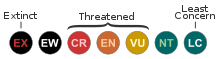
IUCN Red List of Threatened Plants Status : Not available
IUCN Red List
Growth: S = slow M = medium F = fast. Soil: L = light (sandy) M = medium H = heavy (clay). pH: A = acid N = neutral B = basic (alkaline). Shade: F = full shade S = semi-shade N = no shade. Moisture: D = dry M = Moist We = wet Wa = water.
Now available:
Food Forest Plants for Mediterranean Conditions
350+ Perennial Plants For Mediterranean and Drier Food Forests and Permaculture Gardens.
[Paperback and eBook]
This is the third in Plants For A Future's series of plant guides for food forests tailored to
specific climate zones. Following volumes on temperate and tropical ecosystems, this book focuses
on species suited to Mediterranean conditions—regions with hot, dry summers and cool, wet winters,
often facing the added challenge of climate change.
Read More
Expert comment
Author
(Torr. & Frém.) A.Heller
Botanical References
Links / References
For a list of references used on this page please go here
Readers comment
| Add a comment |
|
If you have important information about this plant that may help other users please add a comment or link below. Only comments or links that are felt to be directly relevant to a plant will be included. If you think a comment/link or information contained on this page is inaccurate or misleading we would welcome your feedback at [email protected]. If you have questions about a plant please use the Forum on this website as we do not have the resources to answer questions ourselves.
* Please note: the comments by website users are not necessarily those held by PFAF and may give misleading or inaccurate information.
|
Subject : Chylismia claviformis
|
|
|
|