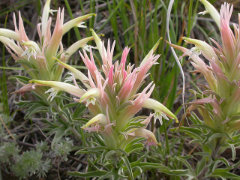
 |
|
Matt Lavin from Bozeman, Montana, USA Creative Commons Attribution-Share Alike 2.0 |
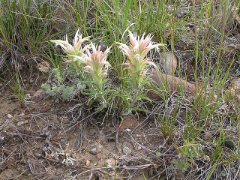 |
| Matt Lavin from Bozeman, Montana, USA Creative Commons Attribution-Share Alike 2.0 |
Translate this page:
Summary
A unique low-growing paintbrush of the Great Plains and Southwest, Castilleja sessiliflora is recognizable by its pale bracts—often yellowish, pinkish, or greenish—and delicate, downy foliage. As with all Castilleja, only the corollas are considered edible, and only with caution due to mineral uptake.
Physical Characteristics

 Castilleja sessiliflora is a PERENNIAL growing to 0.3 m (1ft) by 0.2 m (0ft 8in) at a medium rate.
See above for USDA hardiness. It is hardy to UK zone 4. The flowers are pollinated by Hummingbirds, bees, Insects.
It is noted for attracting wildlife.
Suitable for: light (sandy) and medium (loamy) soils, prefers well-drained soil and can grow in nutritionally poor soil. Suitable pH: mildly acid, neutral and basic (mildly alkaline) soils. It cannot grow in the shade. It prefers dry or moist soil.
UK Hardiness Map
US Hardiness Map
Synonyms
Bartsia grandiflora Spreng. C. grandiflora (Nutt.) Spreng. C. sessiliflora subsp. betheli Cockerell, C. sessiliflora f. purpurina Pennell. Euchroma grandiflora Nutt.
Plant Habitats
Edible Uses
Edible Uses & Rating: Edible uses are confined to corollas, which may contain mild sweetness. The plant’s low stature produces small quantities of flowers, making it unsuitable for significant harvest [2-3]. Overall edible rating: Very Low. Taste, Processing & Kitchen Notes: Corollas are mildly sweet but less flavorful than other species. Bracts taste resinous or bland and are not worthwhile. Nectar infusion is possible but low yield. Seasonality (Phenology): Blooms April–July, depending on latitude and moisture availability [2-3].
References More on Edible Uses
Medicinal Uses
Plants For A Future can not take any responsibility for any adverse effects from the use of plants. Always seek advice from a professional before using a plant medicinally.
None Known
References More on Medicinal Uses
The Bookshop: Edible Plant Books
Our Latest books on Perennial Plants For Food Forests and Permaculture Gardens in paperback or digital formats.
Edible Tropical Plants
Food Forest Plants for Hotter Conditions: 250+ Plants For Tropical Food Forests & Permaculture Gardens.
More
Edible Temperate Plants
Plants for Your Food Forest: 500 Plants for Temperate Food Forests & Permaculture Gardens.
More
More Books
PFAF have eight books available in paperback and digital formats. Browse the shop for more information.
Shop Now
Other Uses
A charming low-growing Great Plains wildflower with minimal edible application and moderate ecological importance. Ecological restorations. Ecology & Wildlife: Pollinated by bees, hawk moths, and occasionally hummingbirds, though less attractive to them than red-bracted species. Provides nectar to insects of open plains.
Special Uses
References More on Other Uses
Cultivation details
Growing Conditions: Prefers dry prairies, sandy plains, shortgrass steppe, and rocky hillsides. Requires a host plant for vigor. USDA Zone 3–8. Habitat & Range: Widespread across the Great Plains, extending into Colorado, New Mexico, Kansas, Nebraska, Oklahoma, and Texas. Size & Landscape Performance: Grows 10–40 cm tall, spreading slowly to 20–30 cm. Forms loose mats or short clusters. Cultivation (Horticulture): Difficult to cultivate except in ecological restorations with native grasses (e.g., blue grama, needle-and-thread). Soil must be lean and well-drained. Pests & Problems: Drought tolerant but declines under competition. Susceptible to root rot if over-watered. Identification & Habit: A perennial herb 10–40 cm tall, often sprawling rather than upright. Leaves are narrow, linear, and may be covered in fine hairs. Bracts are subdued in color compared to western red paintbrushes. Flowers occur in dense spikes; corollas are elongated and pale green.
References Carbon Farming Information and Carbon Sequestration Information
Temperature Converter
Type a value in the Celsius field to convert the value to Fahrenheit:
Fahrenheit:
The PFAF Bookshop
Plants For A Future have a number of books available in paperback and digital form. Book titles include Edible Plants, Edible Perennials, Edible Trees,Edible Shrubs, Woodland Gardening, and Temperate Food Forest Plants. Our new book is Food Forest Plants For Hotter Conditions (Tropical and Sub-Tropical).
Shop Now
Plant Propagation
Seed with cold stratification. Must establish near host roots.
Other Names
If available other names are mentioned here
Great Plains Indian Paintbrush, Downy Paintedcup, Indian Paintbrush (Castilleja sessiliflora)
Native Range
US. USA. Alberta, Arizona, Colorado, Illinois, Iowa, Kansas, Manitoba, Mexico Northeast, Mexico Northwest, Mexico Southwest, Minnesota, Missouri, Montana, Nebraska, New Mexico, North Dakota, Oklahoma, Saskatchewan, South Dakota, Texas, Wisconsin, Wyoming
Weed Potential
Right plant wrong place. We are currently updating this section.
Please note that a plant may be invasive in one area but may not
in your area so it's worth checking.
None. Species is fragile and easily outcompeted.
Conservation Status
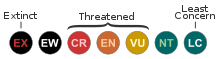
IUCN Red List of Threatened Plants Status : Not available
IUCN Red List
Growth: S = slow M = medium F = fast. Soil: L = light (sandy) M = medium H = heavy (clay). pH: A = acid N = neutral B = basic (alkaline). Shade: F = full shade S = semi-shade N = no shade. Moisture: D = dry M = Moist We = wet Wa = water.
Now available:
Food Forest Plants for Mediterranean Conditions
350+ Perennial Plants For Mediterranean and Drier Food Forests and Permaculture Gardens.
[Paperback and eBook]
This is the third in Plants For A Future's series of plant guides for food forests tailored to
specific climate zones. Following volumes on temperate and tropical ecosystems, this book focuses
on species suited to Mediterranean conditions—regions with hot, dry summers and cool, wet winters,
often facing the added challenge of climate change.
Read More
Expert comment
Author
Pursh
Botanical References
Links / References
For a list of references used on this page please go here
Readers comment
| Add a comment |
|
If you have important information about this plant that may help other users please add a comment or link below. Only comments or links that are felt to be directly relevant to a plant will be included. If you think a comment/link or information contained on this page is inaccurate or misleading we would welcome your feedback at [email protected]. If you have questions about a plant please use the Forum on this website as we do not have the resources to answer questions ourselves.
* Please note: the comments by website users are not necessarily those held by PFAF and may give misleading or inaccurate information.
|
Subject : Castilleja sessiliflora
|
|
|
|