 |
|
Margaret Neilson Armstrong |
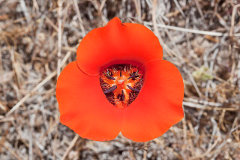 |
| Bill Bouton from San Luis Obispo, CA, USA Attribution-Share Alike 2.0 |
Translate this page:
Summary
Kennedy’s Mariposa Lily, also known as the Desert Mariposa Lily, is one of the most spectacular wildflowers of the American Southwest. Its brilliant orange to scarlet cup-shaped blooms appear like embers scattered across the desert in spring. This hardy perennial thrives in arid, rocky habitats where few other lilies survive, emerging from an underground bulb that stores starch and moisture between seasons. The bulbs are edible and nutritious, once forming a seasonal staple for Indigenous desert communities. Its dazzling flowers, desert resilience, and ethnobotanical significance make it one of the crown jewels of the Calochortus genus.
Physical Characteristics

 Calochortus kennedyi is a BULB growing to 0.3 m (1ft) by 0.1 m (0ft 4in) at a medium rate.
See above for USDA hardiness. It is hardy to UK zone 6. The flowers are pollinated by Bees, Insects.
It is noted for attracting wildlife.
Suitable for: light (sandy) and medium (loamy) soils, prefers well-drained soil and can grow in nutritionally poor soil. Suitable pH: neutral and basic (mildly alkaline) soils. It cannot grow in the shade. It prefers dry or moist soil and can tolerate drought.
UK Hardiness Map
US Hardiness Map
Synonyms
C. kennedyi var. kennedyi
Plant Habitats
Edible Uses
Edible Uses & Rating: The bulbs of C. kennedyi are edible when cooked and were a valued traditional food for several Native American groups, including the Hopi, Zuni, and Navajo. The bulbs are sweet, starchy, and nourishing, while the leaves and seeds have limited or negligible food value [2-3]. Edibility rating: 4.5/5 for bulbs; 1/5 for leaves and seeds. Taste, Processing & Kitchen Notes: Fresh bulbs have a firm, crisp texture and a mildly sweet flavor, somewhat between potato and chestnut. Roasting enhances sweetness and adds a subtle nutty aroma, while boiling yields a soft, bland, starchy result similar to mashed potato. Traditional preparation methods involved roasting bulbs whole in coals or boiling them in stone-lined pits with hot rocks. Drying bulbs for winter use was also practiced, as the flavor and energy value remain excellent after storage [2-3]. Seasonality (Phenology): Desert Mariposa Lily blooms March to May, depending on elevation and rainfall. Seed capsules mature by May–June, releasing seeds in early summer. Plants enter dormancy by midsummer and remain underground until renewed winter or spring rains trigger new growth. The bulbs are viable year-round and can be harvested at any season when located. Safety & Cautions (Food Use): The bulbs are safe when cooked but should not be eaten raw, as they may cause mild digestive discomfort. Avoid collecting from wild populations in national or state parks, as C. kennedyi is considered sensitive or protected in parts of its range. Harvest & Processing Workflow: Bulbs are best harvested after flowering when foliage has begun to wither but before full dormancy. Dig gently with a narrow trowel or digging stick, minimizing soil disturbance. Wash, peel, and roast or boil immediately. Dried bulbs may be stored for several months and rehydrated before cooking. Traditional / Indigenous Use Summary: The Hopi, Zuni, Navajo, and other Pueblo peoples traditionally used C. kennedyi bulbs as a nutritious food and famine resource. Bulbs were roasted or boiled, eaten plain or mashed with other starchy foods. Some tribes considered it a ceremonial plant associated with renewal and sustenance during times of scarcity. Its brilliant orange flowers were also used ornamentally in dances and ceremonies celebrating the spring season.
References More on Edible Uses
Medicinal Uses
Plants For A Future can not take any responsibility for any adverse effects from the use of plants. Always seek advice from a professional before using a plant medicinally.
None Known
References More on Medicinal Uses
The Bookshop: Edible Plant Books
Our Latest books on Perennial Plants For Food Forests and Permaculture Gardens in paperback or digital formats.
Edible Tropical Plants
Food Forest Plants for Hotter Conditions: 250+ Plants For Tropical Food Forests & Permaculture Gardens.
More
Edible Temperate Plants
Plants for Your Food Forest: 500 Plants for Temperate Food Forests & Permaculture Gardens.
More
More Books
PFAF have eight books available in paperback and digital formats. Browse the shop for more information.
Shop Now
Other Uses
C. kennedyi makes a spectacular display in rock gardens and xeriscapes, provided its soil is sandy and dry during dormancy. It is among the most drought-tolerant Calochortus species. Some tribes considered it a ceremonial plant associated with renewal and sustenance during times of scarcity. Its brilliant orange flowers were also used ornamentally in dances and ceremonies celebrating the spring season. Ecology & Wildlife: The striking orange flowers serve as important nectar and pollen sources for native bees and bee flies, especially in early desert spring when few other large blooms are available. The bulbs are occasionally eaten by rodents and small mammals, particularly pocket gophers. Deer and rabbits rarely browse it due to its tough foliage and timing of growth during dry seasons.
Special Uses
References More on Other Uses
Cultivation details
Identification & Habit: Calochortus kennedyi is a perennial herb arising from a rounded underground bulb (1–2.5 cm in diameter) and typically 10–35 cm tall. It produces 1–3 upright flowers per stem. Each flower is a large, tulip-like cup 4–6 cm across, with three broad petals that are vivid orange, copper-red, or occasionally scarlet, often darker near the base. The petal bases feature conspicuous yellow or reddish-brown nectar glands, bordered by tufts of fine golden hairs. The sepals are narrower and greenish to orange-tinged. Leaves are linear and grass-like, 5–25 cm long, arising mainly at the base and typically withering by the time of flowering. The fruit is a three-winged capsule, 2–4 cm long, containing numerous flattened tan seeds. Pollination is by native solitary bees, including Anthophora and Osmia species, as well as bee flies (Bombyliidae) and small butterflies attracted to the vivid petal coloration and nectar rewards. The flowers’ shape and bright color make them highly visible in the desert landscape, a crucial trait for attracting pollinators in sparse habitats. Growing Conditions: Calochortus kennedyi is adapted to arid and semi-arid habitats, favoring well-drained sandy or gravelly soils in deserts, canyons, and rocky slopes. It thrives in full sun and requires a dry dormant period following flowering. USDA Hardiness Zones: 6–9. It tolerates alkaline soils and survives extreme drought through its bulb dormancy strategy. Habitat & Range: Native to the Mojave, Sonoran, and Chihuahuan deserts, this species ranges across southern California, Nevada, Utah, Arizona, New Mexico, and western Texas, extending into northern Mexico. It occurs between 600–2,000 meters elevation, often in creosote bush scrub, desert grasslands, and open juniper slopes. It is especially striking in years of above-average spring rain when mass blooms blanket desert hillsides. Size & Landscape Performance: Plants are typically 10–35 cm tall and 10–20 cm wide, producing brilliant orange blooms that last several weeks. In cultivation, C. kennedyi makes a spectacular display in rock gardens and xeriscapes, provided its soil is sandy and dry during dormancy. It is among the most drought-tolerant Calochortus species. Pests & Problems: The main vulnerability is bulb rot from overwatering or poor drainage. In cultivation, rodents may dig up bulbs. Fungal infections are rare in the wild due to the plant’s arid habitat but can appear in humid or irrigated conditions.
References Carbon Farming Information and Carbon Sequestration Information
Temperature Converter
Type a value in the Celsius field to convert the value to Fahrenheit:
Fahrenheit:
The PFAF Bookshop
Plants For A Future have a number of books available in paperback and digital form. Book titles include Edible Plants, Edible Perennials, Edible Trees,Edible Shrubs, Woodland Gardening, and Temperate Food Forest Plants. Our new book is Food Forest Plants For Hotter Conditions (Tropical and Sub-Tropical).
Shop Now
Plant Propagation
Propagation is by seed or bulb division. Seeds require cold stratification (exposure to winter chill) to germinate and may take several years to flower. Bulbs should be planted 8–10 cm deep in coarse, well-drained soil and left dry in summer. Once established, the plant is long-lived and requires minimal care. Overwatering during dormancy is the most common cause of failure.
Other Names
If available other names are mentioned here
Kennedy’s or Desert Mariposa Lily (Calochortus kennedyi Porter). Calochortus kennedyi var. kennedyi
Native Range
US. USA. Arizona, California, Mexico Northeast, Mexico Northwest, Nevada, Texas, Utah
Weed Potential
Right plant wrong place. We are currently updating this section.
Please note that a plant may be invasive in one area but may not in your area so it's worth checking.
None. C. kennedyi is slow-growing, non-invasive, and sensitive to soil disturbance. It thrives best in undisturbed desert or rocky sites.
Conservation Status
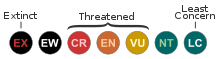
IUCN Red List of Threatened Plants Status : Not available
Growth: S = slow M = medium F = fast. Soil: L = light (sandy) M = medium H = heavy (clay). pH: A = acid N = neutral B = basic (alkaline). Shade: F = full shade S = semi-shade N = no shade. Moisture: D = dry M = Moist We = wet Wa = water.
Now available:
Food Forest Plants for Mediterranean Conditions
350+ Perennial Plants For Mediterranean and Drier Food Forests and Permaculture Gardens.
[Paperback and eBook]
This is the third in Plants For A Future's series of plant guides for food forests tailored to
specific climate zones. Following volumes on temperate and tropical ecosystems, this book focuses
on species suited to Mediterranean conditions—regions with hot, dry summers and cool, wet winters,
often facing the added challenge of climate change.
Read More
Expert comment
Author
Porter
Botanical References
Links / References
For a list of references used on this page please go here
Readers comment
| Add a comment |
|
If you have important information about this plant that may help other users please add a comment or link below. Only comments or links that are felt to be directly relevant to a plant will be included. If you think a comment/link or information contained on this page is inaccurate or misleading we would welcome your feedback at [email protected]. If you have questions about a plant please use the Forum on this website as we do not have the resources to answer questions ourselves.
* Please note: the comments by website users are not necessarily those held by PFAF and may give misleading or inaccurate information.
|
Subject : Calochortus kennedyi
|
|
|
|