 |
|
http://commons.wikimedia.org/wiki/User:Wsiegmund |
 |
| http://commons.wikimedia.org/wiki/User:Wsiegmund |
Translate this page:
Summary
A cold-hardy, native “wintercress” of mountain meadows and cool, moist disturbed sites, American yellowrocket offers peppery brassica greens very early in the season. It’s closest in culinary use to broccoli-raab: harvest young rosette leaves and tight flower clusters and give them a quick boil or sauté to tame the heat. It is mainly a forager’s spring pot-herb, not a calorie crop. USDA zones: ~3–8. Height/Spread: 30–90 cm × 20–40 cm.
Physical Characteristics

 Barbarea orthoceras is a PERENNIAL growing to 0.5 m (1ft 8in).
See above for USDA hardiness. It is hardy to UK zone 4. The species is hermaphrodite (has both male and female organs) and is pollinated by Flies, bees, beetles. The plant is self-fertile.
Suitable for: light (sandy), medium (loamy) and heavy (clay) soils and prefers well-drained soil. Suitable pH: mildly acid, neutral and basic (mildly alkaline) soils and can grow in very alkaline soils.
It can grow in semi-shade (light woodland) or no shade. It prefers moist soil.
UK Hardiness Map
US Hardiness Map
Synonyms
B. americana. Rydb. B. stricta. non Andrz.
Plant Habitats
Bog Garden; Cultivated Beds;
Edible Uses
Edible Parts: Leaves
Edible Uses:
A reliable native spring green for cool mountains and meadows—best before flower. Ecologically useful and culinarily decent with simple blanch-and-sauté prep. Best parts: young rosette leaves and tight buds (cooked).
Quality window: pre-bolt. Rating: 3/5.Young leaves - raw or cooked[177]. The rosettes of the dark green, shiny leaves are eaten raw or cooked [257]. A hot, cress-like flavour. Young leaves and pre-bloom shoots/bud clusters are edible (fresh in small amounts; best cooked). Roots and mature stems are fibrous/pungent and not valued. Edibility rating: 3/5 (good spring green when treated like raab; quality drops fast after bolting) [2-3]. aste, Processing & Kitchen Notes: Flavor is mustardy-peppery with less pungency than many wild mustards when harvested young. Blanch 30–60 s then sauté, or boil 2–3 min and dress with fat/acid. Broth becomes yellow-green and pleasantly savory. Older leaves get sharp/alkaline; avoid. Tight buds can be stir-fried like broccoli raab [2-3]. Harvest & Processing Workflow: 1. Identify clean rosettes; harvest young leaves & tight buds 2. Rinse, then blanch or quick-boil; save the savory broth for soup. 3. Use as raab/greens; avoid older, tough, bitter foliage.Cultivar/Selection Notes: None widely offered; use local/native seed if gardening for habitat. Look-Alikes & Confusion Risks: Other yellow mustards (e.g., Rorippa, Descurainia, Sinapis) and watercress/bittercress (Nasturtium, Cardamine). Confirm smooth stems, clasping lobed upper leaves, and appressed angular siliques with very short beak. Traditional/Indigenous Use Summary: Specific recorded food uses are sparse; as a native “mustard,” young leaves likely served as spring potherbs where available.
References More on Edible Uses
Medicinal Uses
Plants For A Future can not take any responsibility for any adverse effects from the use of plants. Always seek advice from a professional before using a plant medicinally.
None known
References More on Medicinal Uses
The Bookshop: Edible Plant Books
Our Latest books on Perennial Plants For Food Forests and Permaculture Gardens in paperback or digital formats.
Edible Tropical Plants
Food Forest Plants for Hotter Conditions: 250+ Plants For Tropical Food Forests & Permaculture Gardens.
More
Edible Temperate Plants
Plants for Your Food Forest: 500 Plants for Temperate Food Forests & Permaculture Gardens.
More
More Books
PFAF have eight books available in paperback and digital formats. Browse the shop for more information.
Shop Now
Other Uses
Ecology & Wildlife: Early nectar for syrphid flies, native bees; host for brassica-feeding insects. Post-disturbance colonizer that binds surface soils.
Special Uses
References More on Other Uses
Cultivation details
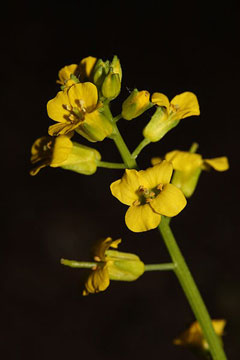
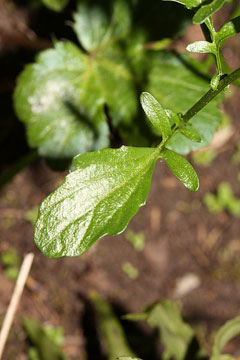
Cool-season plant preferring full sun to bright partial, moist, well-drained loams with consistent spring moisture; tolerates neutral to slightly alkaline soils. Size & Landscape Performance: Clumps 30–90 cm tall in bloom; neat rosettes beforehand. In native plantings it provides early pollinator nectar and a brief gold bloom period; disappears in summer heat. Cultivation (Horticulture): Treat like a cool-season brassica. Identification & Habit: Biennial (occasionally short-lived perennial) with a first-year basal rosette; second year sends up smooth, leafy, unhairy flowering stems. Lower leaves pinnate or deeply lobed (typically <4 lateral pairs) with a larger terminal lobe; upper leaves clasp the stem and are strongly lobed. Four-petaled yellow flowers in elongating racemes. Siliques 2–5 cm, appressed to ascending, 4-angled; beak absent or <2 mm. Seasonality (Phenology): Rosettes: very early spring (often as snow retreats). Bolting/flower: May–August (site elevation dependent). Seed: summer into early autumn. Quality for greens is pre-bolt to early bud. Pests & Problems: Typical brassica issues: flea beetles, aphids, occasional downy mildew/white rust (Albugo) in cool, wet spells. Heat triggers rapid bolting and bitterness.
References Carbon Farming Information and Carbon Sequestration Information
Temperature Converter
Type a value in the Celsius field to convert the value to Fahrenheit:
Fahrenheit:
The PFAF Bookshop
Plants For A Future have a number of books available in paperback and digital form. Book titles include Edible Plants, Edible Perennials, Edible Trees,Edible Shrubs, Woodland Gardening, and Temperate Food Forest Plants. Our new book is Food Forest Plants For Hotter Conditions (Tropical and Sub-Tropical).
Shop Now
Plant Propagation
Seed: easiest; germinates cool (5–15 °C). Self-seeds modestly if allowed to ripen.
Other Names
If available other names are mentioned here
American yellowrocket,
Wintercress
Native Range
TEMPERATE ASIA: Russian Federation (Buryatia, Yakutia-Sakha, Altay, Krasnoyarsk, Taymyr, Chita, Irkutsk, Kurganskaja oblast), Russian Federation (Kurile Islands, Habarovskij kraj, Primorye, Amur, Kamcatskij kraj, Magadanskaja oblast, Sakhalin), China (Heilongjiang Sheng, Gansu Sheng, Jilin Sheng, Liaoning Sheng, Nei Mongol Zizhiqu, Xinjiang Uygur Zizhiqu), Korea, Japan (Hokkaidô, Honshu, Shikoku), Taiwan NORTHERN AMERICA: Canada (Northwest Territories, Yukon, Québec, Ontario, New Brunswick, Newfoundland and Labrador, Saskatchewan, Alberta, Manitoba, British Columbia), United States (Alaska, Maine, Michigan, New Hampshire, Minnesota, South Dakota, Colorado, Idaho, Montana, Oregon, Washington, Wyoming, New Mexico, Arizona, California, Nevada, Utah)
Weed Potential
Right plant wrong place. We are currently updating this section.
Please note that a plant may be invasive in one area but may not in your area so it's worth checking.
This plant can be weedy or invasive. Low to moderate. Native and patch-forming in disturbed cool soils; far less aggressive than B. vulgaris.
Conservation Status
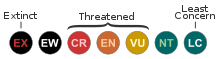
IUCN Red List of Threatened Plants Status : This taxon has not yet been assessed. Threatened and Endangered Information: Maine (American winter-cress)
Possibly Extirpated.
New Hampshire
(American winter-cress)
Endangered.
Growth: S = slow M = medium F = fast. Soil: L = light (sandy) M = medium H = heavy (clay). pH: A = acid N = neutral B = basic (alkaline). Shade: F = full shade S = semi-shade N = no shade. Moisture: D = dry M = Moist We = wet Wa = water.
Now available:
Food Forest Plants for Mediterranean Conditions
350+ Perennial Plants For Mediterranean and Drier Food Forests and Permaculture Gardens.
[Paperback and eBook]
This is the third in Plants For A Future's series of plant guides for food forests tailored to
specific climate zones. Following volumes on temperate and tropical ecosystems, this book focuses
on species suited to Mediterranean conditions—regions with hot, dry summers and cool, wet winters,
often facing the added challenge of climate change.
Read More
Expert comment
Author
Ledeb.
Botanical References
43
Links / References
For a list of references used on this page please go here
Readers comment
| Add a comment |
|
If you have important information about this plant that may help other users please add a comment or link below. Only comments or links that are felt to be directly relevant to a plant will be included. If you think a comment/link or information contained on this page is inaccurate or misleading we would welcome your feedback at [email protected]. If you have questions about a plant please use the Forum on this website as we do not have the resources to answer questions ourselves.
* Please note: the comments by website users are not necessarily those held by PFAF and may give misleading or inaccurate information.
|
Subject : Barbarea orthoceras
|
|
|
|