 |
|
http://www.nps.gov |
 |
| http://flickr.com/photos/22837563@N08 |
Translate this page:
Summary
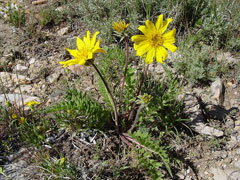
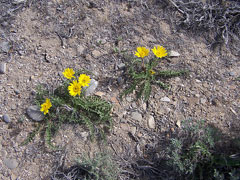
A compact, early-season sunflower-family perennial of western foothills and open meadows, Hooker’s balsamroot pushes up silvery, dissected foliage and bright yellow, daisylike heads shortly after snowmelt. All parts are technically edible, but the thick taproot is the meaningful food—when you find a mild, non-woody one. Leaves are bitter/resinous and best avoided except as emergency greens; seeds are small and often bug-damaged. Ecologically it’s a hardy soil stabilizer and early pollinator resource. In cultivation it’s long-lived, drought-tough, and slow to establish from seed due to its deep taproot. USDA Zones: ~3–8.
Physical Characteristics

 Balsamorhiza hookeri is a PERENNIAL growing to 0.3 m (1ft) by 0.3 m (1ft in).
See above for USDA hardiness. It is hardy to UK zone 5. It is in flower from May to June. The species is hermaphrodite (has both male and female organs) and is pollinated by Insects.
Suitable for: light (sandy) and medium (loamy) soils and prefers well-drained soil. Suitable pH: mildly acid, neutral and basic (mildly alkaline) soils. It cannot grow in the shade. It prefers dry or moist soil.
UK Hardiness Map
US Hardiness Map
Synonyms
B. hirsuta.
Plant Habitats
Cultivated Beds;
Edible Uses
Edible Parts: Root Seed
Edible Uses:
Root - raw or cooked[2, 46, 106, 183, 257]. A sweet and agreeable taste when cooked[61, 105]. Seed - raw or cooked[105, 161]. It can be ground into a powder and formed into cakes for eating raw or made into a bread[257]. Edible Uses & Rating: Roots: principal edible; variable flavor/texture. Young leaves: technically edible, cooked, but very bitter/resinous. Seeds: edible but scarce/bug-prone. Edibility rating: 3/5 (root can be good; other parts poor in practice) [2-3]. Taste, Processing & Kitchen Notes: Fresh root skins are thick and unpleasant—peel thoroughly. The core can be starchy to resinous; large/old roots tend to be woody, balsamic, and strong. Traditional pit-roast ~24 h to mellow resins and soften; then slice, mash, or dry and grind. Leaves: boiling slightly reduces bitterness but produces dark green, unappetizing liquor. Seeds require tedious hand-stripping and winnowing, yielding modest results [2-3]. Seasonality (Phenology): Leaf rosettes: very early spring (through snow).Bloom: April–July (site/elevation dependent).Seed ripening: early summer; plants then wither early.Root harvest: anytime (easiest when the tops of the plants are marked or soon after withering). Harvest & Processing Workflow (roots): 1.Locate patches in bloom; flag for later. 2.Dig smaller roots (younger plants) with a spade bar; minimize population impact. 3.Peel thick bark; trim woody cores. 4.Pit-roast (preferred) 18–24 h or slow simmer several hours. 5.Use fresh (soups/stews) or dry & grind for flour. Traditional/Indigenous Use Summary: Widely used across the Intermountain West: roots pit-roasted as a staple when palatable stocks are found; seeds pounded/winnowed; young greens occasionally boiled. Importance varied by tribe and site quality.
References More on Edible Uses
Medicinal Uses
Plants For A Future can not take any responsibility for any adverse effects from the use of plants. Always seek advice from a professional before using a plant medicinally.
Stomachic Women's complaints
A decoction of the root has been used for stomach problems, bladder complaints and female complaints[257. The sub-species B. hookeri hirsuta has been specified for these uses[257].
References More on Medicinal Uses
The Bookshop: Edible Plant Books
Our Latest books on Perennial Plants For Food Forests and Permaculture Gardens in paperback or digital formats.
Edible Tropical Plants
Food Forest Plants for Hotter Conditions: 250+ Plants For Tropical Food Forests & Permaculture Gardens.
More
Edible Temperate Plants
Plants for Your Food Forest: 500 Plants for Temperate Food Forests & Permaculture Gardens.
More
More Books
PFAF have eight books available in paperback and digital formats. Browse the shop for more information.
Shop Now
Other Uses
Ecology & Wildlife: Early nectar/pollen for native bees, flies, early butterflies. Seed eaten opportunistically by small birds/rodents. Deep root binds coarse soils and aids post-fire recovery.
Special Uses
References More on Other Uses
Cultivation details
Full sun; open, well-drained gravelly/rocky loams, often calcareous; dry-summer climates. Once established the deep root makes it highly drought-tolerant; avoid summer irrigation on heavy soils. Requires a deep fertile well-drained loam in full sun[134, 200]. Plants strongly resent winter wet[134, 200]. Hardy to at least -25°c[200]. Plants are intolerant of root disturbance and should be planted into their permanent positions whilst still small[134]. Identification & Habit: Low, tufted perennial (5–40 cm tall) from a stout, branching taproot. Basal leaves widely lance-shaped and toothed or deeply 1–2-pinnately cut, usually with rough hairs; stems mostly leafless. Heads solitary or to 3 on long, leafless stalks; yellow rays + yellow disks. Involucral bracts herbaceous, weakly shingled, often hairy. Achenes (cypselae) hairless, 4-angled; no pappus. Seasonality (Phenology):•Leaf rosettes: very early spring (through snow). • .•Bloom: April–July (site/elevation dependent). .•Seed ripening: early summer; plants then wither early. •Root harvest: any time (easiest when tops mark plants or soon after withering). Habitat & Range: Open hillsides and meadows, sagebrush and juniper belts, northern half of the Southwest and adjoining Great Basin/Intermountain West; typically 1,200–2,400 m. 5–40 cm H × 20–40 cm W; small clumps persisting many years. Excellent for rock gardens, native meadow mixes, and erosion-resistant plantings. Slow to bulk up the first 2–3 seasons. Pests & Problems: Generally clean. In rich/wet beds may develop root rot. Occasional weevil or seed insect predation reduces seed set. Deer/elk browse young foliage/heads. Look-Alikes & Confusion Risks: Other Balsamorhiza and Wyethia (mulesears). Wyethia has entire, broad leaves (not deeply cut), often glossier; both have yellow ray/disk heads. Dig only when confident of ID.
References Carbon Farming Information and Carbon Sequestration Information
Temperature Converter
Type a value in the Celsius field to convert the value to Fahrenheit:
Fahrenheit:
The PFAF Bookshop
Plants For A Future have a number of books available in paperback and digital form. Book titles include Edible Plants, Edible Perennials, Edible Trees,Edible Shrubs, Woodland Gardening, and Temperate Food Forest Plants. Our new book is Food Forest Plants For Hotter Conditions (Tropical and Sub-Tropical).
Shop Now
Plant Propagation
Seed - sow early spring in a greenhouse and only just cover the seed. Germination usually takes place within 2 - 6 days at 18°c. Either sow the seed in individual pots or pot up the seedlings as soon as they are large enough to handle and plant them out into their permanent positions in the summer[134]. Division in spring. Very difficult since the plant strongly resents root disturbance[134]. It is probably best to take quite small divisions, or basal cuttings, without disturbing the main clump. Pot these up into individual pots and keep them in light shade in the greenhouse until they are growing away well. Plant them out in the summer if they have grown sufficiently, otherwise over-winter them in the greenhouse and plant out in late spring.
Other Names
If available other names are mentioned here
Hooker’s balsamroot (Balsamorhiza hookeri)
Native Range
NORTHERN AMERICA: United States (Oregon, Washington, California, Nevada)
Weed Potential
Right plant wrong place. We are currently updating this section.
Please note that a plant may be invasive in one area but may not in your area so it's worth checking.
Seed: best method. Surface-sow or barely cover; cool bright conditions.
Conservation Status
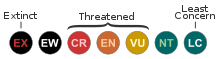
IUCN Red List of Threatened Plants Status : Not available
Growth: S = slow M = medium F = fast. Soil: L = light (sandy) M = medium H = heavy (clay). pH: A = acid N = neutral B = basic (alkaline). Shade: F = full shade S = semi-shade N = no shade. Moisture: D = dry M = Moist We = wet Wa = water.
Now available:
Food Forest Plants for Mediterranean Conditions
350+ Perennial Plants For Mediterranean and Drier Food Forests and Permaculture Gardens.
[Paperback and eBook]
This is the third in Plants For A Future's series of plant guides for food forests tailored to
specific climate zones. Following volumes on temperate and tropical ecosystems, this book focuses
on species suited to Mediterranean conditions—regions with hot, dry summers and cool, wet winters,
often facing the added challenge of climate change.
Read More
Expert comment
Author
(Hook.)Nutt.
Botanical References
60200
Links / References
For a list of references used on this page please go here
Readers comment
| Add a comment |
|
If you have important information about this plant that may help other users please add a comment or link below. Only comments or links that are felt to be directly relevant to a plant will be included. If you think a comment/link or information contained on this page is inaccurate or misleading we would welcome your feedback at [email protected]. If you have questions about a plant please use the Forum on this website as we do not have the resources to answer questions ourselves.
* Please note: the comments by website users are not necessarily those held by PFAF and may give misleading or inaccurate information.
|
Subject : Balsamorhiza hookeri
|
|
|
|