 |
|
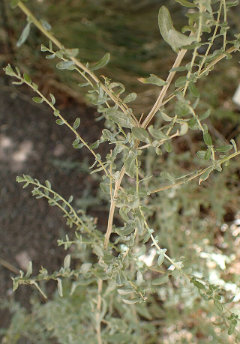
Krzysztof Ziarnek, Kenraiz Creative Commons Attribution-Share Alike 4.0 |
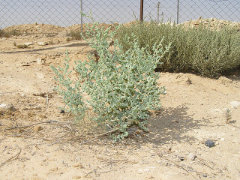 |
| Felagund Creative Commons Attribution-Share Alike 3.0 |
Translate this page:
Summary
Taxonomic Note: This genus was formerly classified in the family Chenopodiaceae. Modern classifications include it within the Amaranthaceae.
A hardy, long-lived desert saltbush native to the Mojave and Sonoran regions, Atriplex polycarpa forms dense, gray-green shrubs that thrive on alkaline, saline, drought-prone soils where few other edibles succeed. It is outstanding for erosion control, wildlife cover, and site reclamation, but it is a poor human food: foliage is intensely acrid and irritating unless subjected to heavy processing, and even then remains unappealing; seeds are likewise harsh. Historically, it has been cited as a last-resort or famine plant in parts of the Southwest. Atriplex polycarpa is a first-rate desert workhorse—stabilizing salty soils, withstanding heat, wind, and drought, and providing wildlife cover where few shrubs will grow. For human consumption, however, it is decidedly inferior: the leaves are intensely acrid and require multiple water changes to become barely edible; the seeds, though collectible in quantity, are harsh and acrid even after processing. Use this species for restoration, hedging, and xeriscape structure, not for the table.
Physical Characteristics

 Atriplex polycarpa is an evergreen Shrub growing to 1 m (3ft 3in) by 1 m (3ft 3in) at a medium rate.
See above for USDA hardiness. It is hardy to UK zone 9 and is not frost tender. The flowers are pollinated by Wind.
It is noted for attracting wildlife.
Suitable for: light (sandy) and medium (loamy) soils, prefers well-drained soil and can grow in nutritionally poor soil. Suitable pH: neutral and basic (mildly alkaline) soils and can grow in very alkaline and saline soils.
It cannot grow in the shade. It prefers dry or moist soil and can tolerate drought.
UK Hardiness Map
US Hardiness Map
Synonyms
Homotypic Synonyms: Obione polycarpa Torr.
Plant Habitats
Edible Uses
Fresh leaves are much too acrid to consume; even with multiple changes of boiling water, they are barely palatable. Initial boils produce thick foam; continue boiling and changing the water until the foam subsides. Texture becomes acceptable, flavor remains poor (“spinach-like” notes overwhelmed by distasteful characteristics). Seeds have a starchy base with salty, woody, and terribly acrid overtones - also poor [2-3]. Edible Uses & Rating: Parts used: Leaves (historically boiled as greens), seeds (used when other foods were scarce). Edibility rating: 1/5 (emergency only). Hopi references mention leaves cooked as greens; ancestral use of the seeds during scarcity. Taste, Processing & Kitchen Notes: Leaves: Mandatory processing: Finely chop - boil hard - discard liquor - repeat until no foam; do not add directly to soups (they will taint the pot). Expect only marginal palatability after full treatment. Portion size: Small; irritating compounds (oxalates/saponins/nitrates) can provoke throat/mouth discomfort. Seeds: Harvest - Shake or strip utricles when dry in autumn; expect chaff and insect-damaged seeds. Processing: Thresh/winnow - boil (often two water changes) or toast, then boil to moderate acridity. Even with care, the flavor typically remains unpleasant. Safety & Cautions (Food Use): Chemistry: Leaves commonly accumulate oxalates, saponins, nitrates (and other salts). Processing is mandatory: Leaves: Finely chop - vigorous boil - discard liquor - repeat until foam stops; even then, expect poor flavor and potential irritation—do not use as soup greens. Seeds: Thresh/winnow - boil (often two water changes) or toast then boil to reduce harshness; results remain marginal. Who should avoid: Individuals with a kidney-stone history (oxalates) or on nitrate-sensitive meds should avoid this plant as food. Recommendation: Treat as non-food for routine use; survival/emergency only. Bottom line: This species is not recommended for routine foraging; reserve for survival scenarios [2-3]. Look-Alikes & Confusion Risks: Other Atriplex shrubs (e.g., A. canescens, A. lentiformis)—similar gray scurf and salty leaves; all share the same cautions. Allenrolfea occidentalis (picklebush)—jointed fleshy stems rather than leafy shoots; different genus and use profile.
References More on Edible Uses
Medicinal Uses
Plants For A Future can not take any responsibility for any adverse effects from the use of plants. Always seek advice from a professional before using a plant medicinally.
None Known
References More on Medicinal Uses
The Bookshop: Edible Plant Books
Our Latest books on Perennial Plants For Food Forests and Permaculture Gardens in paperback or digital formats.

Edible Tropical Plants
Food Forest Plants for Hotter Conditions: 250+ Plants For Tropical Food Forests & Permaculture Gardens.
More

Edible Temperate Plants
Plants for Your Food Forest: 500 Plants for Temperate Food Forests & Permaculture Gardens.
More

More Books
PFAF have eight books available in paperback and digital formats. Browse the shop for more information.
Shop Now
Other Uses
Design uses: Windbreak/hedge, glare and heat-tolerant plants for desert plantings, saline bioswale edges, stabilization of alkali flats. It is outstanding for erosion control, wildlife cover, and site reclamation, but it is not a suitable food source for humans. Roots: Deep, wide-spreading root system; excellent soil binder in loose, salty substrates. Ecology & Wildlife: Cover: Dense branching offers nesting and refuge for small birds and desert mammals. Forage (wildlife/livestock): Browsed sparingly (secondary forage); high salts/oxalates limit intake. Soil: Strong salinity and alkalinity tolerance, erosion control, and rhizosphere salt sequestration via bladder hairs; valuable in reclamation of saline road margins, tailings, and alkali sinks. Pollination: Primarily wind-pollinated (inconspicuous flowers). Companions (desert guilds): Creosote bush (Larrea), bursage (Ambrosia dumosa), saltbush guilds (Atriplex spp.), iodine bush (Allenrolfea), saltgrass (Distichlis), seepweed (Suaeda).
Special Uses
References More on Other Uses
Cultivation details
Growing Conditions: Light: Full sun only. Soil: Sandy to gravelly loams or fine desert alluvium; high pH and salinity tolerated (pH 7.5–9+). Performs in calcareous soils. Moisture: Very drought-tolerant once established; also tolerates episodic flooding in desert washes. Climate/heat: Hot-summer desert shrub; handles reflected heat and desiccating wind. Hardiness: Approx. USDA 8–10 (some stands persist in colder basins given perfect drainage and winter dryness). Native to the Mojave and Sonoran Deserts and adjacent arid valleys, fans, and alkaline flats of the southwestern U.S. (esp. southern California and Arizona) and into northwestern Mexico; common on disturbed, salty, and highly alkaline ground. Size & Landscape Performance: Mature size: Typically 0.5–2 m tall × 0.6–2.5 m wide; slower and smaller on extreme sites. Growth rate: Moderate once established (first year slow while rooting). Longevity: Long-lived shrub under natural desert regimes. Cultivation (Horticulture): Site prep: Minimal; avoid soil amendments—fertility can increase nitrate/oxalate accumulation in leaves. Irrigation: Establish with light, infrequent watering. After year 1, water deeply but rarely (e.g., monthly in the hottest season for faster growth). Over-irrigation encourages lush, weak growth and higher nitrate loads. Nutrition: Do not fertilize; the plant is adapted to lean soils. Pruning: Light shaping only; avoid hard cuts into old wood. Containers: Not recommended beyond short-term nursery culture; wants root run and mineral soils. Seasonality (Phenology): Vegetative growth: Spring surge after winter/spring moisture; maintains foliage through summer drought with reduced growth. Flowering: Mainly summer. Fruit/seed: Late summer–autumn (desert heat can advance timing). Best “edible” window: If attempting greens, use very young shoots only—and still expect heavy processing. Identification & Habit Form: Multi-stemmed, rounded shrub, typically 0.5–2 m tall and similar spread; twiggy and densely branched. Foliage: Small, alternate, oval to spatulate leaves; gray-silvery “scurf” (inflated bladder hairs) gives a mealy cast and often visible surface salt. Leaves are persistent in mild winters (semi-evergreen) but can shed in drought. Flowers/Fruit: Inconspicuous wind-pollinated flowers; female flowers enclosed by a pair of bractlets that harden into the dry, papery utricles around the seed. Fruiting late summer into autumn. Roots: Deep, wide-spreading root system; excellent soil binder in loose, salty substrates. Pests & Problems: Insects: Seed weevils/borers can perforate seeds (common when collecting). Physiological: Over-watering leads to rank growth, possible dieback; excessive fertility leads to elevated nitrates.
References Carbon Farming Information and Carbon Sequestration Information
Temperature Converter
Type a value in the Celsius field to convert the value to Fahrenheit:
Fahrenheit:
The PFAF Bookshop
Plants For A Future have a number of books available in paperback and digital form. Book titles include Edible Plants, Edible Perennials, Edible Trees,Edible Shrubs, Woodland Gardening, and Temperate Food Forest Plants. Our new book is Food Forest Plants For Hotter Conditions (Tropical and Sub-Tropical).
Shop Now
Plant Propagation
Seed: Collect dry utricles in late summer–autumn; dry further, then thresh and winnow. Dormancy: Variable; best results from fall sowing (natural cold/moist after-ripening) or 4–8 weeks cold-moist stratification before spring sowing. Sowing: Broadcast on the surface or barely cover (light helps), keep just moist until germination; avoid over-watering. Cuttings: Semi-ripe to semi-hardwood tip cuttings in warm weather with auxin and intermittent mist root fairly well; useful for clonal hedging. Direct seeding for restoration: Excellent; scratch in lightly on saline/alkaline sites prior to winter moisture. Site prep: Minimal; avoid soil amendments—fertility can increase nitrate/oxalate accumulation in leaves. Irrigation: Establish with light, infrequent watering; after year 1, water deeply but rarely (e.g., monthly in the hottest season if you want faster growth). Over-irrigation encourages lush, weak growth and higher nitrate loads. Nutrition: Do not fertilize; the plant is adapted to lean soils. Pruning: Light shaping only; avoid hard cuts into old wood. Containers: Not recommended beyond short-term nursery culture; wants root run and mineral soils.
Other Names
If available other names are mentioned here
Cattle spinach, Desert saltbush
Native Range
Arizona, California, Mexico Northwest, Nevada, Utah
Weed Potential
Right plant wrong place. We are currently updating this section.
Please note that a plant may be invasive in one area but may not in your area so it's worth checking.
Low in most settings. It establishes on bare, saline ground and can form local dominance, but it rarely invades mesic or fertile landscapes. Monitor in restoration plantings to prevent exclusion of desirable associates.
Conservation Status
IUCN Red List of Threatened Plants Status : Not available

| Related Plants
|
| Latin Name | Common Name | Habit | Height | Hardiness | Growth | Soil | Shade | Moisture | Edible | Medicinal | Other |
| Atriplex argentea | Silvery Orach, Silverscale saltbush, Stalked saltbush | Annual | 0.5 |
4-9
| | LM | N | M | 3 | 2 | 2 |
| Atriplex argentea expansa | Silverscale Saltbush | Annual | 0.6 |
-
| | LM | N | M | 2 | 0 | |
| Atriplex californica | California Orach, California saltbush | Perennial | 0.1 |
7-10
| M | LM | N | DM | 3 | 0 | 3 |
| Atriplex canescens | Grey Sage Brush, Fourwing saltbush | Shrub | 1.8 |
3-9
| M | LM | N | DM | 3 | 1 | 3 |
| Atriplex carnosa | Thickleaf Orach | Annual | 0.9 |
-
| | LM | N | DM | 2 | 0 | |
| Atriplex cinerea | Grey Saltbush | Shrub | 2.0 |
9-11
| M | LM | N | DM | 3 | 0 | 3 |
| Atriplex confertifolia | Shadscale, Shadscale saltbush | Shrub | 1.5 |
4-9
| M | LM | N | DM | 3 | 1 | 2 |
| Atriplex coronata | Crownscale | Annual | 0.4 |
-
| | LM | N | DM | 2 | 0 | |
| Atriplex dimorphostegia | | Annual | 0.2 |
-
| | LM | N | DM | 2 | 0 | |
| Atriplex elegans | Wheelscale Saltbush | Annual | 0.2 |
0-0
| | LM | N | DM | 3 | 0 | 1 |
| Atriplex glabriuscula | Scotland orache, Maritime saltbush, Frankton's saltbush, Northeastern saltbush | Annual | 0.3 |
0-0
| | LM | N | DM | 2 | 0 | |
| Atriplex gmelinii | Gmelin's saltbush | Annual | 0.5 |
0-0
| | LM | N | DM | 2 | 0 | |
| Atriplex halimus | Sea Orach, Saltbush | Shrub | 2.0 |
7-10
| M | LM | N | DM | 5 | 1 | 3 |
| Atriplex hastata | Hastate Orach | Annual | 0.8 |
0-0
| | LM | N | DM | 3 | 0 | 2 |
| Atriplex hortensis | Orach, Garden orache | Annual | 1.8 |
5-9
| F | LM | N | M | 4 | 2 | 3 |
| Atriplex lapathifolia | | Annual | 0.9 |
-
| | LM | N | DM | 3 | 0 | |
| Atriplex lentiformis | Quail Bush, Big saltbush, Quailbush, | Shrub | 3.0 |
8-11
| M | LM | N | DM | 2 | 1 | 3 |
| Atriplex littoralis | Grassleaf orache | Biennial | 0.7 |
4-11
| F | LMH | N | DM | 2 | 0 | 0 |
| Atriplex maximowicziana | Maximowicz's saltbush | Perennial | 0.8 |
0-0
| | LM | N | DM | 2 | 0 | |
| Atriplex mucronata | | Annual | 0.4 |
-
| | LMH | N | DM | 2 | 0 | |
| Atriplex nummularia | Giant Saltbush, Bluegreen saltbush | Shrub | 3.5 |
7-10
| M | LM | N | DM | 3 | 2 | 3 |
| Atriplex nuttallii | Nuttall's Saltbush | Shrub | 0.9 |
5-9
| M | LM | N | DM | 4 | 0 | 2 |
| Atriplex obovata | Mound Saltbrush | Shrub | 1.0 |
5-9
| M | LMH | N | DM | 3 | 0 | 3 |
| Atriplex patula | Spreading Orach, Spear saltbush | Annual | 0.8 |
0-0
| | LM | N | M | 3 | 1 | 0 |
| Atriplex powellii | Powell's Saltweed | Annual | 0.7 |
4-9
| | LM | N | DM | 3 | 0 | 2 |
| Atriplex rosea | Tumbling or redscale saltweed | Annual | 0.6 |
3-10
| F | LM | N | DM | 2 | 2 | 2 |
| Atriplex saccaria | Sack Saltbush | Annual | 0.3 |
5-9
| | LM | N | DM | 3 | 0 | 0 |
| Atriplex semibaccata | Australian Saltbush. Australian saltbush, Creeping saltbush | Shrub | 0.5 |
8-11
| F | LMH | N | DM | 3 | 0 | 3 |
| Atriplex serenana | Bractscale, Davidson's bractscale | Annual | 3.0 |
8-11
| | LM | N | DM | 3 | 0 | 0 |
|
|
Growth: S = slow M = medium F = fast. Soil: L = light (sandy) M = medium H = heavy (clay). pH: A = acid N = neutral B = basic (alkaline). Shade: F = full shade S = semi-shade N = no shade. Moisture: D = dry M = Moist We = wet Wa = water.
Now available:
Food Forest Plants for Mediterranean Conditions
350+ Perennial Plants For Mediterranean and Drier Food Forests and Permaculture Gardens.
[Paperback and eBook]
This is the third in Plants For A Future's series of plant guides for food forests tailored to
specific climate zones. Following volumes on temperate and tropical ecosystems, this book focuses
on species suited to Mediterranean conditions—regions with hot, dry summers and cool, wet winters,
often facing the added challenge of climate change.
Read More
Expert comment
Author
(Torr.) S.Watson
Botanical References
Links / References
For a list of references used on this page please go here
Readers comment
| Add a comment |
|
If you have important information about this plant that may help other users please add a comment or link below. Only comments or links that are felt to be directly relevant to a plant will be included. If you think a comment/link or information contained on this page is inaccurate or misleading we would welcome your feedback at [email protected]. If you have questions about a plant please use the Forum on this website as we do not have the resources to answer questions ourselves.
* Please note: the comments by website users are not necessarily those held by PFAF and may give misleading or inaccurate information.
|
Subject : Atriplex polycarpa
|
|
|
|