 |
|
Kenraiz Creative Commons Attribution-Share Alike 4.0 |
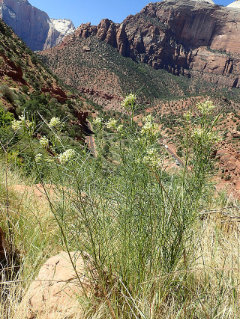 |
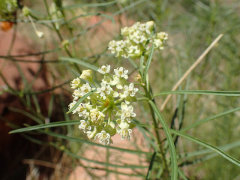
| Kenraiz Creative Commons Attribution-Share Alike 4.0 |
Translate this page:
Summary
Taxonomic Note: This genus was formerly classified in the family Asclepiadaceae. Modern classifications include it within the Apocynaceae.
A historically important wild food in California, but highly toxic raw and risky even when cooked. The Asclepias genus is widespread, distinctive, and historically important. Many species were used by Native Americans for food, gum, and medicine. Cooking is essential to neutralize toxins. Of the species listed here, showy milkweed (A. speciosa) is the safest and best-tasting, followed by spider milkweed (A. asperula). Horsetail milkweed (A. subverticillata) is dangerously toxic and should never be eaten. Butterfly milkweed (A. tuberosa) is edible but of only modest value.
Physical Characteristics

 Asclepias subverticillata is a PERENNIAL growing to 0.4 m (1ft 4in) by 0.3 m (1ft) at a fast rate.
See above for USDA hardiness. It is hardy to UK zone 7 and is not frost tender. The flowers are pollinated by Bees, Insects.
It is noted for attracting wildlife.
Suitable for: light (sandy) and medium (loamy) soils and prefers well-drained soil. Suitable pH: mildly acid, neutral and basic (mildly alkaline) soils. It cannot grow in the shade. It prefers dry or moist soil.
UK Hardiness Map
US Hardiness Map
Synonyms
A. verticillata var. subverticillata A.Gray
Plant Habitats
Edible Uses
Edible parts (after thorough boiling): Leaves only, but very bitter and unpleasant. Preparation: Requires multiple water changes; still unsatisfactory. Safety: Extremely toxic raw; dangerous even after cooking [2-3].
References More on Edible Uses
Medicinal Uses
Plants For A Future can not take any responsibility for any adverse effects from the use of plants. Always seek advice from a professional before using a plant medicinally.
None Known
References More on Medicinal Uses
The Bookshop: Edible Plant Books
Our Latest books on Perennial Plants For Food Forests and Permaculture Gardens in paperback or digital formats.
Edible Tropical Plants
Food Forest Plants for Hotter Conditions: 250+ Plants For Tropical Food Forests & Permaculture Gardens.
More
Edible Temperate Plants
Plants for Your Food Forest: 500 Plants for Temperate Food Forests & Permaculture Gardens.
More
More Books
PFAF have eight books available in paperback and digital formats. Browse the shop for more information.
Shop Now
Other Uses
References More on Other Uses
Cultivation details
Form: Perennial herb, 30–80 cm tall, thread-like leaves. Leaves: Very narrow, linear, whorled. Flowers: White to greenish. Bloom: May–September. Hardiness: USDA zones 6–10. Weed Potential: Locally dominant; toxic to livestock.
References Carbon Farming Information and Carbon Sequestration Information
Temperature Converter
Type a value in the Celsius field to convert the value to Fahrenheit:
Fahrenheit:
The PFAF Bookshop
Plants For A Future have a number of books available in paperback and digital form. Book titles include Edible Plants, Edible Perennials, Edible Trees,Edible Shrubs, Woodland Gardening, and Temperate Food Forest Plants. Our new book is Food Forest Plants For Hotter Conditions (Tropical and Sub-Tropical).
Shop Now
Plant Propagation
Seed; colonizes easily.
Other Names
If available other names are mentioned here
Horsetail / Poison Milkweed (Asclepias subverticillata)
Native Range
USA. Arizona, Colorado, Kansas, Mexico Northeast, Mexico Northwest, Mexico Southeast, Mexico Southwest, Missouri, New Mexico, Oklahoma, Texas, Utah, Wyoming
Weed Potential
Right plant wrong place. We are currently updating this section.
Please note that a plant may be invasive in one area but may not
in your area so it's worth checking.
Locally dominant; toxic to livestock.
Conservation Status
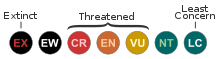
IUCN Red List of Threatened Plants Status : Not available
IUCN Red List
| Related Plants
|
| Latin Name | Common Name | Habit | Height | Hardiness | Growth | Soil | Shade | Moisture | Edible | Medicinal | Other |
| Asclepias asperula | Spider milkweed | Perennial | 0.6 |
5-9
| M | LM | SN | DM | 4 | 1 | 3 |
| Asclepias brachystephana | Bract milkweed | Perennial | 0.3 |
0-0
| | L | SN | DM | 0 | 0 | 2 |
| Asclepias californica | California Milkweed, Greene's milkweed | Perennial | 0.5 |
0-0
| | L | SN | DM | 2 | 1 | 2 |
| Asclepias currasavica | Blood Flower | Perennial | 2.0 |
10-12
| F | LMH | N | M | 0 | 1 | 2 |
| Asclepias decumbens | | Perennial | 0.9 |
-
| | L | SN | DM | 2 | 0 | 2 |
| Asclepias eriocarpa | Woollypod Milkweed | Perennial | 0.9 |
6-10
| | L | SN | DM | 2 | 2 | 3 |
| Asclepias erosa | Desert Milkweed | Perennial | 0.8 |
0-0
| | L | N | DM | 3 | 0 | 3 |
| Asclepias fascicularis | Mexican milkweed | Perennial | 0.8 |
7-10
| F | LM | N | DM | 1 | 0 | 1 |
| Asclepias galioides | Bedstraw Milkweed | Perennial | 0.4 |
-
| | L | SN | DM | 2 | 1 | 2 |
| Asclepias hallii | Purple Silkweed, Hall's milkweed | Perennial | 1.0 |
3-7
| | LM | SN | DM | 3 | 1 | 3 |
| Asclepias incarnata | Swamp Milkweed, Swamp Butterfly Weed, Marsh Milkweed | Perennial | 1.2 |
3-8
| M | LM | SN | DMWe | 3 | 2 | 3 |
| Asclepias involucrata | Dwarf Milkweed | Perennial | 0.0 |
-
| | L | SN | DM | 2 | 1 | 2 |
| Asclepias lanceolata | Purple Silkweed, Fewflower milkweed | Perennial | 1.2 |
4-8
| | LM | SN | DM | 2 | 1 | 3 |
| Asclepias latifolia | Broadleaf Milkweed | Perennial | 0.8 |
-
| | L | SN | DM | 0 | 1 | 2 |
| Asclepias mexicana | | Perennial | 0.8 |
5-9
| | L | SN | DM | 1 | 0 | 2 |
| Asclepias ovalifolia | Oval-leaf milkweed | Perennial | 0.6 |
5-9
| | LM | SN | DM | 2 | 0 | 3 |
| Asclepias pumila | Low Milkweed, Plains milkweed | Perennial | 0.4 |
5-9
| | LM | SN | DM | 2 | 1 | 3 |
| Asclepias purpurascens | Purple Milkweed | Perennial | 0.8 |
-
| | LM | SN | DM | 2 | 1 | 3 |
| Asclepias quadrifolia | Fourleaf Milkweed | Perennial | 0.5 |
4-8
| | LM | SN | DM | 2 | 2 | 3 |
| Asclepias rubra | Red Silkweed | Perennial | 1.2 |
4-8
| | LM | SN | DM | 3 | 1 | 3 |
| Asclepias speciosa | Showy Milkweed | Perennial | 0.8 |
3-9
| | LM | SN | DM | 4 | 2 | 3 |
| Asclepias subulata | Rush Milkweed | Perennial | 2.0 |
5-9
| | L | SN | DM | 0 | 1 | 3 |
| Asclepias sullivantii | Prairie milkweed | Perennial | 1.2 |
0-0
| | L | SN | DM | 0 | 0 | 3 |
| Asclepias syriaca | Common Milkweed, Silkweed, Milkweed | Perennial | 1.0 |
3-8
| M | LM | SN | DM | 3 | 2 | 3 |
| Asclepias tuberosa | Pleurisy Root, Butterfly milkweed, Rolfs' milkweed, Indian Paintbrush | Perennial | 0.8 |
3-9
| M | LM | SN | DM | 3 | 3 | 4 |
| Asclepias viridiflora | Green Milkweed, Green comet milkweed | Perennial | 1.0 |
0-0
| | LM | SN | DM | 3 | 2 | 3 |
|
Growth: S = slow M = medium F = fast. Soil: L = light (sandy) M = medium H = heavy (clay). pH: A = acid N = neutral B = basic (alkaline). Shade: F = full shade S = semi-shade N = no shade. Moisture: D = dry M = Moist We = wet Wa = water.
Now available:
Food Forest Plants for Mediterranean Conditions
350+ Perennial Plants For Mediterranean and Drier Food Forests and Permaculture Gardens.
[Paperback and eBook]
This is the third in Plants For A Future's series of plant guides for food forests tailored to
specific climate zones. Following volumes on temperate and tropical ecosystems, this book focuses
on species suited to Mediterranean conditions—regions with hot, dry summers and cool, wet winters,
often facing the added challenge of climate change.
Read More
Expert comment
Author
(A.Gray) Vail
Botanical References
Links / References
For a list of references used on this page please go here
Readers comment
| Add a comment |
|
If you have important information about this plant that may help other users please add a comment or link below. Only comments or links that are felt to be directly relevant to a plant will be included. If you think a comment/link or information contained on this page is inaccurate or misleading we would welcome your feedback at [email protected]. If you have questions about a plant please use the Forum on this website as we do not have the resources to answer questions ourselves.
* Please note: the comments by website users are not necessarily those held by PFAF and may give misleading or inaccurate information.
|
Subject : Asclepias subverticillata
|
|
|
|