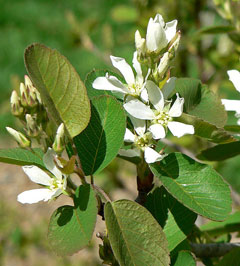
 |
|
http://commons.wikimedia.org/wiki/User:Stan_Shebs |
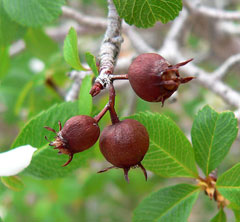 |
| http://commons.wikimedia.org/wiki/User:Stan_Shebs |
Translate this page:
Summary
Amelanchier utahensis, the Utah serviceberry, is a widespread shrub or small tree valued for its edible berries. While not always as consistently delicious as A. alnifolia, the fruits can be very good when conditions are favorable, offering a sweet, apple-like taste. Its ability to thrive across diverse habitats, from desert foothills to high mountain forests, makes it an important wild food plant in the American West. However, its susceptibility to diseases such as orange rust fungus, and the occasional poor fruit texture, can limit its usefulness. Still, for foragers in the western U.S., Utah serviceberry provides a welcome and nutritious summer harvest.
Physical Characteristics

 Amelanchier utahensis is a deciduous Shrub growing to 5 m (16ft 5in).
See above for USDA hardiness. It is hardy to UK zone 4 and is not frost tender. It is in flower from April to May. The species is hermaphrodite (has both male and female organs) and is pollinated by Bees. The plant is self-fertile.
Suitable for: light (sandy), medium (loamy) and heavy (clay) soils and can grow in heavy clay soil. Suitable pH: mildly acid and neutral soils. It can grow in semi-shade (light woodland) or no shade. It prefers dry or moist soil.
UK Hardiness Map
US Hardiness Map
Synonyms
A. prunifolia. A. rubescens.
Plant Habitats
Woodland Garden Secondary; Sunny Edge; Dappled Shade;
Edible Uses
Edible Parts: Fruit
Edible Uses:
The fruits (pomes) of Amelanchier utahensis are edible and vary in quality. At their best, they have a sweet, apple-like flavor with hints of grapes and almonds, making them excellent for fresh eating or for use in pies, jellies, desserts, and preserves. However, the fruit quality is inconsistent: while some are soft and flavorful, others can be bland, dry, or develop a firm, apple-core-like texture that is unappealing [2-3]. Fruits usually mature from June to August, but timing depends on elevation and rainfall. They often pass through stages of green, pink, red, and finally dark purple, though color is not always a reliable indicator of ripeness—yellow and tan varieties also occur. Fruits ripen over time, so repeated harvests from the same shrub are often possible [2-3]. Seeds make up a large portion of the fruit, giving them a chewy or phlegm-like quality. Healthy fruits are high in pectin and suitable for jellies, but diseased fruit is common. Utah serviceberries are particularly prone to orange rust fungus, which can infect entire populations. Careful inspection of each berry is recommended before consumption [2-3]. Like other serviceberries, only the fruits are edible—other parts contain cyanogenic compounds (prunasin) and should be avoided [2-3].
Edibility Rating: 4/5 – Nutritious and often delicious, but inconsistent in quality and sometimes disease-prone. Edible fruit, raw or cooked[105, 172, 229, 257]. The fruit can also be dried and used as a raisin substitute[177, 183]. The fruit is rich in iron and copper[226]. It is produced in small clusters and is about 10mm in diameter[200].
References More on Edible Uses
Medicinal Uses
Plants For A Future can not take any responsibility for any adverse effects from the use of plants. Always seek advice from a professional before using a plant medicinally.
Ophthalmic Oxytoxic
An infusion of the inner bark is used to treat snow-blindness[172]. The plant has been used to ease childbirth during labour and delivery[257].
References More on Medicinal Uses
The Bookshop: Edible Plant Books
Our Latest books on Perennial Plants For Food Forests and Permaculture Gardens in paperback or digital formats.
Edible Tropical Plants
Food Forest Plants for Hotter Conditions: 250+ Plants For Tropical Food Forests & Permaculture Gardens.
More

Edible Temperate Plants
Plants for Your Food Forest: 500 Plants for Temperate Food Forests & Permaculture Gardens.
More
More Books
PFAF have eight books available in paperback and digital formats. Browse the shop for more information.
Shop Now
Other Uses
Wood
Wood - heavy, hard and strong. The hardness of the wood makes it suitable for use as the spindle of a fire drill[257]. Trees are seldom large enough to be of commercial interest[229]. The wood has been used to make the rims of baskets[257].
Special Uses
References More on Other Uses
Cultivation details
Found across a wide elevational range, from blackbrush deserts up through oak, juniper, pine, and spruce woodlands. Common in foothills, mountain slopes, canyons, and mixed shrublands. Prefers a rich loamy soil in a sunny position or semi-shade[1, 200] but thrives in any soil that is not water-logged[11]. Grows well in heavy clay soils. Tolerates dry soils[200]. All members of this genus have edible fruits and, whilst this is dry and uninteresting in some species, in many others it is sweet and juicy. Many of the species have potential for use in the garden as edible ornamentals. The main draw-back to this genus is that birds adore the fruit and will often completely strip a tree before it is fully ripe[K]. This species is closely related to A. alnifolia[11]. Hybridizes freely with other members of this genus[200]. Grafting onto seedlings of A. lamarckii or Sorbus aucuparia is sometimes practised in order to avoid the potential problem of hybridizing[1]. Hardy in zones 3–8. Tolerates cold winters and a wide range of elevations. Drought-tolerant once established but benefits from seasonal moisture. Blooms in spring; fruits persist into late summer or autumn, sometimes dropping quickly after ripening.
References Carbon Farming Information and Carbon Sequestration Information
Temperature Converter
Type a value in the Celsius field to convert the value to Fahrenheit:
Fahrenheit:
The PFAF Bookshop
Plants For A Future have a number of books available in paperback and digital form. Book titles include Edible Plants, Edible Perennials, Edible Trees,Edible Shrubs, Woodland Gardening, and Temperate Food Forest Plants. Our new book is Food Forest Plants For Hotter Conditions (Tropical and Sub-Tropical).
Shop Now
Plant Propagation
Seed - it is best harvested 'green', when the seed is fully formed but before the seed coat has hardened, and then sown immediately in pots outdoors or in a cold frame. If stored seed is obtained early enough in the autumn, it can be given 4 weeks warm stratification before being left out in the winter and it should then germinate in the spring. Otherwise seed can be very slow to germinate, perhaps taking 18 months or more. When large enough to handle, prick the seedlings out into individual pots and grow them on in a sheltered outdoor position, planting them out once they are 20cm or more tall. If there is sufficient seed it is best to sow it thinly in an outdoor seedbed[78, 80]. Grow the seedlings on for two years in the seedbed before planting them out into their permanent positions during the winter. Layering in spring - takes 18 months[78]. Division of suckers in late winter. The suckers need to have been growing for 2 years before you dig them up, otherwise they will not have formed roots. They can be planted out straight into their permanent positions if required.
Other Names
If available other names are mentioned here
Amelanchier utahensis (Utah Serviceberry).
Native Range
NORTHERN AMERICA: United States (Colorado (west), Idaho, Montana (southwest), Oregon (east), Washington (south), Wyoming, New Mexico (northwest), Texas (west), Arizona (north), California, Nevada, Utah), Mexico (Baja)
Weed Potential
Right plant wrong place. We are currently updating this section.
Please note that a plant may be invasive in one area but may not in your area so it's worth checking.
Low weed potential. Though widespread in the western U.S., Utah serviceberry integrates naturally into its habitats and does not behave invasively.
Conservation Status
IUCN Red List of Threatened Plants Status :

| Related Plants
|
| Latin Name | Common Name | Habit | Height | Hardiness | Growth | Soil | Shade | Moisture | Edible | Medicinal | Other |
| Amelanchier alnifolia | Saskatoon, Saskatoon serviceberry, Serviceberry | Shrub | 4.0 |
2-7
| M | LMH | SN | M | 5 | 2 | 3 |
| Amelanchier alnifolia cusickii | Cusick's Serviceberry | Shrub | 3.0 |
0-0
| | LMH | SN | M | 4 | 1 | 0 |
| Amelanchier alnifolia semiintegrifolia | Pacific Serviceberry | Shrub | 3.0 |
0-0
| S | LMH | SN | M | 5 | 1 | 1 |
| Amelanchier arborea | Downy Serviceberry, Alabama serviceberry, Juneberry, Common Serviceberry, Downy Serviceberry | Tree | 10.0 |
5-8
| S | LMH | SN | M | 3 | 1 | 2 |
| Amelanchier asiatica | Korean Juneberry | Tree | 8.0 |
4-8
| | LMH | SN | M | 3 | 0 | |
| Amelanchier bartramiana | Oblongfruit serviceberry | Shrub | 3.0 |
4-8
| | LMH | SN | M | 3 | 0 | 0 |
| Amelanchier basalticola | Dwarf Service-berry | Shrub | 3.0 |
4-8
| | LMH | SN | M | 4 | 0 | 0 |
| Amelanchier canadensis | Juneberry, Canadian serviceberry, Serviceberry Downy, Shadblow, Shadbush, Serviceberry | Shrub | 6.0 |
4-7
| M | LMH | SN | M | 4 | 1 | 4 |
| Amelanchier confusa | Apple Serviceberry | Shrub | 5.0 |
4-8
| | LMH | SN | M | 5 | 0 | 0 |
| Amelanchier humilis | Low serviceberry | Shrub | 1.8 |
4-8
| | LMH | SN | M | 3 | 0 | |
| Amelanchier huroensis | | Tree | 6.0 |
5-9
| | LMH | SN | M | 3 | 0 | |
| Amelanchier interior | Pacific serviceberry | Tree | 9.0 |
5-9
| | LMH | SN | M | 3 | 0 | |
| Amelanchier intermedia | June berry, | Shrub | 6.0 |
4-8
| | LMH | SN | M | 3 | 0 | 0 |
| Amelanchier laevis | Allegheny Shadberry, Allegheny serviceberry, Smooth Serviceberry | Shrub | 9.0 |
5-8
| M | LMH | SN | M | 5 | 1 | 2 |
| Amelanchier lamarckii | Apple Serviceberry | Shrub | 6.0 |
3-3
| | LMH | SN | M | 5 | 0 | 0 |
| Amelanchier obovalis | Southern Juneberry, Coastal serviceberry | Tree | 1.5 |
5-9
| | LMH | SN | M | 3 | 0 | 1 |
| Amelanchier ovalis | Snowy Mespilus, Dwarf Garden Serviceberry | Shrub | 5.0 |
5-7
| S | LMH | N | M | 2 | 0 | |
| Amelanchier ovalis integrifolia | | Shrub | 4.0 |
5-9
| | LMH | SN | M | 2 | 0 | |
| Amelanchier pallida | Pale Serviceberry | Shrub | 4.0 |
-
| | LMH | SN | M | 3 | 1 | |
| Amelanchier parviflora | | Shrub | 2.0 |
4-8
| | LMH | N | M | 2 | 0 | 2 |
| Amelanchier sanguinea | Roundleaf Serviceberry, Gaspé serviceberry | Shrub | 3.0 |
4-8
| | LMH | SN | DM | 3 | 0 | |
| Amelanchier spicata | | Shrub | 2.0 |
4-8
| | LMH | SN | M | 3 | 0 | |
| Amelanchier stolonifera | Quebec Berry, Running serviceberry | Shrub | 1.5 |
4-8
| | LMH | SN | DM | 5 | 1 | 0 |
| Amelanchier weigandii | | Shrub | 5.0 |
5-9
| | LMH | SN | M | 3 | 0 | |
| Amelanchier x grandiflora | Apple Serviceberry | Shrub | 6.0 |
4-7
| S | LMH | SN | M | 5 | 0 | 0 |
|
Growth: S = slow M = medium F = fast. Soil: L = light (sandy) M = medium H = heavy (clay). pH: A = acid N = neutral B = basic (alkaline). Shade: F = full shade S = semi-shade N = no shade. Moisture: D = dry M = Moist We = wet Wa = water.
Now available:
Food Forest Plants for Mediterranean Conditions
350+ Perennial Plants For Mediterranean and Drier Food Forests and Permaculture Gardens.
[Paperback and eBook]
This is the third in Plants For A Future's series of plant guides for food forests tailored to
specific climate zones. Following volumes on temperate and tropical ecosystems, this book focuses
on species suited to Mediterranean conditions—regions with hot, dry summers and cool, wet winters,
often facing the added challenge of climate change.
Read More
Expert comment
Author
Koehne.
Botanical References
1160200
Links / References
For a list of references used on this page please go here
Readers comment
| Add a comment |
|
If you have important information about this plant that may help other users please add a comment or link below. Only comments or links that are felt to be directly relevant to a plant will be included. If you think a comment/link or information contained on this page is inaccurate or misleading we would welcome your feedback at [email protected]. If you have questions about a plant please use the Forum on this website as we do not have the resources to answer questions ourselves.
* Please note: the comments by website users are not necessarily those held by PFAF and may give misleading or inaccurate information.
|
Subject : Amelanchier utahensis
|
|
|
|