 |
|
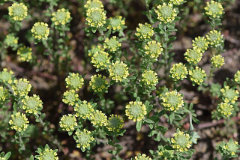
Krzysztof Ziarnek, Kenraiz Creative Commons Attribution-Share Alike 4.0 |
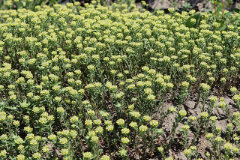 |
| Krzysztof Ziarnek, Kenraiz Creative Commons Attribution-Share Alike 4.0 |
Translate this page:
Summary
Pale madwort is a small annual mustard-family plant that thrives in disturbed soils, sagebrush valleys, and dry fields. Its leaves are edible fresh or cooked, with a mild flavor but covered in star-shaped hairs that can make them less pleasant to eat. The seeds may have some food potential, but their edibility is poorly documented and safety is uncertain. The plant has little caloric value and is more of a survival or supplemental food than a reliable crop. It is sometimes weedy, appearing in agricultural fields and open ground, but not aggressively invasive. The Alyssum genus (Brassicaceae) includes small, annual or perennial herbs often found in dry, rocky, or disturbed habitats. Many species are native to Eurasia, with a handful naturalized in North America. Edibility: A few species have mild leaves that can be eaten raw or cooked, similar to other mustards, though small size and hairy leaves limit usefulness. Seeds are sometimes palatable, but their safety and nutritional value are poorly documented. Most references make little or no mention of food use, suggesting Alyssum was rarely important as a traditional food plant. Medicinal/other uses: Some species have traditional uses as ornamentals or minor medicinal herbs, but these are not well developed. Cautions: The edibility of many Alyssum species remains poorly substantiated. As with many mustards, bitterness, acrid compounds, or high mineral content may be limiting factors. Foragers’ note: While not dangerous, Alyssum species are low-priority edibles. They are abundant in disturbed habitats and can be sampled as minor wild greens, but they are best regarded as a survival food rather than a staple.
Physical Characteristics

 Alyssum alyssoides is a ANNUAL growing to 0.2 m (0ft 8in) by 0.2 m (0ft 8in) at a fast rate.
See above for USDA hardiness. It is hardy to UK zone 5 and is not frost tender. The flowers are pollinated by Insects.
It is noted for attracting wildlife.
Suitable for: light (sandy) and medium (loamy) soils, prefers well-drained soil and can grow in nutritionally poor soil. Suitable pH: mildly acid, neutral and basic (mildly alkaline) soils. It can grow in semi-shade (light woodland) or no shade. It prefers dry or moist soil and can tolerate drought.
UK Hardiness Map
US Hardiness Map
Synonyms
Homotypic Synonyms: Adyseton alyssoides (L.) Nieuwl. Clypeola alyssoides L.
Plant Habitats
Edible Uses
Leaves – edible fresh or cooked [2-3]. Flavor is reportedly mild, though stellate (star-like) hairs cover the surfaces and may be unpleasant. Cooking does not remove the hairs [2-3]. Leaves could serve as a minor green vegetable if eaten in moderation. Seeds – not well documented for this species, but related species (A. desertorum) have mild-tasting seeds with soft texture when raw, toasted, or boiled. Seeds are winged and fall easily from pods [2-3]. Further safety evaluation is needed. Other parts are not reported as edible [2-3]. Caution: The genus is poorly studied for edibility. Safety is not well established, so use sparingly until more is known. Edibility Rating: 2/5 – Mild leaves edible, seeds possible but undocumented. Limited value due to hairs, small size, and lack of thorough safety information.
References More on Edible Uses
Medicinal Uses
Plants For A Future can not take any responsibility for any adverse effects from the use of plants. Always seek advice from a professional before using a plant medicinally.
None Known
References More on Medicinal Uses
The Bookshop: Edible Plant Books
Our Latest books on Perennial Plants For Food Forests and Permaculture Gardens in paperback or digital formats.
Edible Tropical Plants
Food Forest Plants for Hotter Conditions: 250+ Plants For Tropical Food Forests & Permaculture Gardens.
More
Edible Temperate Plants
Plants for Your Food Forest: 500 Plants for Temperate Food Forests & Permaculture Gardens.
More
More Books
PFAF have eight books available in paperback and digital formats. Browse the shop for more information.
Shop Now
Other Uses
References More on Other Uses
Cultivation details
A small, short-lived annual, usually about 5–20 cm tall, sometimes to ~25 cm, forming loose, low mounds or patches roughly 10–30 cm across, depending on density and crowding. Survives in a wide range of climates. Growing Conditions: Sun: Prefers full sun; tolerates partial sun. Soil: Adaptable to sandy, rocky, or disturbed soils; tolerates poor fertility. Moisture: Prefers dry to moderately moist soils, often found in semi-arid regions. Tolerance: Thrives in disturbed ground and open habitats, but is not shade-tolerant. Best suited for zones 4–8, although it may also occur outside these zones where winters are not extreme. An annual plant that grows primarily in the temperate biome. Native to Eurasia; naturalized in much of North America. Common in sagebrush valleys, bluffs, disturbed fields, pastures, and mountains up to 2,000 m. Blooms May–June; seeds ripen in summer. It’s primarily insect-pollinated: the small yellowish flowers attract tiny solitary bees, hoverflies, other flies, and small beetles, and it’s also capable of some self-pollination when visits are scarce.
References Carbon Farming Information and Carbon Sequestration Information
Temperature Converter
Type a value in the Celsius field to convert the value to Fahrenheit:
Fahrenheit:
The PFAF Bookshop
Plants For A Future have a number of books available in paperback and digital form. Book titles include Edible Plants, Edible Perennials, Edible Trees,Edible Shrubs, Woodland Gardening, and Temperate Food Forest Plants. Our new book is Food Forest Plants For Hotter Conditions (Tropical and Sub-Tropical).
Shop Now
Plant Propagation
Seed.
Other Names
If available other names are mentioned here
Pale madwort, lesser madwort, yellow alyssum (Alyssum alyssoides (L.) L.).
Native Range
Afghanistan, Albania, Austria, Baltic States, Belarus, Belgium, Bulgaria, Central European Russia, Corse, Cyprus, Czechia-Slovakia, East European Russia, France, Germany, Greece, Hungary, Iran, Italy, Kazakhstan, Kirgizstan, Krym, Lebanon-Syria, Morocco, Netherlands, North Caucasus, NW. Balkan Pen., Poland, Portugal, Romania, Sardegna, South European Russia, Spain, Switzerland, Tadzhikistan, Transcaucasus, Turkmenistan, Türkey, Türkey-in-Europe, Ukraine, Uzbekistan.
Weed Potential
Right plant wrong place. We are currently updating this section.
Please note that a plant may be invasive in one area but may not
in your area so it's worth checking.
Considered a weedy annual in disturbed habitats, fields, roadsides, and sagebrush valleys. Often found as a casual agricultural weed in grain fields. Not known to be aggressively invasive like some Brassicaceae, but it readily self-seeds and persists in open ground.
Conservation Status
IUCN Red List of Threatened Plants Status : Not available
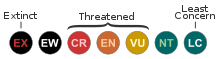
IUCN Red List
Growth: S = slow M = medium F = fast. Soil: L = light (sandy) M = medium H = heavy (clay). pH: A = acid N = neutral B = basic (alkaline). Shade: F = full shade S = semi-shade N = no shade. Moisture: D = dry M = Moist We = wet Wa = water.
Now available:
Food Forest Plants for Mediterranean Conditions
350+ Perennial Plants For Mediterranean and Drier Food Forests and Permaculture Gardens.
[Paperback and eBook]
This is the third in Plants For A Future's series of plant guides for food forests tailored to
specific climate zones. Following volumes on temperate and tropical ecosystems, this book focuses
on species suited to Mediterranean conditions—regions with hot, dry summers and cool, wet winters,
often facing the added challenge of climate change.
Read More
Expert comment
Author
(L.) L.
Botanical References
Links / References
For a list of references used on this page please go here
Readers comment
| Add a comment |
|
If you have important information about this plant that may help other users please add a comment or link below. Only comments or links that are felt to be directly relevant to a plant will be included. If you think a comment/link or information contained on this page is inaccurate or misleading we would welcome your feedback at [email protected]. If you have questions about a plant please use the Forum on this website as we do not have the resources to answer questions ourselves.
* Please note: the comments by website users are not necessarily those held by PFAF and may give misleading or inaccurate information.
|
Subject : Alyssum alyssoides
|
|
|
|