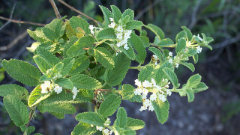
 |
|
XHUANX Creative Commons Attribution-Share Alike 3.0 |
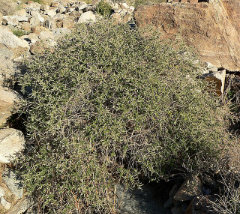 |
| Stan Shebs Creative Commons Attribution-Share Alike 3.0 |
Translate this page:
Summary
Oreganillo is primarily a tea and flavoring plant, with its leaves and flowers providing a refreshing, lemony-herbal infusion. Seeds are technically edible but taste unpleasant and should not be considered a food source. The plant is valued for its fragrance and flavoring qualities rather than for nutrition.
Physical Characteristics

 Aloysia wrightii is an evergreen Shrub growing to 3 m (9ft) by 3 m (9ft) at a medium rate.
See above for USDA hardiness. It is hardy to UK zone 9 and is not frost tender. The flowers are pollinated by Bees, Insects.
It is noted for attracting wildlife.
Suitable for: light (sandy) and medium (loamy) soils, prefers well-drained soil and can grow in nutritionally poor soil. Suitable pH: mildly acid, neutral and basic (mildly alkaline) soils and can grow in very alkaline soils.
It cannot grow in the shade. It prefers dry or moist soil and can tolerate drought.
UK Hardiness Map
US Hardiness Map
Synonyms
Homotypic Synonyms: Lippia wrightii A.Gray
Plant Habitats
Edible Uses
The leaves and flowers can be steeped to make an excellent tea. The flavor is fruity and lemon-like with an herbal overtone. The tea is bright green in color and aromatic, though bitterness may develop if too many leaves are used. Leaves and flowers can also be used as flavorings in desserts, beverages, or combined with fruit for seasoning [2-3]. The seeds are technically edible, but they have an unpleasant flavor and are not recommended. Raw or toasted seeds taste resinous, tar-like, and unpalatable. Boiling improves them slightly, but they remain unsuitable for consumption. Seeds are brown, easy to collect, and available in late autumn, but their lack of palatability makes them of no real food value[2-3]. Other parts of the shrub are inedible[2-3]..
References More on Edible Uses
Medicinal Uses
Plants For A Future can not take any responsibility for any adverse effects from the use of plants. Always seek advice from a professional before using a plant medicinally.
None Known
References More on Medicinal Uses
The Bookshop: Edible Plant Books
Our Latest books on Perennial Plants For Food Forests and Permaculture Gardens in paperback or digital formats.
Edible Tropical Plants
Food Forest Plants for Hotter Conditions: 250+ Plants For Tropical Food Forests & Permaculture Gardens.
More
Edible Temperate Plants
Plants for Your Food Forest: 500 Plants for Temperate Food Forests & Permaculture Gardens.
More
More Books
PFAF have eight books available in paperback and digital formats. Browse the shop for more information.
Shop Now
Other Uses
Wildlife: Excellent nectar plant for bees and butterflies, and often planted in xeriscapes.
Special Uses
References More on Other Uses
Cultivation details
It is a shrub and grows primarily in the desert or dry shrubland biome. Growing Conditions: Sun: Requires full sun for best growth and flowering. Soil: Thrives in well-drained sandy, gravelly, or rocky soils. Tolerates calcareous or alkaline conditions. Water: Very drought-tolerant once established. Occasional deep watering during drought will encourage flowering. Avoid waterlogged soils. Habitat: Naturally found in desert canyons, rocky slopes, washes, and dry foothills, often blooming after monsoon rains. Wildlife: Excellent nectar plant for bees and butterflies, and often planted in xeriscapes. Hardiness: Best suited for USDA zones 8–10. Tolerates brief frosts but is damaged by prolonged freezing below about -9 °C (15 °F). In colder zones it may die back to the ground, sometimes resprouting in spring if roots survive. Growth Rate: Moderate growth rate. In warm desert conditions with good sun, plants can put on about 30–60 cm (1–2 ft) of growth per year. It can reach 2–3 m (6–10 ft) in height over several years. Responds with a flush of new growth and flowering after seasonal rains. Aloysia wrightii has low weed potential. It does not aggressively spread outside its range and is not listed in invasive plant databases. Tends to stay localized in desert washes, slopes, and dry foothills.
References Carbon Farming Information and Carbon Sequestration Information
Temperature Converter
Type a value in the Celsius field to convert the value to Fahrenheit:
Fahrenheit:
The PFAF Bookshop
Plants For A Future have a number of books available in paperback and digital form. Book titles include Edible Plants, Edible Perennials, Edible Trees,Edible Shrubs, Woodland Gardening, and Temperate Food Forest Plants. Our new book is Food Forest Plants For Hotter Conditions (Tropical and Sub-Tropical).
Shop Now
Plant Propagation
Seed.
Other Names
If available other names are mentioned here
Oreganillo, Sonoran beebrush, Wright’s aloysia, mintbush lippa, or highmass (Aloysia wrightii (A. Gray) A. Heller = Lippa wrightii A. Gray).
Native Range
Arizona, California, Mexico Northeast, Mexico Northwest, New Mexico, Texas, Utah
Weed Potential
Right plant wrong place. We are currently updating this section.
Please note that a plant may be invasive in one area but may not in your area so it's worth checking.
Aloysia wrightii has low weed potential. Native to the Sonoran Desert and surrounding areas (Arizona, New Mexico, northern Mexico). It does not aggressively spread outside its range and is not listed in invasive plant databases. Tends to stay localized in desert washes, slopes, and dry foothills.
Conservation Status
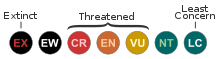
IUCN Red List of Threatened Plants Status : Not available
Growth: S = slow M = medium F = fast. Soil: L = light (sandy) M = medium H = heavy (clay). pH: A = acid N = neutral B = basic (alkaline). Shade: F = full shade S = semi-shade N = no shade. Moisture: D = dry M = Moist We = wet Wa = water.
Now available:
Food Forest Plants for Mediterranean Conditions
350+ Perennial Plants For Mediterranean and Drier Food Forests and Permaculture Gardens.
[Paperback and eBook]
This is the third in Plants For A Future's series of plant guides for food forests tailored to
specific climate zones. Following volumes on temperate and tropical ecosystems, this book focuses
on species suited to Mediterranean conditions—regions with hot, dry summers and cool, wet winters,
often facing the added challenge of climate change.
Read More
Expert comment
Author
(A. Gray) A. Heller
Botanical References
Links / References
For a list of references used on this page please go here
Readers comment
| Add a comment |
|
If you have important information about this plant that may help other users please add a comment or link below. Only comments or links that are felt to be directly relevant to a plant will be included. If you think a comment/link or information contained on this page is inaccurate or misleading we would welcome your feedback at [email protected]. If you have questions about a plant please use the Forum on this website as we do not have the resources to answer questions ourselves.
* Please note: the comments by website users are not necessarily those held by PFAF and may give misleading or inaccurate information.
|
Subject : Aloysia wrightii
|
|
|
|