 |
|
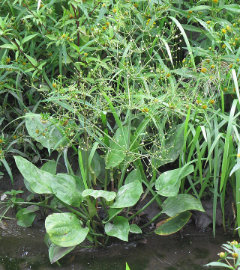
Ayotte, Gilles, 1948- Creative Commons Attribution-Share Alike 4.0 |
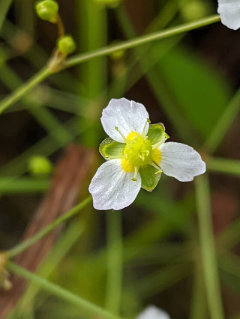 |
| Benoit Renaud Creative Commons Attribution 4.0 |
Translate this page:
Summary
Alisma triviale is the primary North American water-plantain: a shallow-water emergent with broad leaves and airy panicles, historically used as a cooked root crop in some traditions. Properly processed, its starchy rhizomes are edible; raw they are acrid. Compared with A. gramineum, it offers more biomass and clearer ethnobotanical support. USDA Zones roughly 3–8, height 30–90 cm. Northern water plantain produces starchy rhizomes that, when cooked, can be surprisingly mild and potato-like. They are easy to harvest from shallow mud and can be a good survival or supplementary food. Other parts (roots, leaves) are of little value.
Physical Characteristics

 Alisma triviale is a PERENNIAL growing to 0.6 m (2ft) by 0.3 m (1ft in) at a medium rate.
See above for USDA hardiness. It is hardy to UK zone 4 and is not frost tender. The flowers are pollinated by Bees, Insects.
It is noted for attracting wildlife.
Suitable for: light (sandy), medium (loamy) and heavy (clay) soils. Suitable pH: mildly acid, neutral and basic (mildly alkaline) soils. It cannot grow in the shade. It prefers moist or wet soil and can grow in water.
UK Hardiness Map
US Hardiness Map
Synonyms
Homotypic Synonyms: Alisma plantago-aquatica var. triviale (Pursh) Britton, Sterns & Poggenb.
Plant Habitats
Edible Uses
Edible Uses & Rating: The cooked rhizomes/tuberous bases are the principal edible; seeds are theoretically usable but tiny. With correct preparation, it merits an edibility rating of 3/5 as a secondary wetland starch. The rhizomes are the most valuable edible part. They resemble small potatoes in flavor and texture when cooked, with only a faint resinous note. Raw rhizomes are acrid and should not be eaten without cooking. They can be roasted, dried, and ground into a flour that is aromatic and nourishing. Rhizomes are best harvested in late autumn to early spring when carbohydrate content is highest [2-3]. The fibrous roots are less useful but can be chewed as a starchy gum. The leaf bases contain small amounts of starch and can be eaten, though with little caloric value. Other leaf parts are spongy, marshy in taste, and not digestible [2-3]. Taste, Processing & Kitchen Notes: Thoroughly boiled or roasted rhizomes lose much of their acridity and provide a mealy, starchy texture reminiscent of a slightly sharp potato or arrowhead. Incomplete cooking leaves a sharp, peppery burn. Roots can be sliced, leached, and then further cooked to improve flavor. Seasonality (Phenology): Vegetative growth in late spring; flowering mid-summer; seed and rhizome maturity late summer to autumn. Roots are best lifted in late season when starch is highest. Harvest & Processing Workflow: In late summer/autumn, dig rhizomes from firm stands, scrub clean, slice, leach in water if strongly acrid, then boil or roast until palatable. Seeds are rarely worth the effort. Look-Alikes & Confusion Risks: Can be confused with arrowhead (Sagittaria spp.) or other emergent aquatics. Confirm the characteristic Alisma inflorescence and fruiting pattern before use. Traditional/Indigenous Use Summary: Water-plantains were used in some Indigenous North American food systems as auxiliary starchy roots, always cooked; A. triviale is consistent with that pattern.
References More on Edible Uses
Medicinal Uses
Plants For A Future can not take any responsibility for any adverse effects from the use of plants. Always seek advice from a professional before using a plant medicinally.
None Known
References More on Medicinal Uses
The Bookshop: Edible Plant Books
Our Latest books on Perennial Plants For Food Forests and Permaculture Gardens in paperback or digital formats.
Edible Tropical Plants
Food Forest Plants for Hotter Conditions: 250+ Plants For Tropical Food Forests & Permaculture Gardens.
More
Edible Temperate Plants
Plants for Your Food Forest: 500 Plants for Temperate Food Forests & Permaculture Gardens.
More
More Books
PFAF have eight books available in paperback and digital formats. Browse the shop for more information.
Shop Now
Other Uses
Compared with A. gramineum, it offers more biomass and clearer ethnobotanical support. A useful emergent in wildlife ponds, forming modest clumps and providing structure without overwhelming most sites. Ecology & Wildlife: Provides cover and foraging habitat for amphibians, aquatic invertebrates, and some waterfowl. Flowers are visited by small flies and bees, providing limited insect-pollinated reproduction; some selfing occurs.
Special Uses
References More on Other Uses
Cultivation details
A historically relevant, modest wetland food plant: useful where abundant, but processing-intensive and habitat-limited. Identification & Habit: Plants form clumps of ovate to lanceolate basal leaves on long petioles, emerging from muddy shallows. Leaf blades are broader than in A. gramineum. Slender, branching scapes rise above, bearing many small white to pale lilac flowers with three petals. Fruits are rings of small, crescentic achenes. Habit is tufted and emergent along pond and ditch margins. Growing Conditions: Prefers sunny, shallow, slow or still water, soft mud, and clean conditions. Tolerates fluctuating water levels and cold winters (dies back to rootstock). Habitat & Range: Widespread in North American wetlands: ponds, marshes, ditches, backwaters, slow streams. Size & Landscape Performance: A useful emergent in wildlife ponds, forming modest clumps and providing structure without overwhelming most sites .Cultivation (Horticulture): Simple to grow in pond margins or bog gardens: plant pieces of rootstock in shallow mud; ensure at least several cm of water above crowns during growing season. Pests & Problems: Sensitive to herbicides, pollution, and habitat drainage. Otherwise robust. Cultivar/Selection Notes: No named varieties for food.
References Carbon Farming Information and Carbon Sequestration Information
Temperature Converter
Type a value in the Celsius field to convert the value to Fahrenheit:
Fahrenheit:
The PFAF Bookshop
Plants For A Future have a number of books available in paperback and digital form. Book titles include Edible Plants, Edible Perennials, Edible Trees,Edible Shrubs, Woodland Gardening, and Temperate Food Forest Plants. Our new book is Food Forest Plants For Hotter Conditions (Tropical and Sub-Tropical).
Shop Now
Plant Propagation
By seed sown in wet mud or by division of rhizomes/crowns in spring.
Other Names
If available other names are mentioned here
Alisma triviale (Mud or Northern Water Plantain). American Water-plantain.
Native Range
Alaska, Alberta, Arizona, British Columbia, California, Colorado, Connecticut, Idaho, Illinois, Indiana, Iowa, Kansas, Maine, Manitoba, Massachusetts, Mexico Northwest, Michigan, Minnesota, Montana, Nebraska, Nevada, New Brunswick, New Hampshire, New Mexico, New York, Newfoundland, North Dakota, Northwest Territories, Nova Scotia, Ohio, Oklahoma, Ontario, Oregon, Pennsylvania, Prince Edward I., Québec, Saskatchewan, South Dakota, Utah, Vermont, Washington, Wisconsin, Wyoming
Weed Potential
Right plant wrong place. We are currently updating this section.
Please note that a plant may be invasive in one area but may not in your area so it's worth checking.
Usually low to moderate. It can spread where conditions are ideal but is not typically a severe invasive compared with other aquatics.
Conservation Status
IUCN Red List of Threatened Plants Status : Predicted extinction risk: not threatened. Confidence: confident

| Related Plants
|
| Latin Name | Common Name | Habit | Height | Hardiness | Growth | Soil | Shade | Moisture | Edible | Medicinal | Other |
| Alisma canaliculatum | | Perennial | 0.8 |
5-9
| | LMH | N | WeWa | 1 | 0 | |
| Alisma gramineum | Ribbonleaf Water Plantain | Perennial | 0.5 |
4-8
| M | LMH | N | MWeWa | 2 | 0 | 1 |
| Alisma plantago-aquatica | Great Water Plantain, ZE-XIE, European water plantain, American water plantain, Northern water plan | Perennial | 0.9 |
5-9
| | LMH | N | WeWa | 1 | 3 | |
| Damasonium alisma | Thrumwort | Annual/Perennial | 0.3 |
6-9
| | LMH | SN | WeWa | 1 | 0 | |
| Limnocharis flava | Sawah Lettuce, Sawah Flowering Rush | Perennial | 0.6 |
10-12
| F | LMH | N | MWeWa | 4 | 0 | 3 |
| Sagittaria aginashi | | Perennial | 0.0 |
-
| | LMH | N | WeWa | 1 | 0 | |
| Sagittaria brevirosta | Short-Beaked Arrow Leaf | Perennial | 1.2 |
-
| | LMH | N | WeWa | 2 | 0 | |
| Sagittaria chapmanii | Chapman's arrowhead | Perennial | 0.5 |
-
| | LMH | N | WeWa | 0 | 0 | |
| Sagittaria cuneata | Wapato, arumleaf arrowhead | Perennial | 0.8 |
5-9
| | LMH | N | WeWa | 4 | 1 | |
| Sagittaria graminea | Chinese Arrowhead, Grassy Arrowhead, Weatherby's arrowhead | Annual/Perennial | 0.5 |
5-9
| | LMH | SN | WeWa | 1 | 0 | 0 |
| Sagittaria latifolia | Duck Potato, Broadleaf Arrowhead | Perennial | 1.2 |
6-9
| | LMH | N | WeWa | 5 | 1 | 0 |
| Sagittaria rigida | Sessile-Fruited Arrowhead | Perennial | 0.8 |
6-9
| | LMH | N | WeWa | 3 | 0 | |
| Sagittaria sagittifolia | Arrow Head, Hawaii arrowhead | Perennial | 1.0 |
6-9
| | LMH | N | WeWa | 5 | 1 | 0 |
| Sagittaria sagittifolia leucopetala | | Perennial | 1.0 |
-
| | LMH | SN | WeWa | 3 | 1 | |
| Sagittaria trifolia | Chinese Arrowroot, Threeleaf arrowhead | Perennial | 1.0 |
10-12
| | LMH | SN | WeWa | 4 | 2 | 0 |
|
Growth: S = slow M = medium F = fast. Soil: L = light (sandy) M = medium H = heavy (clay). pH: A = acid N = neutral B = basic (alkaline). Shade: F = full shade S = semi-shade N = no shade. Moisture: D = dry M = Moist We = wet Wa = water.
Now available:
Food Forest Plants for Mediterranean Conditions
350+ Perennial Plants For Mediterranean and Drier Food Forests and Permaculture Gardens.
[Paperback and eBook]
This is the third in Plants For A Future's series of plant guides for food forests tailored to
specific climate zones. Following volumes on temperate and tropical ecosystems, this book focuses
on species suited to Mediterranean conditions—regions with hot, dry summers and cool, wet winters,
often facing the added challenge of climate change.
Read More
Expert comment
Author
Pursh
Botanical References
Links / References
For a list of references used on this page please go here
Readers comment
| Add a comment |
|
If you have important information about this plant that may help other users please add a comment or link below. Only comments or links that are felt to be directly relevant to a plant will be included. If you think a comment/link or information contained on this page is inaccurate or misleading we would welcome your feedback at [email protected]. If you have questions about a plant please use the Forum on this website as we do not have the resources to answer questions ourselves.
* Please note: the comments by website users are not necessarily those held by PFAF and may give misleading or inaccurate information.
|
Subject : Alisma triviale
|
|
|
|