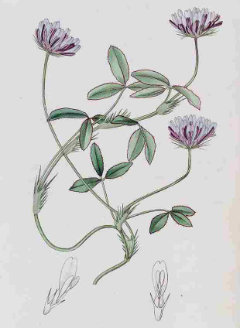
 |
|
edibleplants.org |
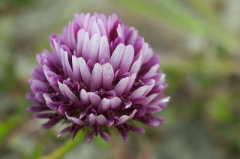 |
| Eric in SF Creative Commons Attribution-Share Alike 3.0 |
Translate this page:
Summary
Trifolium wormskioldii is a robust, herbaceous perennial plant with a creeping rootstock and branched, erect to creeping stems up to 80cm long; the plant can grow 10 - 30cm tall[71 , 277 ]. The plant was a favourite traditional food for the native peoples, and is still often harvested for local use. Cow clover (Trifolium wormskioldii) is a US native clover with edible leaves, flowers, seeds, and rhizomes, though all parts must be eaten with caution due to potentially harmful compounds. Historically used sparingly by Native Americans, it offers some food value but is not a major staple. USDA Zones 5–9; US native, not invasive.
Physical Characteristics

 Trifolium wormskioldii is a PERENNIAL growing to 1 m (3ft 3in) by 0.5 m (1ft 8in).
See above for USDA hardiness. It is hardy to UK zone 6 and is not frost tender. The flowers are pollinated by Insects. The plant is not self-fertile.
It can fix Nitrogen.
Suitable for: light (sandy), medium (loamy) and heavy (clay) soils and can grow in nutritionally poor soil. Suitable pH: mildly acid, neutral and basic (mildly alkaline) soils and can grow in very alkaline and saline soils.
It cannot grow in the shade. It prefers moist or wet soil.
UK Hardiness Map
US Hardiness Map
Synonyms
Accepted Infraspecifics: T. wormskioldii var. arizonicum (Greene) Barneby. T. wormskioldii var. longicaule (Wooton & Standl.) L.D.Benson. T. wormskioldii var. wormskioldii.
Plant Habitats
Edible Uses
Root - raw or cooked[61 , 105 , 118 , 257 ]. The long, fleshy, white rhizome was a very important food crop for several native North American tribes, who semi-cultivated the plant to ensure good yields every year[256 , 277 ]. The roots can be harvested at any time of the year and were normally dried before being cooked, though they were also occasionally eaten raw[256 ]. The dried root will store for a considerable period of time if it is kept in a cool place[256 ]. The native Americans considered the long horizontal rhizomes to be superior to the shorter taproots, and also considered that the best roots grew in soft sandy soils[256 ]. The rhizomes were commonly harvested and prepared together with the long, brown roots of Pacific silverweed (Potentilla anserinas ssp. pacifica). Both plants were usually dug in the autumn, after the leaves had started to die back for the winter. The rhizomes were pried out with long, pointed wooden digging sticks. They were cleaned and tied in fist-sized bundles using one of the rhizomes as a tie. Traditionally, they were cooked in an underground pit[277 ]. Leaves and flowers - raw[257 ]. Usually eaten raw with salt[257 ]. Often eaten in quantity, especially since it produces tender leaves later than most other species in the genus[1151 ]. The wilted, dry leaves have been soaked and stirred in cold water to make a sour drink[257 ]. Cow clover (Trifolium wormskioldii), also called slender clover, is a member of the sunflower family’s Artemisia genus. Like other clovers, it should be eaten with caution because the plant can contain harmful compounds such as nitrates, slaframine, cyanogenic glycosides (linamarin and lotaustralin), phytoestrogens, and saponins. These chemicals are especially dangerous to grazing livestock, but in small amounts, healthy fresh clover parts are usually tolerated by people. Wilted or discolored plants should never be eaten, and larger servings should always be cooked to reduce potential toxins. All clovers in this group have edible leaves, flowers, and seeds, while cow clover also provides edible rhizomes. Leaves and flowers can be eaten fresh in salads or cooked as potherbs. Fresh leaves range from mild to slightly bitter or acrid, sometimes with a soapy accent. Cooking improves safety and flavor, producing a bright emerald-green broth that works well in soups. The flowers can also be used in teas, which are considered pleasant. Seeds may be sprouted like alfalfa sprouts or prepared as mush, adding some nutritional variety. Despite these uses, clovers were rarely a major staple for Native Americans in the Southwest, though they were more commonly eaten in the western U.S. and Pacific Northwest. Foragers will find that clover plants are not especially productive, since each plant produces only a few leaves and flower heads, and grazing animals may heavily compete for them. Still, clovers can provide useful supplemental food when harvested carefully [2-3].
References More on Edible Uses
Medicinal Uses
Plants For A Future can not take any responsibility for any adverse effects from the use of plants. Always seek advice from a professional before using a plant medicinally.
None known
References More on Medicinal Uses
The Bookshop: Edible Plant Books
Our Latest books on Perennial Plants For Food Forests and Permaculture Gardens in paperback or digital formats.

Edible Tropical Plants
Food Forest Plants for Hotter Conditions: 250+ Plants For Tropical Food Forests & Permaculture Gardens.
More

Edible Temperate Plants
Plants for Your Food Forest: 500 Plants for Temperate Food Forests & Permaculture Gardens.
More
More Books
PFAF have eight books available in paperback and digital formats. Browse the shop for more information.
Shop Now
Other Uses
Nitrogen Fixer.
Special Uses
References More on Other Uses
Cultivation details
It is a perennial and grows primarily in the temperate biome. Succeeds in moist, well-drained, circum-neutral soil in full sun[200 ]. Succeeds in poor soils. Dividing the plant every 3 - 4 years maintains vigour and promotes new growth of roots[277 ]. Its native habitat is beaches to mountain meadows, growing in wet and periodically inundated places, such as high salt and brackish marshes, coastal dunes, wet meadows, and stream banks, generally in open, moist or marshy places; at elevations up to 3,200 metres[277 ]. This species produces fresh, tender leaves later into the summer than other edible species of Trifolium in western N. America[1151 ] This species has a symbiotic relationship with certain soil bacteria, which form nodules on the roots and fix atmospheric nitrogen. Some of this nitrogen is utilised by the growing plant but some can also be used by other plants growing nearby[200 ]. Buttercups growing nearby depress the growth of the nitrogen bacteria by means of a root exudate[201 ]. USDA Hardiness Zones: Generally thrives in Zones 5–9, especially in mountain meadow habitats. Weed/Invasiveness: Native to North America and considered a prime forage species rather than an invasive threat.
References Carbon Farming Information and Carbon Sequestration Information
Temperature Converter
Type a value in the Celsius field to convert the value to Fahrenheit:
Fahrenheit:
The PFAF Bookshop
Plants For A Future have a number of books available in paperback and digital form. Book titles include Edible Plants, Edible Perennials, Edible Trees,Edible Shrubs, Woodland Gardening, and Temperate Food Forest Plants. Our new book is Food Forest Plants For Hotter Conditions (Tropical and Sub-Tropical).
Shop Now
Plant Propagation
Pre-soak the seed for 12 hours in warm water and then sow in spring in situ. If the seed is in short supply it might be better to sow it in pots in a cold frame. When they are large enough to handle, prick the seedlings out into individual pots and plant them out after the last expected frosts. Division is easy. Preferably carried out in spring, though careful division at other times of the year generally work[K ].
Other Names
If available other names are mentioned here
Springbank Clover, Cow clover (Trifolium wormskioldii), Slender clover
Native Range
Native to: Arizona, California, Colorado, Mexico Central, Mexico Gulf, Mexico Northeast, Mexico Northwest, Mexico Southwest, Nevada, New Mexico, Oregon, Texas, Utah, Washington, Wyoming.
Weed Potential
Right plant wrong place. We are currently updating this section.
Please note that a plant may be invasive in one area but may not in your area so it's worth checking.
Native to North America and considered a prime forage species rather than an invasive threat.
Conservation Status
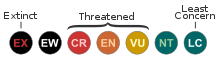
IUCN Red List of Threatened Plants Status : Not available
| Related Plants
|
| Latin Name | Common Name | Habit | Height | Hardiness | Growth | Soil | Shade | Moisture | Edible | Medicinal | Other |
| Trifolium bifidum | Piñole Clover, Notchleaf clover | Annual | 0.5 |
0-0
| | LMH | N | M | 2 | 0 | 3 |
| Trifolium ciliatum | Foothill Clover | Annual | 0.5 |
0-0
| | LMH | N | M | 2 | 0 | 3 |
| Trifolium cyathiferum | Cup Clover | Annual | 0.5 |
0-0
| | LMH | N | M | 1 | 0 | 2 |
| Trifolium dichotomum | Branched Indian Clover | Annual | 0.6 |
0-0
| | LMH | N | M | 2 | 0 | 2 |
| Trifolium dubium | Suckling Clover | Annual | 0.5 |
0-0
| | LMH | N | M | 0 | 1 | 3 |
| Trifolium fimbriatum | Springbank Clover, Cows clover | Perennial | 1.0 |
0-0
| | LMH | N | M | 3 | 0 | 2 |
| Trifolium fucatum | Sour Clover, Bull clover | Annual | 0.6 |
0-0
| | LMH | N | M | 2 | 0 | 2 |
| Trifolium fucatum virescens | | Annual | 0.6 |
0-0
| | LMH | N | M | 2 | 0 | 2 |
| Trifolium gracilentum | Pin-Point Clover, Palmer's clover | Annual | 0.6 |
0-0
| | LMH | N | M | 2 | 0 | 2 |
| Trifolium hybridum | Alsike Clover | Perennial | 0.6 |
0-0
| | LMH | N | M | 2 | 1 | 2 |
| Trifolium incarnatum | Crimson Clover | Annual | 0.5 |
3-9
| M | LMH | N | M | 2 | 0 | 4 |
| Trifolium lupinaster | Lupine clover | Perennial | 0.5 |
0-0
| | LMH | N | M | 1 | 0 | 2 |
| Trifolium macrocephalum | Bighead Clover, Largehead clover | Perennial | 0.3 |
4-8
| | LMH | N | M | 1 | 0 | 3 |
| Trifolium microcephalum | Smallhead Clover | Annual | 0.6 |
-
| | LMH | N | M | 1 | 0 | |
| Trifolium obtusiflorum | Clammy Clover | Annual | 1.0 |
0-0
| | LMH | N | M | 2 | 0 | 2 |
| Trifolium ornithopodioides | Birdsfoot Fenugreek, Bird clover | Annual/Perennial | 0.2 |
0-0
| | LMH | N | MWe | 1 | 0 | 3 |
| Trifolium pratense | Red Clover | Perennial | 0.6 |
5-9
| M | LMH | N | M | 3 | 3 | 4 |
| Trifolium repens | White Clover, Dutch Clover, Purple Dutch Clover, Shamrock, White Clover | Perennial | 0.1 |
4-8
| M | LMH | N | M | 3 | 2 | 4 |
| Trifolium subterraneum | Subterranean Clover | Annual | 0.2 |
7-10
| | LMH | N | M | 1 | 0 | 4 |
| Trifolium tridentatum | Tomcat Clover | Annual | 0.6 |
0-0
| | LMH | N | M | 2 | 0 | 2 |
| Trifolium variegatum | Whitetip Clover | Annual | 1.0 |
-
| | LMH | N | M | 1 | 0 | |
|
Growth: S = slow M = medium F = fast. Soil: L = light (sandy) M = medium H = heavy (clay). pH: A = acid N = neutral B = basic (alkaline). Shade: F = full shade S = semi-shade N = no shade. Moisture: D = dry M = Moist We = wet Wa = water.
Now available:
Food Forest Plants for Mediterranean Conditions
350+ Perennial Plants For Mediterranean and Drier Food Forests and Permaculture Gardens.
[Paperback and eBook]
This is the third in Plants For A Future's series of plant guides for food forests tailored to
specific climate zones. Following volumes on temperate and tropical ecosystems, this book focuses
on species suited to Mediterranean conditions—regions with hot, dry summers and cool, wet winters,
often facing the added challenge of climate change.
Read More
Expert comment
Author
Lehm.
Botanical References
Links / References
For a list of references used on this page please go here
A special thanks to Ken Fern for some of the information used on this page.
Readers comment
| Add a comment |
|
If you have important information about this plant that may help other users please add a comment or link below. Only comments or links that are felt to be directly relevant to a plant will be included. If you think a comment/link or information contained on this page is inaccurate or misleading we would welcome your feedback at [email protected]. If you have questions about a plant please use the Forum on this website as we do not have the resources to answer questions ourselves.
* Please note: the comments by website users are not necessarily those held by PFAF and may give misleading or inaccurate information.
|
Subject : Trifolium wormskioldii
|
|
|
|