 |
|
Joe Decruyenaere. Creative Commons Attribution-Share Alike 2.0 |
 |
| Dcrjsr. Creative Commons Attribution 4.0 |
Translate this page:
Summary
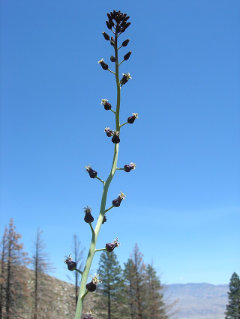
Hairy wild cabbage is a widespread Great Basin wild mustard with soft-hairy leaves and non-inflated stems. It was used by the Panamint Indians of California as a source of leaves, but like most wild cabbages it is a modest emergency resource rather than a desirable vegetable. Leaves can be eaten cooked and perhaps in small amounts raw, while seeds are theoretically edible but labour-intensive and poorly documented. The plant is adapted to dry, open habitats and shares the general caution of the genus: potential accumulation of salts and selenium and a need for moderation.
Physical Characteristics

 Streptanthus pilosus is a PERENNIAL growing to 1.2 m (4ft) by 0.4 m (1ft 4in) at a fast rate.
See above for USDA hardiness. It is hardy to UK zone 5. The flowers are pollinated by Bees, Insects.
It is noted for attracting wildlife.
Suitable for: light (sandy) and medium (loamy) soils, prefers well-drained soil and can grow in nutritionally poor soil. Suitable pH: mildly acid, neutral and basic (mildly alkaline) soils. It cannot grow in the shade. It prefers dry or moist soil and can tolerate drought.
UK Hardiness Map
US Hardiness Map
Synonyms
Caulanthus pilosus S.Watson, Thelypodium stamineum Eastw.
Plant Habitats
Edible Uses
Edible: cooked leaves (limited quantities), seeds in theory. Avoid: raw foliage in large amounts, plants from saline or contaminated sites, and heavy reliance on this species as a regular food. It is best presented as a minor, cautious addition rather than a recommended staple. Edible Uses & Rating: Documented edible parts are the leaves, used by the Panamint Indians, and possibly seeds by analogy with other Caulanthus species. As a vegetable, the leaves represent a low-ranking green: useful when little else is available, but not among the better wild mustards [2-3]. Overall rating might be 2/5 as a food plant: serviceable in lean times, otherwise overshadowed by more palatable options. Taste, Processing & Kitchen Notes: Specific tasting notes are sparse, but given the genus and the reported use by Panamint people, we can infer that leaves have a cabbage-like, mustardy flavour with some bitterness and perhaps a faint “alkaline desert” undertone. The soft hairs will add a slightly raspy mouthfeel unless well cooked. Boiling or stewing the leaves is the safest and most palatable preparation: it softens both texture and flavour, reduces any emetic potential and leaches out some of the harsher compounds. Seeds, if used, would likely function as a pungent spice or, when ground and cooked, a very modest grain substitute. Flowers and buds are not documented as edible but are likely similar to other wild cabbages: potentially edible when cooked but not especially pleasant. Seasonality (Phenology): Hairy wild cabbage grows through spring and early summer, with basal leaves appearing in early spring, stems elongating soon after, and flowering from roughly April to July depending on elevation and rainfall. Leaves are best collected before or during early flowering, while still turgid and green. By mid to late summer, plants dry down and persist as seed stalks [2-3]. Harvest & Processing Workflow: For leaves: in spring, locate vigorous plants with abundant basal foliage. Harvest younger, tender leaves from multiple plants. Rinse thoroughly, then boil in ample water until tender; discard the first cooking water if harshness is an issue, and season the cooked greens as desired. For seeds: allow siliques to mature and dry, then collect seed stalks and thresh. Given the limited yield and uncertain flavour, seed harvest is more of ethnobotanical interest than practical. Cultivar/Selection Notes: There are no cultivars or selection programmes for this species. Any culinary improvement would require long-term breeding from wild material, which is unlikely given its modest appeal. Look-Alikes & Confusion Risks: Hairy wild cabbage is most easily confused with thickstem wild cabbage and other Caulanthus species. Non-inflated stems and soft pilose leaves help distinguish it from C. crassicaulis, while overall habit and urn-shaped calyces separate it from typical Lepidium or other mustards. In Great Basin settings, careful attention to stem inflation, leaf hairiness and calyx features will reduce misidentification. Traditional/Indigenous Use Summary: Ethnobotanical notes indicate that the Panamint Indians used hairy wild cabbage as a source of leaves, presumably cooked as greens. There is no indication that it was a staple, but rather a supplementary plant known and used when available within a broader wild-greens repertoire.
References More on Edible Uses
Medicinal Uses
Plants For A Future can not take any responsibility for any adverse effects from the use of plants. Always seek advice from a professional before using a plant medicinally.
None Known
References More on Medicinal Uses
The Bookshop: Edible Plant Books
Our Latest books on Perennial Plants For Food Forests and Permaculture Gardens in paperback or digital formats.
Edible Tropical Plants
Food Forest Plants for Hotter Conditions: 250+ Plants For Tropical Food Forests & Permaculture Gardens.
More
Edible Temperate Plants
Plants for Your Food Forest: 500 Plants for Temperate Food Forests & Permaculture Gardens.
More
More Books
PFAF have eight books available in paperback and digital formats. Browse the shop for more information.
Shop Now
Other Uses
Ecology & Wildlife: The white, nectar-bearing flowers attract generalist insect pollinators such as native bees, flies and small beetles. As part of desert and Great Basin plant communities, it contributes to early-season nectar availability. It may also serve as a larval host for brassica-feeding insects and as occasional forage for browsing wildlife that have evolved tolerance for mustard compounds.
Special Uses
References More on Other Uses
Cultivation details
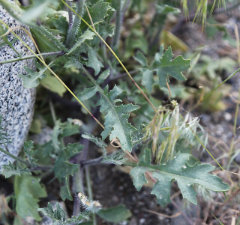
Growing Conditions: This species is adapted to dry, open sites throughout the Great Basin, including desert foothills, rocky slopes and open shrubland. It prefers full sun and well-drained, often sandy or gravelly soils, tolerating drought and nutrient-poor substrates. As with its congeners, it tends to reflect the chemistry of its soil, including any elevated salts. Habitat & Range: Hairy wild cabbage occurs widely across the Great Basin and adjacent arid regions. It is most often observed in open, sparsely vegetated landscapes, sometimes in association with sagebrush, saltbush or other desert shrubs but remaining a subordinate component of the flora. Size & Landscape Performance: Plants commonly reach 30–120 cm in height with a spread of about 20–40 cm. In a native garden it would be a medium-sized, somewhat wispy mustard with modest ornamental appeal. Its pilose foliage and urn-shaped flowers may interest native-plant enthusiasts but it is not showy. Likely hardiness is roughly USDA Zones 5–8. Cultivation (Horticulture): Hairy wild cabbage is rarely, if ever, cultivated intentionally. It could be grown from seed in a dry, sunny, reasonably poor soil, similar to other desert brassicas. Excessive moisture or rich soil may lead to lush but potentially more problematic growth (greater accumulation of unwanted compounds). For most gardeners, other brassicas or wildgreens will be superior choices. Pests & Problems: In natural settings, herbivory and environmental stress are the main limiting factors; the plant is generally resilient. In cultivation, flea beetles, aphids, or caterpillars might target the foliage, and poorly drained soil could encourage root diseases. Wind exposure is usually tolerated due to flexible stems. Cultivar/Selection Notes: There are no cultivars or selection programmes for this species. Any culinary improvement would require long-term breeding from wild material, which is unlikely given its modest appeal. Identification & Habit: Hairy wild cabbage is an upright, short-lived plant 30–120 cm tall, with one or more erect stems that are not inflated. Stems and leaves bear soft, unbranched hairs (pilose), giving the plant a slightly fuzzy appearance. Basal leaves are simple, oblanceolate and stalked, with pinnately cut margins and a soft-hairy surface. Upper leaves are similar but smaller and reduced, and they do not clasp the stems. Flowers are arranged in open racemes; sepals collectively form an urn-like tube, often densely hairy and sometimes non-green, enclosing white petals marked with darker highlights. Siliques are linear, cylindrical, 6–12 cm long, slightly curved and spreading, with brownish wingless seeds in a single row per valve.
References Carbon Farming Information and Carbon Sequestration Information
Temperature Converter
Type a value in the Celsius field to convert the value to Fahrenheit:
Fahrenheit:
The PFAF Bookshop
Plants For A Future have a number of books available in paperback and digital form. Book titles include Edible Plants, Edible Perennials, Edible Trees,Edible Shrubs, Woodland Gardening, and Temperate Food Forest Plants. Our new book is Food Forest Plants For Hotter Conditions (Tropical and Sub-Tropical).
Shop Now
Plant Propagation
Propagation is by seed. Mature siliques can be harvested when dry, then threshed. Seeds can be sown in autumn or early spring. There is no vegetative propagation via rhizomes; the species behaves as a short-lived herb depending on seed.
Other Names
If available other names are mentioned here
Caulanthus pilosus
Native Range
US. USA. California, Idaho, Nevada, Oregon, Utah
Weed Potential
Right plant wrong place. We are currently updating this section.
Please note that a plant may be invasive in one area but may not in your area so it's worth checking.
Within its native range, hairy wild cabbage can be a regular component of disturbed or open sites but is not generally viewed as a serious weed at the scale of agricultural systems. It is not known as a major invader outside its home region.
Conservation Status
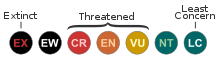
IUCN Red List of Threatened Plants Status : Not available
Growth: S = slow M = medium F = fast. Soil: L = light (sandy) M = medium H = heavy (clay). pH: A = acid N = neutral B = basic (alkaline). Shade: F = full shade S = semi-shade N = no shade. Moisture: D = dry M = Moist We = wet Wa = water.
Now available:
Food Forest Plants for Mediterranean Conditions
350+ Perennial Plants For Mediterranean and Drier Food Forests and Permaculture Gardens.
[Paperback and eBook]
This is the third in Plants For A Future's series of plant guides for food forests tailored to
specific climate zones. Following volumes on temperate and tropical ecosystems, this book focuses
on species suited to Mediterranean conditions—regions with hot, dry summers and cool, wet winters,
often facing the added challenge of climate change.
Read More
Expert comment
Author
(S.Watson) Jeps.
Botanical References
Links / References
For a list of references used on this page please go here
Readers comment
| Add a comment |
|
If you have important information about this plant that may help other users please add a comment or link below. Only comments or links that are felt to be directly relevant to a plant will be included. If you think a comment/link or information contained on this page is inaccurate or misleading we would welcome your feedback at [email protected]. If you have questions about a plant please use the Forum on this website as we do not have the resources to answer questions ourselves.
* Please note: the comments by website users are not necessarily those held by PFAF and may give misleading or inaccurate information.
|
Subject : Streptanthus pilosus
|
|
|
|