 |
|
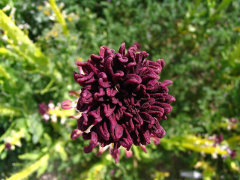
Jim Staley. Creative Commons Attribution-Share Alike 2.0 |
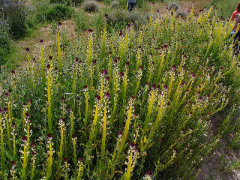 |
| Jim Staley. Creative Commons Attribution-Share Alike 2.0 |
Translate this page:
Summary
Desert candle is one of the most visually dramatic wild cabbages: a tall, bright yellow, inflated stem rising from the desert floor, topped with a spike of urn-shaped flower buds. Traditional sources report edible leaves, stems and seeds, and modern writers describe the plant as tasty, cabbage-like and suitable for stews. As with other Caulanthus, it can accumulate salts and selenium, so consumption should be moderate and site-selective. Among the wild cabbages it is arguably the most promising for flavour, but still a minor, opportunistic resource rather than a staple.
Physical Characteristics

 Streptanthus inflatus is a ANNUAL growing to 0.6 m (2ft) by 0.3 m (1ft in) at a fast rate.
See above for USDA hardiness. It is hardy to UK zone 8. The flowers are pollinated by Bees, Insects.
It is noted for attracting wildlife.
Suitable for: light (sandy) and medium (loamy) soils, prefers well-drained soil and can grow in nutritionally poor soil. Suitable pH: mildly acid, neutral and basic (mildly alkaline) soils. It cannot grow in the shade. It prefers dry or moist soil and can tolerate drought.
UK Hardiness Map
US Hardiness Map
Synonyms
Caulanthus inflatus S.Watson
Plant Habitats
Edible Uses
Edible Uses & Rating: Reported edible parts include the leaves and stems (fresh or cooked) and the seeds. Unlike thickstem wild cabbage, multiple sources describe desert candle as actually palatable and cabbage-like, with stems and leaves used in stews and as greens. The seeds are edible but small and labour-intensive. Overall, as a wild mustard it earns a higher rating than most of its congeners: perhaps 3/5 as a minor wild vegetable, again with the caveat of potential selenium accumulation [2-3]. Taste, Processing & Kitchen Notes: Desert candle’s leaves and stems have been described as tasty and reminiscent of cabbage, particularly when cooked. Young leaves can reportedly be eaten raw as a salad green in small quantities, though boiling or stewing is safer and softens both flavour and texture. The inflated stems provide a fleshy, mild, cabbage-like vegetable; chopped and simmered, they can form the base of a simple desert stew. Stems and leaves would likely respond well to a classic “greens and potatoes” type preparation. Seeds, if gathered, can be lightly toasted and used as a pungent seasoning or boiled into a porridge-like mush, though yield per plant is modest [2-3]. Seasonality (Phenology): As an annual, desert candle germinates following winter rains and grows rapidly in late winter and early spring. Flowering usually occurs from March to May, with seeds ripening soon afterward. Leaves and stems are at their best while the plant is actively growing and before the stems become woody or the plant begins to senesce. By early summer, plants have typically dried and turned to pale seed stalks [2-3]. Safety & Cautions (Food Use): Because Caulanthus (Streptanthus ) species can concentrate salts and selenium, desert candle should be eaten sparingly and never harvested from areas with known selenium contamination, tailings, or industrial soils. As with all wild mustards, moderate consumption and thorough cooking are prudent. Individuals with thyroid issues or sensitivity to brassica-type goitrogens should also treat it cautiously. Harvest & Processing Workflow: For leaves and stems: in early to mid-spring, identify healthy plants with turgid, fully expanded foliage and still-tender stems. Harvest a portion of the leaves and upper stem from multiple plants rather than stripping any one individual. Rinse thoroughly to remove dust, then chop and boil or stew until tender. For seeds: allow siliques to dry on the plants, then cut seed stalks into a container and thresh once dry. Given low yields, seed use is mainly for seasoning rather than bulk food. Look-Alikes & Confusion Risks: Desert candle is readily recognised among wild mustards by its tall, bright yellow, greatly inflated stem and urn-shaped calyces. Potential confusion might occur with thickstem wild cabbage or other Caulanthus in bud, but inflated yellow stems and clasping upper leaves are good field marks. Any Caulanthus in rare plant hotspots should be cross-checked with local floras to avoid collecting protected taxa.Traditional/Indigenous Use Summary: Ethnobotanical records indicate that desert candle was used by Native peoples of southern California as a source of greens and stew vegetables, with stems and leaves gathered and cooked. Seeds have also been cited as edible, though specific preparation methods are less well documented. It appears as a minor but recognised plant in traditional food repertoires, valued when available but not a staple.
References More on Edible Uses
Medicinal Uses
Plants For A Future can not take any responsibility for any adverse effects from the use of plants. Always seek advice from a professional before using a plant medicinally.
None Known
References More on Medicinal Uses
The Bookshop: Edible Plant Books
Our Latest books on Perennial Plants For Food Forests and Permaculture Gardens in paperback or digital formats.
Edible Tropical Plants
Food Forest Plants for Hotter Conditions: 250+ Plants For Tropical Food Forests & Permaculture Gardens.
More
Edible Temperate Plants
Plants for Your Food Forest: 500 Plants for Temperate Food Forests & Permaculture Gardens.
More
More Books
PFAF have eight books available in paperback and digital formats. Browse the shop for more information.
Shop Now
Other Uses
In a native garden it would be a striking annual accent, especially en masse in a dry, sandy bed. Desert candle is simultaneously a botanical curiosity and a modest edible wild mustard, notable for its inflated yellow “candle” stem and its reported palatability. It fits well as a visually striking wild vegetable of desert and Mojave conditions, with clear notes on limitations and safe use. Ecology & Wildlife: The white, tubular flowers and colourful sepals attract a suite of insect pollinators, including bees, small beetles and flies typical of desert mustard communities. The nectar in the tubular flowers serves both insects and possibly bats or moths, although primary pollinators are insects. In its native communities, desert candle contributes to the brief but important spring bloom that supports early-season pollinators.
Special Uses
References More on Other Uses
Cultivation details
Growing Conditions: Desert candle is adapted to sandy or gravelly soils in deserts and dry hills, especially in central California and the western Mojave. It requires full sun, tolerates drought, and benefits from winter/early spring precipitation. Soils are often low in organic matter but may be high in mineral content; as with other wild cabbages, it can concentrate soil-borne salts and selenium. Habitat & Range. The species occurs in central California and the western Mojave Desert, typically in open, sparsely vegetated desert scrub, washes, and gentle slopes. It is more frequent in intact desert landscapes than in heavily developed valleys. Size & Landscape Performance: Desert candle usually reaches 30–60 cm in height, with a narrow spread of 10–30 cm. In a native garden it would be a striking annual accent, especially en masse in a dry, sandy bed. Hardiness is approximately USDA Zones 7–9, mirroring its Mojave/central California distribution, though it could be grown as a cool-season annual in similar climates. Cultivation (Horticulture): Although not widely cultivated, desert candle could be grown from seed in a well-drained sandy soil with full sun and minimal irrigation once established. Fall or winter sowing in mild climates would mimic natural germination patterns. Over-watering or rich soils may produce rank growth and potentially higher accumulation of unwanted compounds; a lean, low-fertility regime is more appropriate. Pests & Problems: Like other mustards, desert candle may experience some herbivory by caterpillars or beetles, and siliques may be attacked by seed-feeding insects. In cultivation, the main “problems” would be damping-off in poorly drained soils or lodging in strong winds if plants become etiolated in too-rich ground. Cultivar/Selection Notes: No named cultivars exist. The species is uniform enough that selection for food would be starting from scratch; given its wild, stress-tolerant character, flavour improvement would likely be slow. Identification & Habit: Desert candle is an upright annual, about 30–60 cm tall, with a striking, greatly inflated central stem that is often bright yellow and smooth. The stem resembles a candle or narrow lantern, tapering somewhat toward the top and hollow inside. Basal leaves are simple, oblanceolate to lance-ovate, with entire or finely toothed margins and hairless surfaces; upper leaves are similar but smaller and clasp the inflated stem. The inflorescence is a spike-like raceme of non-green, urn-shaped sepals surrounding white petals. Seedpods are slender, cylindrical siliques 6–10 cm long, ascending from the upper stem. From a distance, a stand of desert candles looks like a scattering of yellow tapers across the sandy Mojave landscape.
References Carbon Farming Information and Carbon Sequestration Information
Temperature Converter
Type a value in the Celsius field to convert the value to Fahrenheit:
Fahrenheit:
The PFAF Bookshop
Plants For A Future have a number of books available in paperback and digital form. Book titles include Edible Plants, Edible Perennials, Edible Trees,Edible Shrubs, Woodland Gardening, and Temperate Food Forest Plants. Our new book is Food Forest Plants For Hotter Conditions (Tropical and Sub-Tropical).
Shop Now
Plant Propagation
Propagation is by seed. Ripe siliques can be collected once dry, then threshed to release small brown seeds. Sown directly in fall or early spring in situ, they should germinate with cool, moist conditions followed by warming. There is no vegetative propagation in this annual species.
Other Names
If available other names are mentioned here
Desert Candle (Caulanthus inflatus)
Native Range
US. USA. California
Weed Potential
Right plant wrong place. We are currently updating this section.
Please note that a plant may be invasive in one area but may not in your area so it's worth checking.
Desert candle is not generally considered a serious weed. It is a native annual that can appear in abundance after favourable rains but does not typically dominate or invade away from its natural range. It is unlikely to become a problem in gardens so long as seed set is not excessive.
Conservation Status
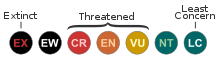
IUCN Red List of Threatened Plants Status : Not available
Growth: S = slow M = medium F = fast. Soil: L = light (sandy) M = medium H = heavy (clay). pH: A = acid N = neutral B = basic (alkaline). Shade: F = full shade S = semi-shade N = no shade. Moisture: D = dry M = Moist We = wet Wa = water.
Now available:
Food Forest Plants for Mediterranean Conditions
350+ Perennial Plants For Mediterranean and Drier Food Forests and Permaculture Gardens.
[Paperback and eBook]
This is the third in Plants For A Future's series of plant guides for food forests tailored to
specific climate zones. Following volumes on temperate and tropical ecosystems, this book focuses
on species suited to Mediterranean conditions—regions with hot, dry summers and cool, wet winters,
often facing the added challenge of climate change.
Read More
Expert comment
Author
(S.Watson) Greene
Botanical References
Links / References
For a list of references used on this page please go here
Readers comment
| Add a comment |
|
If you have important information about this plant that may help other users please add a comment or link below. Only comments or links that are felt to be directly relevant to a plant will be included. If you think a comment/link or information contained on this page is inaccurate or misleading we would welcome your feedback at [email protected]. If you have questions about a plant please use the Forum on this website as we do not have the resources to answer questions ourselves.
* Please note: the comments by website users are not necessarily those held by PFAF and may give misleading or inaccurate information.
|
Subject : Streptanthus inflatus
|
|
|
|