 |
|
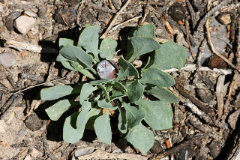
Patrick Alexander from Las Cruces, NM. Creative Commons Zero, Public Domain Dedication |
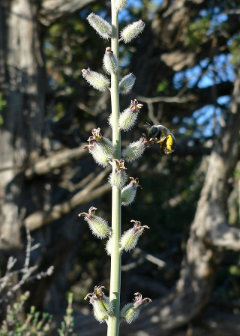 |
| Stan Shebs. Creative Commons Attribution-Share Alike 3.0 |
Translate this page:
Summary
Thickstem wild cabbage is a distinctive Great Basin mustard with inflated, dusty stems and urn-shaped flowers that give it a very “desert cabbage” look. Edible potential is mixed: the young stems are fair-quality emergency vegetables with a mild, cabbage-like flavour, while the leaves and flower buds are strongly emetic when raw and remain unpleasant even after cooking. As a food plant, it is strictly a survival resource rather than a staple, though it has a cultural history with Native groups in southern California. It is adapted to barren, alkaline slopes and desert grasslands, largely insect-pollinated, and is capable of concentrating salts and potentially toxic elements from the soil. Caulanthus crassicaulis (Torr.) S.Watson is a synonym of Streptanthus crassicaulis.
Physical Characteristics

 Streptanthus crassicaulis is a PERENNIAL growing to 0.8 m (2ft 7in) by 0.3 m (1ft) at a medium rate.
See above for USDA hardiness. It is hardy to UK zone 6. The flowers are pollinated by Bees, Insects.
It is noted for attracting wildlife.
Suitable for: light (sandy), medium (loamy) and heavy (clay) soils, prefers well-drained soil and can grow in nutritionally poor soil. Suitable pH: mildly acid, neutral and basic (mildly alkaline) soils. It cannot grow in the shade. It prefers dry or moist soil and can tolerate drought. The plant can tolerates strong winds but not maritime exposure.
UK Hardiness Map
US Hardiness Map
Synonyms
Caulanthus crassicaulis (Torr.) S.Watson
Plant Habitats
Edible Uses
Edible Uses & Rating: Edible parts include the young stems and, with much more caution, the seeds. The leaves and flower buds are technically edible after cooking but are unpleasant and can be emetic. As a foraging resource, thickstem wild cabbage rates low to moderate: the stems can provide some calories and a vaguely familiar, cabbage-like vegetable in very lean times, while leaves and seeds are at best marginal [2-3]. Overall rating: 2/5 as a food plant, 3/5 as an “emergency/curiosity” plant for experienced foragers. Taste, Processing & Kitchen Notes: Young stems are the best-tasting part. When fresh and tender they have a mild cabbage flavour with an underlying alkaline “desert” overtone; the texture is stringy but the fibres are weak enough to chew through, and the thin fleshy layer around the hollow centre can be reasonably pleasant. Cooking improves both flavour and texture, softening the fibres slightly and muting the odd mineral note, although it never becomes as agreeable as garden brassicas. In contrast, the leaves and buds taste harsh, unpleasant and strongly emetic when raw, with a nauseating bitterness and “off” cabbage character that lingers. Even with thorough boiling the leaves remain unappealing. Seeds are small, spice-like and mustardy, but not well enough documented or pleasant to recommend as a regular seasoning. Seasonality (Phenology): Basal leaves emerge early in spring, often as early as March. Stems thicken and elongate soon afterward, with flowering primarily from April to July and seeds ripening from June into September,, depending on elevation and seasonal moisture. Stems are at their best when still elongating and before flowering is fully underway. Older stems become more fibrous and less palatable, and by late summer the plants are mostly dry seed stalks [2-3]. Safety & Cautions (Food Use): The most important cautions are: Leaves (and likely buds) are strongly emetic when raw, and even cooked they are unpleasant and potentially upsetting to the stomach. As with other wild cabbages, plants can accumulate salts, nitrates and potentially selenium or metals from the soil; consumption should be occasional and in modest quantities, never from contaminated sites. People with sensitive digestion should treat this strictly as a survival food and not as a regular vegetable. Harvest & Processing Workflow: For stems, the best approach is to identify healthy plants in early spring when stems are expanding but before full flowering. Cut the tender upper stem portions, peel or trim tough outer tissue if needed, chop, and boil or stew until palatable. For seeds, allow siliques to fully mature and dry on the plant, then cut entire seed stalks into a container, dry further if necessary, and thresh. Given the small seed size and modest caloric return, seed harvest is mostly of ethnobotanical interest rather than practical food gathering. Look-Alikes & Confusion Risks: Thickstem wild cabbage is part of a complex Caulanthus–Streptanthus group. Key look-alikes include other Caulanthus species and some Streptanthus with urn-shaped calyces. The strongly inflated stems, dusty lower stem coating and the general Great Basin distribution are helpful clues for C. crassicaulis. Care should be taken not to confuse it with rare or protected Caulanthus species in California and Nevada, particularly in botanically sensitive areas. Traditional/Indigenous Use Summary: Wild cabbages in the Caulanthus group were used mainly by Native Americans in southern California, but they were never major staples. Reports mention use of leaves and sometimes seeds as supplementary greens or emergency food, always with the understanding that these were minor, sometimes unpleasant resources. Thickstem wild cabbage appears in this context as a marginal but known plant that could supplement diets in lean times.
References More on Edible Uses
Medicinal Uses
Plants For A Future can not take any responsibility for any adverse effects from the use of plants. Always seek advice from a professional before using a plant medicinally.
None Known
References More on Medicinal Uses
The Bookshop: Edible Plant Books
Our Latest books on Perennial Plants For Food Forests and Permaculture Gardens in paperback or digital formats.
Edible Tropical Plants
Food Forest Plants for Hotter Conditions: 250+ Plants For Tropical Food Forests & Permaculture Gardens.
More
Edible Temperate Plants
Plants for Your Food Forest: 500 Plants for Temperate Food Forests & Permaculture Gardens.
More
More Books
PFAF have eight books available in paperback and digital formats. Browse the shop for more information.
Shop Now
Other Uses
Ecology & Wildlife: As a flowering mustard, it supports a suite of pollinating insects: small native bees, hoverflies and other generalist pollinators visit the purple flowers for nectar and pollen. As a partial stress-tolerant component of desert plant communities, it contributes to floral resources in otherwise sparse areas. It may also serve as a host for specialist brassica-feeding insects.
Special Uses
References More on Other Uses
Cultivation details
Growing Conditions: Thickstem wild cabbage is adapted to harsh, open, often alkaline or gravelly soils. It tolerates full sun, drought, wind and large temperature swings, and appears in disturbed or naturally sparse vegetation. It does not require rich soil and actually reflects the nutrient and mineral profile of the substrate, including elevated salts or selenium. In a cultivation setting, it would behave as a hardy, drought-tolerant perennial of poor soils; over-fertilisation is unnecessary and may exacerbate the accumulation of undesirable compounds. Habitat & Range: This species is characteristic of barren slopes, washes and open desert or Great Basin shrublands from California and Nevada eastward into Utah, northern Arizona and New Mexico. It is most often encountered in the interior West in dry valleys and foothills, sometimes scattered among sagebrush or other low shrubs, sometimes on almost bare, rocky ground. Size & Landscape Performance: Plants typically range from 10–80 cm tall, with a single inflated stem or a few stems from the taproot; spread is usually 10–30 cm across. As a landscape plant it is visually interesting but not highly ornamental outside of native or desert restoration schemes. Its inflated stems and purple flowers can provide seasonal interest in a wild desert garden. Approximate hardiness is around USDA Zones 5–8, depending on provenance, with best performance in arid to semi-arid climates. Cultivation (Horticulture): Thickstem wild cabbage is not usually cultivated intentionally, but in principle it can be grown from seed in well-drained, lean, sandy or gravelly soil in full sun. Fall or early spring sowing would mimic natural cycles; cold stratification may help germination. Once established, it requires little care beyond occasional watering in very dry sites. Because it can accumulate salts and potentially toxic metals, any attempted cultivation for food should avoid contaminated soils, mine spoils, or heavily fertilised ground. Pests & Problems: In the wild, the main “issues” are herbivory by insects and occasional disease, but these rarely threaten the population. In cultivation, flea beetles or other brassica pests might feed on the foliage, and the inflated stems could be susceptible to mechanical damage from wind or animals. Fungal diseases can occur in poorly drained soils, but the plant’s natural preference is for well-drained, dry conditions. Cultivar/Selection Notes: There are no known cultivars or selected food forms of thickstem wild cabbage. It remains a wild, unselected species with considerable variability in stem thickness, leaf harshness and phenology between populations. Identification & Habit: Thickstem wild cabbage is an upright perennial, usually 10–80 cm tall, emerging from a taproot and forming one or several thick, hollow stems. The stems are often strikingly swollen (inflated), especially in the lower portion, with a dusty, glaucous or whitish coating and usually hairless surfaces. Basal leaves are simple, pinnately lobed, dusty and hairless, while upper leaves are narrow, linear and not clasping the stem. The inflorescences are spike-like racemes of urn-shaped calyces that are often non-green and hairy, each enclosing purple petals typical of the mustard family. Seedpods are long, narrow siliques 7–14 cm long, nearly cylindrical, spreading to ascending at maturity, and filled with one row of brownish wingless seeds per valve.
References Carbon Farming Information and Carbon Sequestration Information
Temperature Converter
Type a value in the Celsius field to convert the value to Fahrenheit:
Fahrenheit:
The PFAF Bookshop
Plants For A Future have a number of books available in paperback and digital form. Book titles include Edible Plants, Edible Perennials, Edible Trees,Edible Shrubs, Woodland Gardening, and Temperate Food Forest Plants. Our new book is Food Forest Plants For Hotter Conditions (Tropical and Sub-Tropical).
Shop Now
Plant Propagation
Propagation is primarily by seed. Collect dry siliques in late summer, thresh to release the small brown seeds and sow them in place or in a nursery bed. Vegetative propagation is not practical; the species does not normally form rhizomes or offsets. Seeds likely have some innate dormancy but should germinate readily with cool, moist conditions followed by warming.
Other Names
If available other names are mentioned here
Thickstem Wild Cabbage (Caulanthus crassicaulis)
Native Range
US. USA. Arizona, California, Colorado, Idaho, Nevada, Oregon, Utah, Wyoming
Weed Potential
Right plant wrong place. We are currently updating this section.
Please note that a plant may be invasive in one area but may not in your area so it's worth checking.
Compared to many Brassicaceae, thickstem wild cabbage is not a major agricultural weed, but in its native and natural range it is a persistent inhabitant of open, poor soils. It can maintain local populations without cultivation but is not typically aggressively invasive in the same way as Sahara mustard or hoarycress.
Conservation Status
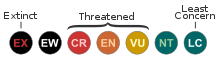
IUCN Red List of Threatened Plants Status : Not available
Growth: S = slow M = medium F = fast. Soil: L = light (sandy) M = medium H = heavy (clay). pH: A = acid N = neutral B = basic (alkaline). Shade: F = full shade S = semi-shade N = no shade. Moisture: D = dry M = Moist We = wet Wa = water.
Now available:
Food Forest Plants for Mediterranean Conditions
350+ Perennial Plants For Mediterranean and Drier Food Forests and Permaculture Gardens.
[Paperback and eBook]
This is the third in Plants For A Future's series of plant guides for food forests tailored to
specific climate zones. Following volumes on temperate and tropical ecosystems, this book focuses
on species suited to Mediterranean conditions—regions with hot, dry summers and cool, wet winters,
often facing the added challenge of climate change.
Read More
Expert comment
Author
Torr. & A.Gray
Botanical References
Links / References
For a list of references used on this page please go here
Readers comment
| Add a comment |
|
If you have important information about this plant that may help other users please add a comment or link below. Only comments or links that are felt to be directly relevant to a plant will be included. If you think a comment/link or information contained on this page is inaccurate or misleading we would welcome your feedback at [email protected]. If you have questions about a plant please use the Forum on this website as we do not have the resources to answer questions ourselves.
* Please note: the comments by website users are not necessarily those held by PFAF and may give misleading or inaccurate information.
|
Subject : Streptanthus crassicaulis
|
|
|
|