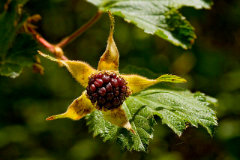
 |
|
Patrick Alexander from Las Cruces, NM Creative Commons Zero, Public Domain Dedication |
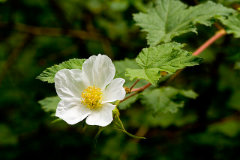 |
| Patrick Alexander from Las Cruces, NM Creative Commons Zero, Public Domain Dedication |
Translate this page:
Summary
Rubus neomexicanus is a deciduous shrub producing a cluster of erect, unarmed stems 200 - 300cm tall from a woody rootstock[270 ]. The plant is harvested from the wild for local use as food. New Mexico raspberry is a thornless, mountain-dwelling raspberry producing purple fruits of moderate quality. Its fruits are reasonably sweet and tart, though not as flavorful as some other raspberries. Harvest is best in summer before fruits dry out. While not the highest-quality species in the genus, it is a reliable and useful wild food, with the added benefit of being easy to handle thanks to its lack of thorns. The distinction between Rubus deliciosus and Rubus neomexicanus is unclear, especially when the former has more narrowly obtuse lobes and denser leaf abaxial hairs. Rubus deliciosus is also similar to Rubus bartonianus of Idaho and Oregon, as well as the Mexican Rubus trilobus Seringe. It might be reasonable to recognize a broader concept of Rubus deliciosus, one containing multiple infraspecific. Rubus deliciosus and its close relatives require a revisionary study[270 ]. The genus Rubus (especially the blackberries, often loosely referred to as Rubus fruticosus agg.) presents some of the most difficult taxonomic problems. This is partly due to the frequency of polyploidy, the frequent occurrence of hybridization, and apomixis, where minor differences between plants are preserved because seedlings are genetically identical to their parent. As a result, differences of opinion on the number of species to be recognized from a given region can vary tremendously (for example, a treatment by M. L. Fernald[43 ] in 1950 recognized 205 species for the northern half of the eastern United States plus parts of southeastern Canada, whilst H. A. Gleason and A. Cronquist in 1991 recognized only 25)[270 ]. Where possible, a relatively conservative approach is taken here[K ].
Physical Characteristics

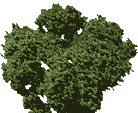 Rubus deliciosus var. neomexicanus is a deciduous Shrub growing to 2 m (6ft) by 1.5 m (5ft) at a fast rate.
See above for USDA hardiness. It is hardy to UK zone 6 and is not frost tender. The flowers are pollinated by Insects.
It is noted for attracting wildlife.
Suitable for: light (sandy), medium (loamy) and heavy (clay) soils and prefers well-drained soil. Suitable pH: mildly acid, neutral and basic (mildly alkaline) soils. It can grow in semi-shade (light woodland) or no shade. It prefers moist soil.
UK Hardiness Map
US Hardiness Map
Synonyms
Homotypic Synonyms: Oreobatus deliciosus subsp. neomexicanus (A.Gray) W.A.Weber. Oreobatus neomexicanus (A.Gray) Rydb. R. neomexicanus A.Gray. Heterotypic Synonyms: Oreobatus rubicundus Wooton & Standl. R. exrubicundus L.H.Bailey. R. rubicundus (Wooton & Standl.) Tidestr.
Plant Habitats
Edible Uses
Fruit - raw or cooked. The red, hemispherical fruit is up to 10mm wide[270 ]. Edible Uses & Caution: Like all members of the Rubus genus, New Mexico raspberry produces edible fruits. The fruits are aggregates of drupelets, commonly called raspberries or blackberries. They are safe to eat raw or cooked and have been gathered across North America since ancient times [2-3]. Food Potential: New Mexico raspberry produces purple fruits that are slightly sweet and slightly tart. The quality is considered moderate compared to other raspberries. The shrubs themselves are noteworthy for being long-lived and completely thornless, which is unusual for the genus. Fruits normally ripen between June and August, with the possibility of a second crop after summer rains, extending the season by several weeks. Beyond maturity, the fruits dry out, become mostly seeds, and fall to the ground, so harvesting is best done promptly [2-3]. The flavor is reasonably pleasant—sweet enough with a mild tartness—and the seeds are fairly soft when the fruits mature, though not delicately crunchy. The fruits are best eaten fresh, but they can also be dried for later use, though their seedy nature makes them less suited for processing into jams compared to cultivated raspberries [2-3].
References More on Edible Uses
Medicinal Uses
Plants For A Future can not take any responsibility for any adverse effects from the use of plants. Always seek advice from a professional before using a plant medicinally.
None known
References More on Medicinal Uses
The Bookshop: Edible Plant Books
Our Latest books on Perennial Plants For Food Forests and Permaculture Gardens in paperback or digital formats.
Edible Tropical Plants
Food Forest Plants for Hotter Conditions: 250+ Plants For Tropical Food Forests & Permaculture Gardens.
More
Edible Temperate Plants
Plants for Your Food Forest: 500 Plants for Temperate Food Forests & Permaculture Gardens.
More
More Books
PFAF have eight books available in paperback and digital formats. Browse the shop for more information.
Shop Now
Other Uses
References More on Other Uses
Cultivation details
Easily grown in a good, well-drained, loamy soil in sun or semi-shade[1, 11, 200 ]. Plants in this genus are notably susceptible to honey fungus[200 ]. USDA Hardiness Zone: 5–9. Weed Potential: Low – New Mexico raspberry is a native species and not invasive. It integrates well into local ecosystems and provides food for wildlife as well as humans.
References Carbon Farming Information and Carbon Sequestration Information
Temperature Converter
Type a value in the Celsius field to convert the value to Fahrenheit:
Fahrenheit:
The PFAF Bookshop
Plants For A Future have a number of books available in paperback and digital form. Book titles include Edible Plants, Edible Perennials, Edible Trees,Edible Shrubs, Woodland Gardening, and Temperate Food Forest Plants. Our new book is Food Forest Plants For Hotter Conditions (Tropical and Sub-Tropical).
Shop Now
Plant Propagation
Seed - requires stratification and is best sown in early autumn in a cold frame. Stored seed requires one month stratification at about 3°c and is best sown as early as possible in the year. Prick out the seedlings when they are large enough to handle and grow on in a cold frame. Plant them out into their permanent positions in late spring of the following year. Cuttings of half-ripe wood, mid summer in a frame[200 ]. Tip layering in July. Plant out in autumn. Division in early spring or just before leaf-fall in the autumn[200 ].
Other Names
If available other names are mentioned here
New Mexico Raspberry (Rubus neomexicanus A. Gray)
Native Range
Native to: Arizona, Colorado, Mexico Northeast, Mexico Northwest, New Mexico, Utah.
Weed Potential
Right plant wrong place. We are currently updating this section.
Please note that a plant may be invasive in one area but may not in your area so it's worth checking.
Low – New Mexico raspberry is a native species and not invasive. It integrates well into local ecosystems and provides food for wildlife as well as humans.
Conservation Status
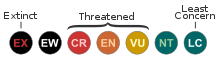
IUCN Red List of Threatened Plants Status : Not available
Growth: S = slow M = medium F = fast. Soil: L = light (sandy) M = medium H = heavy (clay). pH: A = acid N = neutral B = basic (alkaline). Shade: F = full shade S = semi-shade N = no shade. Moisture: D = dry M = Moist We = wet Wa = water.
Now available:
Food Forest Plants for Mediterranean Conditions
350+ Perennial Plants For Mediterranean and Drier Food Forests and Permaculture Gardens.
[Paperback and eBook]
This is the third in Plants For A Future's series of plant guides for food forests tailored to
specific climate zones. Following volumes on temperate and tropical ecosystems, this book focuses
on species suited to Mediterranean conditions—regions with hot, dry summers and cool, wet winters,
often facing the added challenge of climate change.
Read More
Expert comment
Author
(A.Gray) Kearney
Botanical References
Links / References
For a list of references used on this page please go here
A special thanks to Ken Fern for some of the information used on this page.
Readers comment
| Add a comment |
|
If you have important information about this plant that may help other users please add a comment or link below. Only comments or links that are felt to be directly relevant to a plant will be included. If you think a comment/link or information contained on this page is inaccurate or misleading we would welcome your feedback at [email protected]. If you have questions about a plant please use the Forum on this website as we do not have the resources to answer questions ourselves.
* Please note: the comments by website users are not necessarily those held by PFAF and may give misleading or inaccurate information.
|
Subject : Rubus deliciosus var. neomexicanus
|
|
|
|