 |
|
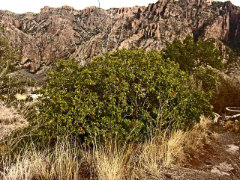
Homer Edward Price Creative Commons Attribution 2.0 |
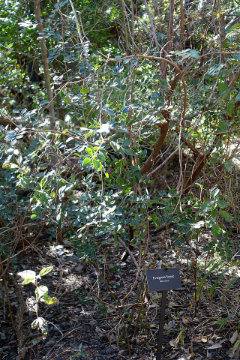 |
| Daderot Creative Commons Zero, Public Domain Dedication |
Translate this page:
Summary
Rhus virens is an evergreen shrub with a rounded form and spreading branches; it can grow up to 3.5 metres tall. The lower branches often touch the ground[149 ]. Although an evergreen, the leaves easily turn a maroon colour with the onset of cold in the winter and then fall just before the new leaves appear in spring[423 ]. The plant is harvested from the wild for local use as a food, medicine, and source of materials. Evergreen sumac produces sweet-tart fruits ideal for refreshing drinks, much like other sumac species. It’s a good but less reliable wild food in the Southwest, with productivity varying by rainfall. Despite its unpredictability, it remains a useful native plant and a traditional food resource. There has been considerable uncertainty amongst botanists as to the best way of treating the genus Rhus, with some viewing it in a strict sense as comprising around 35 species and electing to separate the other species into several distinct genera, whilst others prefer to view the genus in a looser sense being comprised of perhaps 250 species grouped into several subgenera. The genus is treated here in its strict sense, with many other species that have at times been included here being moved to the genera Cotinus, Searsia and Toxicodendron.
Physical Characteristics

 Rhus virens is an evergreen Tree growing to 3.5 m (11ft) by 3.5 m (11ft).
See above for USDA hardiness. It is hardy to UK zone 8 and is not frost tender. The flowers are pollinated by Bees. The plant is not self-fertile.
Suitable for: light (sandy), medium (loamy) and heavy (clay) soils and prefers well-drained soil. Suitable pH: mildly acid, neutral and basic (mildly alkaline) soils. It cannot grow in the shade. It prefers dry or moist soil and can tolerate drought.
UK Hardiness Map
US Hardiness Map
Synonyms
Homotypic Synonyms: Schmaltzia virens (Lindh. ex A.Gray) Small. Accepted Infraspecifics: R. virens var. australis B.L.Turner R. virens var. virens
Plant Habitats
Edible Uses
Fruit - raw or cooked[149 ]. When soaked for 10 - 30 minutes in hot or cold water it makes a very refreshing lemonade-like drink (without any fizz of course)[149 ]. The mixture should not be boiled since this will release tannic acids and make the drink astringent. The individual, subglobose fruits are quite small, around 8 - 10mm long and with very little flesh, but they are produced in clusters and are easily harvested[149 , K ]. Like other edible sumacs, evergreen sumac produces small red to reddish-brown, hairy fruits (drupes). These hairs can be irritating if eaten directly, so the fruits are best used to make beverages such as “sumac lemonade” (also called rhus-ade). The ripe fruits are soaked in cold water to release their sweet-tart flavor, then strained to remove hairs and seeds. Avoid sumacs with white, smooth fruits, as those are poisonous [2-3]. Food Potential: Fruits: Thin-fleshed but pleasantly sweet and tart. Best soaked in water for drinks, sometimes eaten fresh in small amounts [2-3].
References More on Edible Uses
Medicinal Uses
Plants For A Future can not take any responsibility for any adverse effects from the use of plants. Always seek advice from a professional before using a plant medicinally.
The leaves are used in domestic medicine for relieving asthma[227 ]. Some caution is advised in the use of the leaves and stems of this plant, see the notes above on toxicity.
References More on Medicinal Uses
The Bookshop: Edible Plant Books
Our Latest books on Perennial Plants For Food Forests and Permaculture Gardens in paperback or digital formats.
Edible Tropical Plants
Food Forest Plants for Hotter Conditions: 250+ Plants For Tropical Food Forests & Permaculture Gardens.
More
Edible Temperate Plants
Plants for Your Food Forest: 500 Plants for Temperate Food Forests & Permaculture Gardens.
More
More Books
PFAF have eight books available in paperback and digital formats. Browse the shop for more information.
Shop Now
Other Uses
An oil is extracted from the seeds[4 ]. It attains a tallow-like consistency on standing and is used to make candles. These burn brilliantly, though they emit a pungent smoke[4 ]. The leaves are rich in tannin. They can be collected as they fall in the autumn and used as a brown dye or as a mordant[169 ]. Native Americans historically used leaves, bark, and stems of sumacs for medicine, tobacco flavoring, and basket-making, though fruits are the main edible part [2-3].
Special Uses
References More on Other Uses
Cultivation details
Rhus virens is native to warm temperate to tropical, semi-arid regions of southern N. America, where it can be found at elevations up to 2,250 metres. It requires hot summers if it is to thrive and is unlikely to withstand any more than light frosts with occasional temperatures down to around -5 to 8°c[K ]. The young growth in spring is susceptible to cold and can be damaged by late frosts. Succeeds in a well-drained, fertile soil in full sun[11, 200 ]. Established plants are drought-tolerant. Plants have brittle branches, and these can be broken off in strong winds[200 ]. Plants are also susceptible to coral spot fungus[11 ]. Plants in this genus are notably resistant to honey fungus[200 ]. A dioecious species - both male and female forms must be grown if fruit and seed are required. Habitat & Range: Evergreen sumac grows from southeastern Arizona to western Texas and extends into northern Mexico. Like littleleaf sumac (R. microphylla), it responds to rainfall, sometimes producing more than one crop per year. Fruits generally ripen from late summer into autumn. USDA Hardiness Zone: 7–10. Weed Potential: Low – native, non-invasive, and typically restricted to its regional desert-mountain habitats.
References Carbon Farming Information and Carbon Sequestration Information
Temperature Converter
Type a value in the Celsius field to convert the value to Fahrenheit:
Fahrenheit:
The PFAF Bookshop
Plants For A Future have a number of books available in paperback and digital form. Book titles include Edible Plants, Edible Perennials, Edible Trees,Edible Shrubs, Woodland Gardening, and Temperate Food Forest Plants. Our new book is Food Forest Plants For Hotter Conditions (Tropical and Sub-Tropical).
Shop Now
Plant Propagation
Seed - best sown in a cold frame as soon as it is ripe. Pre-soak the seed for 24 hours in hot water (starting at a temperature of 80 - 90c and allowing it to cool) prior to sowing in order to leach out any germination inhibitors[200 ]. This soak water can be drunk and has a delicious lemon-flavour. The stored seed also needs hot water treatment and can be sown in early spring in a cold frame[200 ]. When they are large enough to handle, prick the seedlings out into individual pots and grow them on in the greenhouse for their first winter. Plant them out into their permanent positions in late spring or early summer, after the last expected frosts. Cuttings of half-ripe wood, 10cm with a heel, mid summer in a frame[200 ]. Root cuttings 4cm long taken in December and potted up vertically in a greenhouse. Good percentage[78 , 200 ]. Suckers in late autumn to winter[200 ].
Other Names
If available other names are mentioned here
Evergreen Sumac (Rhus virens Lindh. ex A. Gray var. choriophylla)
Native Range
Native to: Mexico Central, Mexico Gulf, Mexico Northeast, Mexico Northwest, Mexico Southwest, New Mexico, Texas.
Weed Potential
Right plant wrong place. We are currently updating this section.
Please note that a plant may be invasive in one area but may not in your area so it's worth checking.
Low – native, non-invasive, and typically restricted to its regional desert-mountain habitats.
Conservation Status
IUCN Red List of Threatened Plants Status : Least Concern.

| Related Plants
|
| Latin Name | Common Name | Habit | Height | Hardiness | Growth | Soil | Shade | Moisture | Edible | Medicinal | Other |
| Rhus ambigua | | Climber | 0.0 |
6-9
| | LMH | SN | M | 0 | 0 | 2 |
| Rhus aromatica | Lemon Sumach, Fragrant sumac | Shrub | 1.2 |
3-9
| S | LMH | N | DM | 4 | 2 | 2 |
| Rhus chinensis | Chinese Gall, Chinese sumac | Tree | 6.0 |
7-10
| | LMH | N | M | 2 | 3 | 2 |
| Rhus copallina | Dwarf Sumach, Winged sumac, Flameleaf Sumac, Winged Sumac, Shining Sumac | Shrub | 2.0 |
4-10
| F | LMH | N | DM | 4 | 2 | 3 |
| Rhus coriaria | Elm-Leaved Sumach, Sicilian sumac | Shrub | 3.0 |
8-11
| M | LMH | N | DM | 2 | 1 | 2 |
| Rhus diversiloba | Western Poison Oak, Pacific poison oak | Shrub | 2.5 |
4-8
| | LMH | N | M | 0 | 2 | 2 |
| Rhus glabra | Smooth Sumach | Shrub | 3.0 |
3-9
| M | LMH | N | DM | 4 | 3 | 3 |
| Rhus integrifolia | Lemonade Berry, Lemonade sumac | Shrub | 2.0 |
8-10
| M | LMH | N | DM | 2 | 0 | 2 |
| Rhus microphylla | Desert Sumach, Littleleaf sumac | Shrub | 2.0 |
8-11
| | LMH | N | D | 2 | 0 | 2 |
| Rhus ovata | Sugar Bush, Sugar sumac | Shrub | 2.0 |
8-11
| | LM | N | DM | 2 | 1 | 2 |
| Rhus potaninii | | Tree | 12.0 |
4-8
| | LMH | N | M | 0 | 2 | 2 |
| Rhus punjabensis | | Tree | 12.0 |
5-9
| | LMH | N | M | 3 | 2 | 2 |
| Rhus punjabensis sinica | | Tree | 12.0 |
5-9
| | LMH | N | M | 3 | 2 | 2 |
| Rhus radicans | Poison Ivy | Climber | 2.5 |
4-8
| F | LMH | N | M | 0 | 1 | 2 |
| Rhus sempervirens | | Shrub | 3.5 |
-
| | LMH | N | DM | 2 | 1 | 2 |
| Rhus succedanea | Wax Tree | Tree | 9.0 |
4-9
| | LMH | N | M | 1 | 2 | 4 |
| Rhus sylvestris | | Tree | 10.0 |
-
| | LMH | N | M | 0 | 0 | 2 |
| Rhus toxicodendron | Eastern Poison Oak | Shrub | 0.6 |
6-9
| | LMH | N | DM | 0 | 2 | 2 |
| Rhus trichocarpa | | Tree | 6.0 |
-
| | LMH | N | M | 0 | 0 | 2 |
| Rhus trilobata | Skunk Bush, Basketbush, Squawbush, Three Leaf Sumac | Shrub | 1.8 |
4-6
| M | LMH | N | DM | 4 | 2 | 3 |
| Rhus typhina | Stag's Horn Sumach, Velvet Sumac, Staghorn Sumac | Shrub | 6.0 |
4-8
| F | LMH | N | DM | 4 | 2 | 3 |
| Rhus vernix | Poison Sumach | Shrub | 3.0 |
3-7
| | LMH | N | MWe | 0 | 1 | 2 |
| Rhus wallichii | | Tree | 8.0 |
-
| | LMH | N | M | 0 | 1 | 2 |
| Rhus x pulvinata | Northern Hybrid Sumac | Shrub | 3.0 |
0-0
| | LMH | N | DM | 4 | 2 | 2 |
|
Growth: S = slow M = medium F = fast. Soil: L = light (sandy) M = medium H = heavy (clay). pH: A = acid N = neutral B = basic (alkaline). Shade: F = full shade S = semi-shade N = no shade. Moisture: D = dry M = Moist We = wet Wa = water.
Now available:
Food Forest Plants for Mediterranean Conditions
350+ Perennial Plants For Mediterranean and Drier Food Forests and Permaculture Gardens.
[Paperback and eBook]
This is the third in Plants For A Future's series of plant guides for food forests tailored to
specific climate zones. Following volumes on temperate and tropical ecosystems, this book focuses
on species suited to Mediterranean conditions—regions with hot, dry summers and cool, wet winters,
often facing the added challenge of climate change.
Read More
Expert comment
Author
Lindh. ex A.Gray
Botanical References
Links / References
For a list of references used on this page please go here
A special thanks to Ken Fern for some of the information used on this page.
Readers comment
| Add a comment |
|
If you have important information about this plant that may help other users please add a comment or link below. Only comments or links that are felt to be directly relevant to a plant will be included. If you think a comment/link or information contained on this page is inaccurate or misleading we would welcome your feedback at [email protected]. If you have questions about a plant please use the Forum on this website as we do not have the resources to answer questions ourselves.
* Please note: the comments by website users are not necessarily those held by PFAF and may give misleading or inaccurate information.
|
|