 |
|
Margaret Williams @ USDA-NRCS PLANTS Database |
 |
| Margaret Williams @ USDA-NRCS PLANTS Database |
Translate this page:
Summary
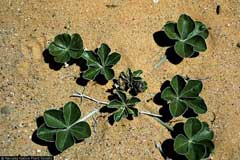
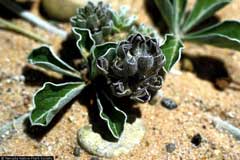
Beaver Dam breadroot is an edible-rooted legume of the desert Southwest. Although not common, its starchy roots can be boiled, baked, dried into flour, or fried, making it a versatile food when found. However, limited abundance reduces its practical importance as a regular foraging plant. This name is a synonym of Pediomelum castoreum. Pediomelum castoreum is a low-growing, erect, herbaceous perennial plant growing from a deep-rooted, spindle-shaped taproot that can be 5 - 8cm long and 1 - 3cm wide; the plant usually only produces a single stem 2 - 5cm tall, sometimes with decumbent branches 10cm or longer. This is one of several related species that provide an edible, nutritious root and, as such, was commonly harvested for food by the native N. Americans. It is still often used as a wild food.
Physical Characteristics

 Psoralea castorea is a PERENNIAL growing to 0.1 m (0ft 4in) by 0.1 m (0ft 4in).
See above for USDA hardiness. It is hardy to UK zone 5. The species is hermaphrodite (has both male and female organs) and is pollinated by Insects.
It can fix Nitrogen.
Suitable for: light (sandy) and medium (loamy) soils and prefers well-drained soil. Suitable pH: mildly acid, neutral and basic (mildly alkaline) soils. It cannot grow in the shade. It prefers dry or moist soil.
UK Hardiness Map
US Hardiness Map
Synonyms
Plant Habitats
Cultivated Beds;
Edible Uses
Edible Parts: Root
Edible Uses:
Root - raw or cooked[2, 46, 105, 161]. A good size[85]. The root can also be dried and ground into a powder then used in soups or with cereals for making bread etc[161]. Edible Uses & Caution: Only the roots of Beaver Dam breadroot are edible. All other plant parts are inedible. Like other breadroots, it stores energy as underground tuberous roots. While the Plains species (P. esculentum) was widely used by Native Americans, Beaver Dam breadroot and other southwestern species were more limited in use due to their relative scarcity [2-3]. Food Potential: Roots are starchy and carbohydrate-rich, providing a nutritious wild food when large enough to be worth harvesting. They are generally off-white with brown skins, and most of the interior is chewable aside from the harder cores. The skins are bitter and best peeled off before eating. Cooking greatly improves the flavor: Boiling draws out bitterness, softens the root, and highlights its starchy taste. Baking or adding to soups makes them a useful staple-style food. Drying and grinding into flour produces a fine-quality meal. Dried root shavings can also be rehydrated or fried in oil for a snack [2-3]. Quality varies between individual plants—some roots are small and not worth the effort, while others are substantial. Strong, vigorous above-ground growth often signals more robust root systems below [2-3].
References More on Edible Uses
Medicinal Uses
Plants For A Future can not take any responsibility for any adverse effects from the use of plants. Always seek advice from a professional before using a plant medicinally.
None known
References More on Medicinal Uses
The Bookshop: Edible Plant Books
Our Latest books on Perennial Plants For Food Forests and Permaculture Gardens in paperback or digital formats.
Edible Tropical Plants
Food Forest Plants for Hotter Conditions: 250+ Plants For Tropical Food Forests & Permaculture Gardens.
More
Edible Temperate Plants
Plants for Your Food Forest: 500 Plants for Temperate Food Forests & Permaculture Gardens.
More
More Books
PFAF have eight books available in paperback and digital formats. Browse the shop for more information.
Shop Now
Other Uses
References More on Other Uses
Cultivation details
Succeeds in an ordinary garden soil[1 ]. Requires a well-drained soil in a sunny position[200 ]. Plants are very intolerant of root disturbance, they are best planted out into their permanent positions whilst still small[200 ]. This species has a symbiotic relationship with certain soil bacteria, these bacteria form nodules on the roots and fix atmospheric nitrogen. Some of this nitrogen is utilized by the growing plant, but some can also be used by other plants growing nearby[200 ]. Habitat & Range: Beaver Dam breadroot is native to arid regions of the Southwest, usually found in dry soils. Its scarcity means it was not a staple food, but it was occasionally used when encountered. USDA Hardiness Zone: 4–8. Weed Potential: Low – a native species with no tendency to become invasive.
References Carbon Farming Information and Carbon Sequestration Information
Temperature Converter
Type a value in the Celsius field to convert the value to Fahrenheit:
Fahrenheit:
The PFAF Bookshop
Plants For A Future have a number of books available in paperback and digital form. Book titles include Edible Plants, Edible Perennials, Edible Trees,Edible Shrubs, Woodland Gardening, and Temperate Food Forest Plants. Our new book is Food Forest Plants For Hotter Conditions (Tropical and Sub-Tropical).
Shop Now
Plant Propagation
Pre-soak the seed for 24 hours in warm water and then sow in early to mid spring in a greenhouse. Either sow the seed in individual pots or pot up the young seedlings as soon as possible in order to avoid root disturbance. Grow them on in the pots until planting out in their final positions. It is usually impossible to transplant this species without fatal damage to the root[200]. Division in spring. With great care since the plant resents root disturbance. It is virtually impossible to divide this species successfully[200].
Other Names
If available other names are mentioned here
Beaver Dam breadroot (Pediomelum castoreum (S. Watson) Rydb. = Psoralea castorea S. Watson).
Native Range
US: Arizona, California, Nevada.
Weed Potential
Right plant wrong place. We are currently updating this section.
Please note that a plant may be invasive in one area but may not
in your area so it's worth checking.
Low – a native species with no tendency to become invasive.
Conservation Status
IUCN Red List of Threatened Plants Status :
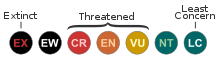
IUCN Red List
Growth: S = slow M = medium F = fast. Soil: L = light (sandy) M = medium H = heavy (clay). pH: A = acid N = neutral B = basic (alkaline). Shade: F = full shade S = semi-shade N = no shade. Moisture: D = dry M = Moist We = wet Wa = water.
Now available:
Food Forest Plants for Mediterranean Conditions
350+ Perennial Plants For Mediterranean and Drier Food Forests and Permaculture Gardens.
[Paperback and eBook]
This is the third in Plants For A Future's series of plant guides for food forests tailored to
specific climate zones. Following volumes on temperate and tropical ecosystems, this book focuses
on species suited to Mediterranean conditions—regions with hot, dry summers and cool, wet winters,
often facing the added challenge of climate change.
Read More
Expert comment
Author
S.Watson.
Botanical References
71
Links / References
For a list of references used on this page please go here
Readers comment
| Add a comment |
|
If you have important information about this plant that may help other users please add a comment or link below. Only comments or links that are felt to be directly relevant to a plant will be included. If you think a comment/link or information contained on this page is inaccurate or misleading we would welcome your feedback at [email protected]. If you have questions about a plant please use the Forum on this website as we do not have the resources to answer questions ourselves.
* Please note: the comments by website users are not necessarily those held by PFAF and may give misleading or inaccurate information.
|
Subject : Psoralea castorea
|
|
|
|