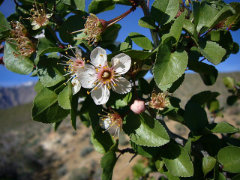
 |
|
Florian Boyd Creative Commons Attribution-Share Alike 2.0 |
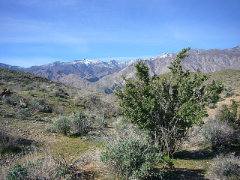 |
| Florian Boyd Creative Commons Attribution-Share Alike 2.0 |
Translate this page:
Summary
Prunus fremontii is a much-branched, thorny, deciduous shrub or small tree; it can grow 100 - 400cm tall[270 ]. The plant is harvested from the wild for local use as food. While the desert apricot is visually similar to cultivated apricots, its fruits are usually too bitter and astringent to be useful as food. The kernels are potentially toxic unless carefully processed, and even then, remain risky. Foragers should approach this plant with caution and focus on other, safer Prunus species such as chokecherry or black cherry for edible use. The taxonomic history of Prunus is long and complicated, partly due to the economic value of its fruit crops and the ease with which some species hybridize. Here, Prunus is circumscribed in its broad sense based on the argument that when viewed worldwide, the morphologic discontinuities among the segregate genera diminish and overlap. Included here are species sometimes in the genera Amygdalus, Armeniaca, Cerasus, Laurocerasus, Padus, and Persica. At the species level, Prunus has been the object of the usual combining and splitting common among taxonomists with different philosophies and opinions. In particular, over-reliance on the indument of various vegetative and floral parts has led to naming numerous species and infraspecific taxa. Similarly, too much has been made of fruit colour and palatability in naming taxa of Prunus. It is very likely that, as molecular and genetic data are analyzed and, more importantly, correlated with morphological data, circumscriptions will be redrawn, and the number of Prunus species will be reduced[270 ].
Physical Characteristics

 Prunus fremontii is a deciduous Shrub growing to 2.5 m (8ft) by 2 m (6ft).
See above for USDA hardiness. It is hardy to UK zone 8 and is not frost tender. The flowers are pollinated by Insects.
It is noted for attracting wildlife.
Suitable for: light (sandy) and medium (loamy) soils, prefers well-drained soil and can grow in heavy clay and nutritionally poor soils. Suitable pH: mildly acid, neutral and basic (mildly alkaline) soils. It cannot grow in the shade. It prefers dry or moist soil and can tolerate drought.
UK Hardiness Map
US Hardiness Map
Synonyms
Homotypic Synonyms: Amygdalus fremontii (S.Watson) Abrams. Emplectocladus fremontii (S.Watson) Dayton. Heterotypic Synonyms: P. fremontii subsp. pilulata (Jeps.) A.E.Murray. P. fremontii var. pilulata Jeps.
Plant Habitats
Edible Uses
Fruit - raw or cooked. The fruit was considered to be a great delicacy, important food and a highly prized food source[257 ]. The fruit is densely puberulent with a leathery to dry flesh[270 ]. The yellowish, ellipsoid-ovoid fruit is 8 - 15mm long[270 ]. Seed - raw or cooked. Do not eat the seed if it is too bitter - see the notes above on toxicity. Members of the Prunus genus are well-known for their edible fruits, but most parts of the plants—including roots, bark, leaves, and kernels—contain cyanogenic glycosides (such as amygdalin and prunasin). These compounds can break down into hydrocyanic acid (cyanide), which is highly toxic and potentially fatal. The fleshy fruit is generally free of these toxins and may be eaten raw, although it is often excessively astringent and bitter. The kernels inside the pits resemble almonds but should not be eaten raw, as they contain dangerous levels of cyanogenic compounds. Although traditional Native American groups processed these kernels by grinding, soaking, boiling, and roasting to reduce toxicity, modern foragers are advised to avoid consuming them due to the risks involved [2-3]. Food Potential: The fleshy portion of the desert apricot looks and smells like cultivated apricots, but the resemblance is misleading. The pulp is scanty, semi-dry, and often unpleasantly bitter; only rarely do the fruits develop noticeable sweetness. The hard pits, which make up most of the fruit’s volume, contain the almond-like kernels. With traditional processing methods, these could be rendered edible in small amounts, but the danger from cyanide precursors makes their consumption inadvisable today. The fruits mature in June and July, and the fleshy layers split naturally from the pits, which makes separating them easier [2-3]. Cultural Notes: Desert apricot was used by Native Americans mainly as a source of kernels rather than for its flesh. It is one of three southwestern Prunus species (with desert almond and desert peach) in the Amygdalus subgenus, closely related to cultivated almonds [2-3].
References More on Edible Uses
Medicinal Uses
Plants For A Future can not take any responsibility for any adverse effects from the use of plants. Always seek advice from a professional before using a plant medicinally.
Although no specific mention has been seen for this species, all members of the genus contain amygdalin and prunasin, substances which break down in water to form hydrocyanic acid (cyanide or prussic acid). In small amounts this exceedingly poisonous compound stimulates respiration, improves digestion and gives a sense of well-being[238 ].
References More on Medicinal Uses
The Bookshop: Edible Plant Books
Our Latest books on Perennial Plants For Food Forests and Permaculture Gardens in paperback or digital formats.
Edible Tropical Plants
Food Forest Plants for Hotter Conditions: 250+ Plants For Tropical Food Forests & Permaculture Gardens.
More
Edible Temperate Plants
Plants for Your Food Forest: 500 Plants for Temperate Food Forests & Permaculture Gardens.
More
More Books
PFAF have eight books available in paperback and digital formats. Browse the shop for more information.
Shop Now
Other Uses
A green dye can be obtained from the leaves[168 ], and a dark grey to green dye can be obtained from the fruit[168 ]. Prunus ferganensis belongs to the secondary Gene Pool of the Peach (Prunus persica), and so it has the potential to be used as a gene donor for crop improvement, for example, to confer drought resistance[338 ].
Special Uses
References More on Other Uses
Cultivation details
Requires a sunny position[1050 ]. It is found mainly in sandy soils in the wild[1050 ]. Extrafloral nectaries attract various insects, particularly wasps and ants, to the leaves. The presence of these insects discourages browsing by herbivores[1050 ]. The plant generally survives fire. Top growth may be killed, but it generally resprouts vigorously from the root crown[1050 ]. Most members of this genus are shallow-rooted and will produce suckers if the roots are damaged[238 ]. Plants in this genus are notably susceptible to honey fungus[200 ]. Habitat & Range: Desert apricot is native to southern California, especially along the eastern slopes of the Peninsular Ranges. It grows as a shrub or small tree, typically reaching 1–4 meters in height. USDA Hardiness Zone: 7–9. Weed Potential: Desert apricot is not considered weedy or invasive. Its value as a wild food is low due to poor fruit quality and the hazardous nature of its kernels.
References Carbon Farming Information and Carbon Sequestration Information
Temperature Converter
Type a value in the Celsius field to convert the value to Fahrenheit:
Fahrenheit:
The PFAF Bookshop
Plants For A Future have a number of books available in paperback and digital form. Book titles include Edible Plants, Edible Perennials, Edible Trees,Edible Shrubs, Woodland Gardening, and Temperate Food Forest Plants. Our new book is Food Forest Plants For Hotter Conditions (Tropical and Sub-Tropical).
Shop Now
Plant Propagation
Seed - requires 2 - 3 months of cold stratification and is best sown in a cold frame as soon as it is ripe[200 ]. Sow stored seed in a cold frame as early in the year as possible[200 ]. Protect the seed from mice etc. The seed can be rather slow, sometimes taking 18 months to germinate[113 ]. Prick out the seedlings into individual pots when they are large enough to handle. Grow them in a greenhouse or cold frame for their first winter and plant them out in late spring or early summer of the following year. Cuttings of half-ripe wood with a heel, mid-summer in a frame[11, 200 ]. Softwood cuttings from strongly growing plants in spring to early summer in a frame[200 ]. Layering in spring.
Other Names
If available other names are mentioned here
Native Range
Native to: California, Mexico Northwest.
Weed Potential
Right plant wrong place. We are currently updating this section.
Please note that a plant may be invasive in one area but may not in your area so it's worth checking.
Weed Potential: Desert apricot is not considered weedy or invasive. Its value as a wild food is low due to poor fruit quality and the hazardous nature of its kernels.
Conservation Status
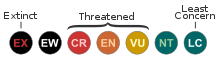
IUCN Red List of Threatened Plants Status : Least Concern.
| Related Plants
|
| Latin Name | Common Name | Habit | Height | Hardiness | Growth | Soil | Shade | Moisture | Edible | Medicinal | Other |
| Prunus africana | Pygeum | Tree | 18.0 |
10-12
| F | LM | N | M | 0 | 5 | 2 |
| Prunus alabamensis | Alabama Cherry | Tree | 8.0 |
-
| | LMH | SN | M | 2 | 1 | 1 |
| Prunus alleghaniensis | Allegheny Plum, Davis' plum | Tree | 3.5 |
4-8
| F | LMH | SN | M | 3 | 1 | 2 |
| Prunus americana | American Plum, American Wild Plum, Wild Plum | Tree | 6.0 |
3-8
| M | LMH | SN | M | 3 | 2 | 3 |
| Prunus americana lanata | | Tree | 10.0 |
3-7
| | LMH | SN | M | 3 | 1 | 2 |
| Prunus andersonii | Desert Peach | Shrub | 1.8 |
-
| | LMH | SN | M | 2 | 2 | 1 |
| Prunus angustifolia | Chickasaw Plum, Watson's plum, Hally Jolivette Cherry | Tree | 3.0 |
5-9
| M | LMH | SN | M | 3 | 1 | 3 |
| Prunus angustifolia watsonii | Sand Plum | Shrub | 3.0 |
5-9
| | LMH | SN | M | 4 | 1 | 2 |
| Prunus apetala | Clove Cherry | Shrub | 7.0 |
-
| | LMH | SN | M | 2 | 1 | 1 |
| Prunus arabica | | Shrub | 0.0 |
-
| | LMH | SN | DM | 2 | 1 | 2 |
| Prunus armeniaca | Apricot | Tree | 9.0 |
5-7
| M | LM | SN | M | 4 | 3 | 4 |
| Prunus armeniaca mandschurica | Manchurian apricot | Tree | 6.0 |
3-9
| M | LM | SN | M | 4 | 3 | 3 |
| Prunus avium | Wild Cherry, Sweet cherry | Tree | 18.0 |
3-7
| F | LMH | SN | M | 4 | 2 | 4 |
| Prunus besseriana | Dwarf Almond | Tree | 0.0 |
-
| | LMH | SN | M | 2 | 1 | 2 |
| Prunus besseyi | Western Sand Cherry | Shrub | 1.2 |
3-6
| M | LMH | SN | M | 4 | 1 | 2 |
| Prunus bifrons | | Shrub | 1.8 |
-
| | LMH | SN | M | 2 | 1 | 1 |
| Prunus bokharensis | Bokhara Plum | Tree | 0.0 |
-
| | LMH | SN | M | 2 | 1 | 1 |
| Prunus brigantina | Briançon Apricot | Tree | 6.0 |
6-9
| M | LMH | SN | DM | 4 | 1 | 3 |
| Prunus buergeriana | | Tree | 9.0 |
4-8
| | LMH | SN | M | 2 | 1 | 1 |
| Prunus campanulata | Taiwan Cherry | Tree | 7.0 |
7-9
| M | LMH | SN | M | 2 | 1 | 1 |
| Prunus canescens | Greyleaf Cherry | Shrub | 3.0 |
5-9
| | LMH | SN | M | 3 | 1 | 2 |
| Prunus capsica | | Tree | 0.0 |
-
| | LMH | SN | M | 2 | 1 | 1 |
| Prunus caroliniana | American Cherry Laurel, Carolina laurelcherry, Laurel Cherry, | Shrub | 12.0 |
7-10
| F | LMH | SN | DM | 2 | 1 | 3 |
| Prunus cerasifera | Cherry Plum, Myrobalan Plum, Newport Cherry Plum, Pissard Plum | Tree | 9.0 |
5-8
| M | LMH | SN | M | 4 | 1 | 3 |
| Prunus cerasifera divaricata | | Tree | 10.0 |
4-8
| | LMH | SN | M | 4 | 1 | 1 |
| Prunus cerasoides | Wild Himalayan Cherry | Tree | 30.0 |
7-10
| | LMH | SN | M | 2 | 2 | 2 |
| Prunus cerasus | Sour Cherry | Tree | 6.0 |
3-7
| | LMH | SN | M | 1 | 2 | 3 |
| Prunus cerasus austera | Morello Cherry | Tree | 9.0 |
3-7
| | LMH | SN | M | 3 | 1 | 3 |
| Prunus cerasus caproniana | Kentish Red Cherry | Tree | 9.0 |
3-7
| | LMH | SN | M | 3 | 1 | 3 |
| Prunus cerasus frutescens | Bush Sour Cherry | Tree | 1.0 |
3-7
| | LMH | SN | M | 3 | 1 | 3 |
|
|
Growth: S = slow M = medium F = fast. Soil: L = light (sandy) M = medium H = heavy (clay). pH: A = acid N = neutral B = basic (alkaline). Shade: F = full shade S = semi-shade N = no shade. Moisture: D = dry M = Moist We = wet Wa = water.
Now available:
Food Forest Plants for Mediterranean Conditions
350+ Perennial Plants For Mediterranean and Drier Food Forests and Permaculture Gardens.
[Paperback and eBook]
This is the third in Plants For A Future's series of plant guides for food forests tailored to
specific climate zones. Following volumes on temperate and tropical ecosystems, this book focuses
on species suited to Mediterranean conditions—regions with hot, dry summers and cool, wet winters,
often facing the added challenge of climate change.
Read More
Expert comment
Author
S. Watson
Botanical References
Links / References
For a list of references used on this page please go here
A special thanks to Ken Fern for some of the information used on this page.
Readers comment
| Add a comment |
|
If you have important information about this plant that may help other users please add a comment or link below. Only comments or links that are felt to be directly relevant to a plant will be included. If you think a comment/link or information contained on this page is inaccurate or misleading we would welcome your feedback at [email protected]. If you have questions about a plant please use the Forum on this website as we do not have the resources to answer questions ourselves.
* Please note: the comments by website users are not necessarily those held by PFAF and may give misleading or inaccurate information.
|
Subject : Prunus fremontii
|
|
|
|