 |
|
|
 |
| The Marmot https://www.flickr.com/photos/themarmot/22637150487/ |
Translate this page:
Summary
Phaseolus acutifolius is a herbaceous, annual plant growing from a fibrous rootstock. It produces weak stems that either trail over the ground or twine around other plants for support[418 ]. The plants vary widely in height according to cultivar, with dwarf forms only 30cm tall and large forms up to 4 metres tall[299 , 418 , 1555 ]. The plant is grown mainly for its edible seed and is said to have been in cultivation for over 5,000 years in southwestern N. America[375 ]. Nowadays it is grown mainly in south-western USA and Mexico as a traditional pulse crop, though it is also cultivated, mostly on a small scale, in further parts of USA; Central America; the West Indies; Chile; Australia; S Asia; E and W Africa (Uganda, Mali, Senegal)[317 ]. After World War II the cultivation decreased drastically in the traditional areas, the crop however is nowadays once more gaining interest[317 ]. The cultivated forms were formerly called var latifolius. This was recently recognised as an obsolete synonym of var acutifolius (formerly considered a wild form of the species). This means this variety comprises wild and cultivated populations[317 ].
Physical Characteristics

 Phaseolus acutifolius is a ANNUAL CLIMBER growing to 2 m (6ft) by 1 m (3ft 3in) at a fast rate.
See above for USDA hardiness. It is hardy to UK zone 7 and is not frost tender. The flowers are pollinated by Insects.
It can fix Nitrogen.
It is noted for attracting wildlife.
Suitable for: light (sandy), medium (loamy) and heavy (clay) soils, prefers well-drained soil and can grow in nutritionally poor soil. Suitable pH: mildly acid, neutral and basic (mildly alkaline) soils. It cannot grow in the shade. It prefers dry or moist soil and can tolerate drought.
UK Hardiness Map
US Hardiness Map
Synonyms
Phaseolus acutifolius latifolius G.F.Freeman. Phaseolus montanus Brandegee. Phaseolus pauper Standl. Phaseolus tenuifolius (A.Gray) Wooton & Standl. Common Name: Tepary Bean.
Plant Habitats
Edible Uses
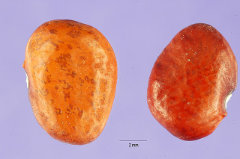
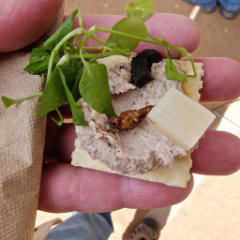
Mature seeds - dried[310 , 418 ]. They are used as dry shell beans to make soups[310 , 418 ]. They are also ground into flour, fried, parched, or processed into a meal for commercial use[418 ]. Tepary beans have a strong flavour and odour and are less palatable than common beans[299 ]. The seedpods are 40 - 100mm long, 5 - 13mm wide and 4 - 8mm thick, containing 2 - 9 oblong to rounded seeds 4 - 10mm long, 4 - 7mm wide and 2 - 5mm thick[418 , 1555 ]. On storage, the dry seeds become very hard and take a very long time to cook[310 ]. Cultivars with white seeds have a more permeable seedcoat than cultivars with black seeds, resulting in a shorter cooking time[299 ]. The young, green seedpods are occasionally eaten[299 ]. The seeds can be sprouted and then eaten cooked or in salads[299 ]. The leaves are considered edible in parts of Africa, but they are tougher than those of common bean (Phaseolus vulgaris) and take longer to cook[299 ]. The wideleaf tepary bean (Phaseolus acutifolius var. latifolius) produces mature seeds that are edible once properly prepared. Like other members of the bean family, the raw or undercooked seeds are toxic due to the presence of lectins and other anti-nutritive compounds. These substances can cause serious health effects, but fortunately, they are destroyed by thorough boiling. Cooking also reduces additional compounds such as trypsin inhibitors and phytates, leaving the beans safe to eat. Sprouts from wild beans should not be eaten raw, as they may retain harmful levels of these compounds. When boiled, wideleaf tepary beans are comparable in flavor, texture, and aroma to cultivated beans. They were traditionally eaten by Native American peoples in the southwestern United States, and their domestication can be traced back more than 2,000 years to the Tehuacan Valley of Mexico[2-3]. Tepary beans are highly drought-tolerant and well adapted to desert conditions, capable of producing a crop in as little as two months during the hot summer following seasonal rains. The beans are generally harvested in early to mid-autumn. Immature pods are dull green, while mature pods turn brown, brittle, and often hairy. When ripe, they split open and scatter the seeds, sometimes during collection, so careful handling is needed. Because the pods ripen over several weeks, frequent checking ensures a good harvest. Even after pods have opened, beans can often be gathered from the ground for some time, though they can be difficult to spot. Once collected, the beans require little processing, as winnowing is straightforward, and they make a reliable and nutritious food source [2-3].
References More on Edible Uses
Medicinal Uses
Plants For A Future can not take any responsibility for any adverse effects from the use of plants. Always seek advice from a professional before using a plant medicinally.
None known
References More on Medicinal Uses
The Bookshop: Edible Plant Books
Our Latest books on Perennial Plants For Food Forests and Permaculture Gardens in paperback or digital formats.

Edible Tropical Plants
Food Forest Plants for Hotter Conditions: 250+ Plants For Tropical Food Forests & Permaculture Gardens.
More

Edible Temperate Plants
Plants for Your Food Forest: 500 Plants for Temperate Food Forests & Permaculture Gardens.
More
More Books
PFAF have eight books available in paperback and digital formats. Browse the shop for more information.
Shop Now
Other Uses
Agroforestry Uses: Tepary bean has occasionally been grown as a green manure, e.g. in the United States[299 ]. It may also be used as a cover crop and an intercrop in agroforestry systems[299 ]. Other Uses: The plant is bitten and held between the teeth as a traditional treatment for toothache[257 ].
Special Uses
References More on Other Uses
Cultivation details
Phaseolus acutifolius is a plant mainly of the drier subtropics. However, it can also be cultivated in warmer regions of the temperate zone so long as there is a sufficiently long growing season to ripen the crops in autumn. It can also be grown in tropical areas at elevations up to 1,900 metres so long as the climate is not excessively wet[418 ]. It prefers a mean annual temperature within the range 20 - 30°c, but can tolerate 8 - 38°c[418 ] It cannot be grown in areas where night temperatures fall below 8°c[418 ]. It prefers a mean annual rainfall of 600 - 1,000mm, tolerating 300 - 1,700mm[418 ]. Excessive rainfall may create vegetative growth at the expense of seed yield[418 ]. The plant can withstand heat and a dry atmosphere, though only very few varieties are suited for the wet tropics[418 ]. Requires a sunny position[418 ]. Succeeds in most soils that are well-drained[418 ]. Succeeds in poor, shallow soils[310 ]. Established plants are rather drought resistant[317 ].Prefers a pH in the range 6 - 7, but tolerates 5 - 8[418 ]. The crop can be grown on residual soil moisture[418 ]. Often cultivated for its edible seed, there are many cultivated forms with seeds considerably larger than the wild forms[1555 ] The seedpods of wild forms have pods that burst open explosively when ripe to expel the seeds, which are smaller than cultivated forms[1556 ]. The seedpods of cultivated forms remain closed when the seeds first ripen, making harvesting much simpler[1556 ]. The species is highly daylength sensitive, growmg under natural field conditions during the long days of summer and beginning to bloom in late summer when daylength has fallen to around 13 hours[1555 ]. Flowering occurs within 27 - 40 days from germination[299 ]. First harvest may be taken in as little as 60 days in the tropics, though in cooler climates it can be up to 120 days from sowing[418 ]. The seeds of many domesticated types of tepary bean are shattered less easily than those of wild types[299 ]. Average yields of dry seed under dry conditions are reported to be 450 - 800 kg/ha and with irrigation 0.9-1.7 t/ha[418 ]. In areas of poor rainfall, tepary bean has possibilities as a catch-crop where a rapid food supply is needed[310 ]. This species has a symbiotic relationship with certain soil bacteria; these bacteria form nodules on the roots and fix atmospheric nitrogen. Some of this nitrogen is utilized by the growing plant but some can also be used by other plants growing nearby[755 ]. Tepary beans are highly drought-tolerant and well adapted to desert conditions, capable of producing a crop in as little as two months during the hot summer following seasonal rains [2-3].
References Carbon Farming Information and Carbon Sequestration Information
Temperature Converter
Type a value in the Celsius field to convert the value to Fahrenheit:
Fahrenheit:
The PFAF Bookshop
Plants For A Future have a number of books available in paperback and digital form. Book titles include Edible Plants, Edible Perennials, Edible Trees,Edible Shrubs, Woodland Gardening, and Temperate Food Forest Plants. Our new book is Food Forest Plants For Hotter Conditions (Tropical and Sub-Tropical).
Shop Now
Plant Propagation
The seed of cultivated forms absorbs water easily; in moist soils, the testa wrinkles within 5 minutes, whilst when soaked in water, the testa wrinkles in 3 minutes[299 ]. This leads to quick and even germination[299 ]. The rate of germination increases with increasing temperatures from 10 - 35°c[299 ]. Seedling emergence is faster in white-seeded than in dark-seeded types[299 ]. The seed of wild forms usually has a hard seedcoat and will benefit from scarification before sowing in order to speed up and improve germination. This can usually be done by pouring a small amount of nearly boiling water on the seeds (being careful not to cook them!) and then soaking them for 12 - 24 hours in warm water. By this time they should have imbibed moisture and swollen - if they have not, then carefully make a nick in the seedcoat (being careful not to damage the embryo) and soak for a further 12 hours before sowing. The seeds of domesticated types have no dormancy, which is a disadvantage in humid regions, where fallen seeds will germinate rapidly[299 ].
Other Names
If available other names are mentioned here
Wideleaf tepary bean
Native Range
Native to: Arizona, Mexico Northeast, Mexico Northwest, Mexico Southwest, New Mexico, Texas. Introduced into: Canary Is., Central European Rus, India, Kazakhstan, Kirgizstan, Krym, Mali, South European Russi, Ukraine.
Weed Potential
Right plant wrong place. We are currently updating this section.
Please note that a plant may be invasive in one area but may not in your area so it's worth checking.
Tepary beans are not generally considered a weedy or invasive species. It is native to the arid and semi-arid regions of the southwestern United States and Mexico, where it has coexisted with natural ecosystems for thousands of years.
Conservation Status
IUCN Red List of Threatened Plants Status : Not available
Growth: S = slow M = medium F = fast. Soil: L = light (sandy) M = medium H = heavy (clay). pH: A = acid N = neutral B = basic (alkaline). Shade: F = full shade S = semi-shade N = no shade. Moisture: D = dry M = Moist We = wet Wa = water.
Now available:
Food Forest Plants for Mediterranean Conditions
350+ Perennial Plants For Mediterranean and Drier Food Forests and Permaculture Gardens.
[Paperback and eBook]
This is the third in Plants For A Future's series of plant guides for food forests tailored to
specific climate zones. Following volumes on temperate and tropical ecosystems, this book focuses
on species suited to Mediterranean conditions—regions with hot, dry summers and cool, wet winters,
often facing the added challenge of climate change.
Read More
Expert comment
Author
A.Gray
Botanical References
Links / References
For a list of references used on this page please go here
A special thanks to Ken Fern for some of the information used on this page.
Readers comment
| Add a comment |
|
If you have important information about this plant that may help other users please add a comment or link below. Only comments or links that are felt to be directly relevant to a plant will be included. If you think a comment/link or information contained on this page is inaccurate or misleading we would welcome your feedback at [email protected]. If you have questions about a plant please use the Forum on this website as we do not have the resources to answer questions ourselves.
* Please note: the comments by website users are not necessarily those held by PFAF and may give misleading or inaccurate information.
|
Subject : Phaseolus acutifolius
|
|
|
|