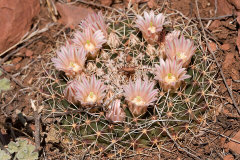
 |
|
Patrick Alexander from Las Cruces, NM. Creative Commons Zero, Public Domain Dedication |
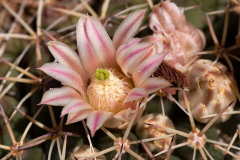 |
| Patrick Alexander from Las Cruces, NM. Creative Commons Zero, Public Domain Dedication |
Translate this page:
Summary
Little nipple cactus is a small desert cactus native to the southwestern United States and northern Mexico. Like other members of the Mammillaria genus, it produces edible red fruits that have traditionally been gathered in small quantities by Native Americans. However, the fruits are produced sparingly, making the species only a minor wild food. As with many native cacti, wild populations may be protected, so harvesting should be avoided.
Physical Characteristics

 Mammillaria meiacantha is a SHRUB growing to 0.1 m (0ft 4in) by 0.1 m (0ft 4in) at a slow rate.
See above for USDA hardiness. It is hardy to UK zone 9. The flowers are pollinated by Bees, Insects.
It is noted for attracting wildlife.
Suitable for: light (sandy) and medium (loamy) soils, prefers well-drained soil and can grow in nutritionally poor soil. Suitable pH: mildly acid, neutral and basic (mildly alkaline) soils. It cannot grow in the shade. It prefers dry or moist soil and can tolerate drought.
UK Hardiness Map
US Hardiness Map
Synonyms
Cactus meiacanthus (Engelm.) Kuntze. Mammillaria gummifera var. meiacantha (Engelm.) L.D.Benson. Mammillaria heyderi var. meiacantha (Engelm.) L.D.Benson. Mammillaria heyderi subsp. meiacantha (Engelm.) D.R.Hunt. Mammillaria melanocentra var. meiacantha (Engelm.) R.T.Craig. Neomammillaria meiacantha (Engelm.) Britton & Rose.
Plant Habitats
Edible Uses
Little nipple cactus is another attractive member of the Mammillaria genus whose edible fruits provide only a modest seasonal food source. While the fruits are safe to eat, their limited production and the protected status of many wild cactus populations mean the species has relatively little importance as a modern foraging plant. Its greatest value lies in its ecological role and its contribution to the diversity of desert cactus communities [2-3]. The fruits are edible. No other parts of the plant are reported to be edible [2-3]. Edibility Rating: 2 out of 5 – The fruits are edible but are produced in small quantities and are unlikely to provide a significant food resource [2-3]. Taste and Preparation: The fruits are eaten fresh. Fruits of Mammillaria species have traditionally been consumed as a seasonal snack. Individual plants generally produce too few fruits to justify harvesting as a substantial food source [2-3]. Safety: Although the fruits are edible, many Mammillaria species are protected throughout their natural range, and several species are uncommon or locally rare. Wild plants should not be harvested, and collection may be prohibited in protected areas [2-3]. Seasonality: Plants flower during the warmer months, with fruits ripening later in the growing season depending on rainfall and local environmental conditions. Traditional Uses: Native Americans occasionally gathered the fruits of Mammillaria cacti, but these fruits represented only a minor part of the traditional diet because of their limited abundance [2-3].
References More on Edible Uses
Medicinal Uses
Plants For A Future can not take any responsibility for any adverse effects from the use of plants. Always seek advice from a professional before using a plant medicinally.
Traditional and Ethnobotanical Uses: Headache Relief: Mammillaria meiacantha is classified taxonomically by some authorities as a subspecies or variety of Mammillaria heyderi (i.e., Mammillaria heyderi var. meiacantha). In Mexican folk medicine and Tarahumara indigenous traditions, these types of latex-bearing Mammillaria cacti are used as remedies. Specifically, after removing the spines, people roast parts of the plant for a few minutes and apply them to relieve headaches. Ceremonial & Ritual Use: Historically, several species within the Mammillaria genus (including varieties closely related to M. meiacantha) have been documented as "peyote substitutes" or sacred plants used by local indigenous groups in spiritual and healing rituals. While modern pharmacological studies specifically targeting Mammillaria meiacantha are virtually non-existent, broader research on the Mammillaria genus indicates that these plants contain phenolic acids and flavonoids
References More on Medicinal Uses
Other Uses
Little nipple cactus is well suited to cactus collections and desert gardens. Its flowers provide nectar and pollen for native bees and other pollinating insects, while birds and small mammals consume the ripe fruits and assist in seed dispersal. Historically, several species within the Mammillaria genus (including varieties closely related to M. meiacantha) have been documented as "peyote substitutes" or sacred plants used by local indigenous groups in spiritual and healing rituals.
Special Uses
References More on Other Uses
Cultivation details
Little nipple cactus grows best in full sun and well-drained rocky, sandy, or gravelly soils. It is highly drought-tolerant and well adapted to arid desert conditions. Habitat: It occurs in desert scrub, rocky slopes, gravelly plains, and open desert habitats across parts of Arizona, New Mexico, Texas, and northern Mexico. USDA Hardiness Zones: USDA Zones 8–11. Growth Rate: Slow. Plants develop gradually and may live for many decades. Mature Size: Typically 3–12 cm (1–5 inches) tall, growing singly or occasionally forming small clusters. Cultivation: Little nipple cactus suits cactus collections and desert gardens. It requires excellent drainage, abundant sunlight, and only occasional watering after establishment. Identification: Little nipple cactus is a small, rounded-to-short-cylindrical cactus with numerous ungrooved tubercles arranged in spirals. The areoles bear straight spines, and flowers form in a ring below the growing tip, arising from the bases of the tubercles rather than the tips. The fruits are smooth, elongated, spineless, and usually bright red when mature. Similar Species: Little nipple cactus resembles strawberry cactus (Mammillaria dioica), Graham's pincushion cactus (Cochemiea grahamii), little pincushion cactus (Mammillaria heyderi), common fishhook cactus (Mammillaria tetrancistra), and other members of the genus. It differs from species of Coryphantha and Escobaria in that its tubercles are ungrooved, whereas those genera have conspicuously grooved tubercles. As with all Mammillaria, the flowers arise from the bases of the tubercles rather than the tips.
References Carbon Farming Information and Carbon Sequestration Information
Temperature Converter
Type a value in the Celsius field to convert the value to Fahrenheit:
Fahrenheit:
The PFAF Bookshop
Plants For A Future have a number of books available in paperback and digital form. Book titles include Edible Plants, Edible Perennials, Edible Trees,Edible Shrubs, Woodland Gardening, and Temperate Food Forest Plants. Our new book is Food Forest Plants For Hotter Conditions (Tropical and Sub-Tropical).
Shop Now
Plant Propagation
Propagation is by seed or by separating offsets where present.
Other Names
If available other names are mentioned here
Cream pincushion
Native Range
US. USA. Mexico Northeast, New Mexico, Texas.
Weed Potential
Right plant wrong place. We are currently updating this section.
Please note that a plant may be invasive in one area but may not
in your area so it's worth checking.
None. This is a slow-growing native cactus with no invasive tendencies.
Conservation Status
IUCN Red List of Threatened Plants Status : Not listed.
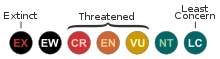
IUCN Red List
Growth: S = slow M = medium F = fast. Soil: L = light (sandy) M = medium H = heavy (clay). pH: A = acid N = neutral B = basic (alkaline). Shade: F = full shade S = semi-shade N = no shade. Moisture: D = dry M = Moist We = wet Wa = water.
Now available:
Food Forest Plants for Mediterranean Conditions
350+ Perennial Plants For Mediterranean and Drier Food Forests and Permaculture Gardens.
[Paperback and eBook]
This is the third in Plants For A Future's series of plant guides for food forests tailored to
specific climate zones. Following volumes on temperate and tropical ecosystems, this book focuses
on species suited to Mediterranean conditions—regions with hot, dry summers and cool, wet winters,
often facing the added challenge of climate change.
Read More
Expert comment
Author
Engelm.
Botanical References
Links / References
For a list of references used on this page please go here
Readers comment
| Add a comment |
|
If you have important information about this plant that may help other users please add a comment or link below. Only comments or links that are felt to be directly relevant to a plant will be included. If you think a comment/link or information contained on this page is inaccurate or misleading we would welcome your feedback at [email protected]. If you have questions about a plant please use the Forum on this website as we do not have the resources to answer questions ourselves.
* Please note: the comments by website users are not necessarily those held by PFAF and may give misleading or inaccurate information.
|
Subject : Mammillaria meiacantha
|
|
|
|