 |
|
Matt Lavin from Bozeman, Montana, USA wikimedia.org |
 |
| Matt Lavin from Bozeman, Montana, USA wikimedia.org |
Translate this page:
Summary
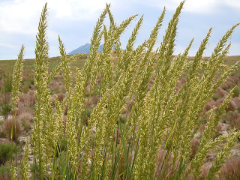
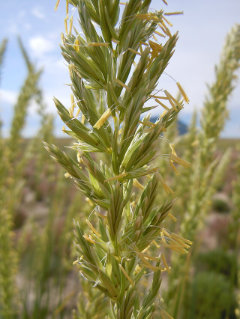
Leymus cinereus is a robust, clump-forming, perennial grass with short rhizomes and an extensive, deep, coarse, fibrous root system. It can grow around 100 - 200cm tall, occasionally reaching 300cm[236 , 277 ]. The plant is harvested from the wild for local use as a food. Basin wildrye is a prominent western bunchgrass with edible grains long used by Native Americans. Its role as a wild cereal makes it valuable, but only safe when free of ergot fungus.
Physical Characteristics

 Leymus cinereus is a PERENNIAL growing to 1.5 m (5ft) by 0.3 m (1ft in).
See above for USDA hardiness. It is hardy to UK zone 5 and is not frost tender. The flowers are pollinated by Wind.
Suitable for: light (sandy) and medium (loamy) soils, prefers well-drained soil and can grow in nutritionally poor soil. Suitable pH: mildly acid, neutral and basic (mildly alkaline) soils. It cannot grow in the shade. It prefers dry or moist soil and can tolerate drought. The plant can tolerates strong winds but not maritime exposure.
UK Hardiness Map
US Hardiness Map
Synonyms
Homotypic Synonyms: Elymus cinereus Scribn. & Merr. Heterotypic Synonyms: Aneurolepidium piperi (Bowden) B.R.Baum. Elymus cinereus var. pubens (Piper) C.L.Hitchc. Elymus condensatus f. pubens (Piper) H.St.John. Elymus condensatus var. pubens Piper. Elymus piperi Bowden.
Plant Habitats
Edible Uses
Seed - cooked[236 ]. It can be ground into a flour and used to make bread. Basin wildrye is a tall perennial bunchgrass native to western North America and well adapted to arid conditions. Its grains were traditionally valued as a food by Native Americans throughout the Great Basin. Harvesting took place from midsummer to autumn, as flowers bloom from June to August and grains mature between July and October. The grains can be ground and prepared much like other wild cereals [2-3]. A critical caution is the risk of ergot infection (Claviceps purpurea), a toxic fungus that can infest the grains. Ergot contamination has a long and tragic history of poisoning, and cooking does not remove the toxins. Foragers must take care to gather only healthy grains free of fungal infection [2-3]. Basin wildrye is most often found in saltbrush flats, sagebrush valleys, and open juniper woodlands, where its tall, dense clumps stand out in the landscape. It represents a reliable cereal source in dry country, provided the grains are clean [2-3].
References More on Edible Uses
Medicinal Uses
Plants For A Future can not take any responsibility for any adverse effects from the use of plants. Always seek advice from a professional before using a plant medicinally.
None known
References More on Medicinal Uses
The Bookshop: Edible Plant Books
Our Latest books on Perennial Plants For Food Forests and Permaculture Gardens in paperback or digital formats.
Edible Tropical Plants
Food Forest Plants for Hotter Conditions: 250+ Plants For Tropical Food Forests & Permaculture Gardens.
More
Edible Temperate Plants
Plants for Your Food Forest: 500 Plants for Temperate Food Forests & Permaculture Gardens.
More
More Books
PFAF have eight books available in paperback and digital formats. Browse the shop for more information.
Shop Now
Other Uses
Agroforestry Uses: The plant is well adapted to stabilizing disturbed soils[236 ]. The plant’s drought tolerance, combined with fibrous root system and fair seedling vigour, make it desirable for reclamation in areas receiving 200 - 500mm annual precipitation. It is commonly used as a grass barrier for controlling wind erosion or blowing snowl, and has also been planted on hilly cropland as a vegetative terrace for controlling water erosion[236 ].
Special Uses
References More on Other Uses
Cultivation details
Leymus cinereus is a very winter-hardy plant and has a rather broad climatic adaptation, though it prefers cycles of wet winters and dry summers. It can be found at elevations from 600 - 2,700 metres. It grows best in areas with average annual precipitation within the range of 200 - 500mm or more[277 ]. It succeeds in most soils, preferring sandy soil and a sunny position[1 , 162 ]. It is most common in the wild on deep soils with high water -holding capacitiesand is not adapted to shallow soils[277 ]. The plant can tolerate moderate levels of salt in the soil[277 ]. Established plants are very drought -tolerant 277 ]. USDA Hardiness Zone: 4–9 (cold hardy, tolerant of drought and poor soils). Weed Potential: Basin wildrye is not generally considered a weedy species, but it is competitive in dryland habitats and can form dense stands in favorable sites.
References Carbon Farming Information and Carbon Sequestration Information
Temperature Converter
Type a value in the Celsius field to convert the value to Fahrenheit:
Fahrenheit:
The PFAF Bookshop
Plants For A Future have a number of books available in paperback and digital form. Book titles include Edible Plants, Edible Perennials, Edible Trees,Edible Shrubs, Woodland Gardening, and Temperate Food Forest Plants. Our new book is Food Forest Plants For Hotter Conditions (Tropical and Sub-Tropical).
Shop Now
Plant Propagation
Seed - sow mid spring in situ and only just cover the seed[162 ]. Germination should take place within 2 weeks. If the supply of seed is limited, it can also be sown in mid spring in a cold frame. Only just cover the seed. When large enough to handle, prick the seedlings out into individual pots and plant them out in summer[K ] Division in spring or summer[162 ]. Very easy, larger clumps can be replanted direct into their permanent positions, though it is best to pot up smaller clumps and grow them on in a cold frame until they are rooting well. Plant them out in the spring.
Other Names
If available other names are mentioned here
Basin Wildrye (Leymus cinereus (Scribn. & Merr.) Á. Löve = Elymus cinereus Scribn. & Merr.)
Native Range
Native to: Alberta, Arizona, British Columbia, California, Colorado, Idaho, Minnesota, Montana, Nebraska, Nevada, New Mexico, Oregon, Saskatchewan, South Dakota, Utah, Washington, Wyoming.
Weed Potential
Right plant wrong place. We are currently updating this section.
Please note that a plant may be invasive in one area but may not in your area so it's worth checking.
Basin wildrye is not generally considered a weedy species, but it is competitive in dryland habitats and can form dense stands in favorable sites.
Conservation Status
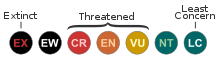
IUCN Red List of Threatened Plants Status : Not available
Growth: S = slow M = medium F = fast. Soil: L = light (sandy) M = medium H = heavy (clay). pH: A = acid N = neutral B = basic (alkaline). Shade: F = full shade S = semi-shade N = no shade. Moisture: D = dry M = Moist We = wet Wa = water.
Now available:
Food Forest Plants for Mediterranean Conditions
350+ Perennial Plants For Mediterranean and Drier Food Forests and Permaculture Gardens.
[Paperback and eBook]
This is the third in Plants For A Future's series of plant guides for food forests tailored to
specific climate zones. Following volumes on temperate and tropical ecosystems, this book focuses
on species suited to Mediterranean conditions—regions with hot, dry summers and cool, wet winters,
often facing the added challenge of climate change.
Read More
Expert comment
Author
(Scribn. & Merr.) Á.Löve
Botanical References
Links / References
For a list of references used on this page please go here
A special thanks to Ken Fern for some of the information used on this page.
Readers comment
| Add a comment |
|
If you have important information about this plant that may help other users please add a comment or link below. Only comments or links that are felt to be directly relevant to a plant will be included. If you think a comment/link or information contained on this page is inaccurate or misleading we would welcome your feedback at [email protected]. If you have questions about a plant please use the Forum on this website as we do not have the resources to answer questions ourselves.
* Please note: the comments by website users are not necessarily those held by PFAF and may give misleading or inaccurate information.
|
Subject : Leymus cinereus
|
|
|
|