 |
|
Public domain |
 |
| Mx. Granger. Creative Commons Zero, Public Domain Dedication |
Translate this page:
Summary
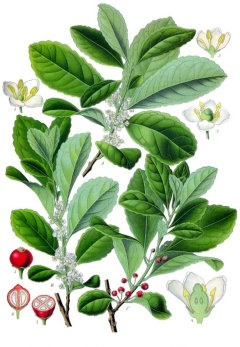
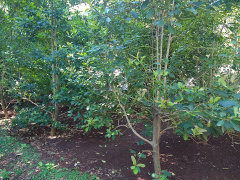
Yerba mate is one of the world’s most important caffeine-producing plants. Its dried leaves and young twigs are steeped in hot water to make mate, a traditional South American beverage. It is not a fruit or vegetable crop; its value is as a stimulant tea plant. Yerba mate, Ilex paraguariensis, belongs to the holly family (Aquifoliaceae) and the genus Ilex. Common names include yerba mate, maté, Paraguay tea, and Jesuit’s tea. It is an evergreen shrub or tree native from Brazil to northeastern Argentina. It is generally hardy outdoors in USDA Zone 9 and warmer; cultivated plants are often kept pruned to about 4–8 m, though wild trees can grow much taller.
Physical Characteristics

 Ilex paraguariensis is a TREE growing to 8 m (26ft) by 6 m (19ft) at a medium rate.
See above for USDA hardiness. It is hardy to UK zone 10. The flowers are pollinated by Insects.
It is noted for attracting wildlife.
Suitable for: light (sandy), medium (loamy) and heavy (clay) soils and prefers well-drained soil. Suitable pH: mildly acid, neutral and basic (mildly alkaline) soils and can grow in very acid soils.
It can grow in semi-shade (light woodland) or no shade. It prefers moist soil.
UK Hardiness Map
US Hardiness Map
Synonyms
Ilex paraguariensis var. genuina Loes.
Plant Habitats
Edible Uses
The leaves and young twigs are used for tea. They contain caffeine, theobromine, and related compounds. The fruits are not normally eaten. Edible Uses & Rating: As a beverage plant, yerba mate ranks very high. As a food plant, it has little direct value. It is best grown or used for tea, not as a bulk edible. Taste, Processing & Kitchen Notes: Mate has a grassy, earthy, slightly bitter flavor, often with roasted, green, or tobacco-like notes depending on how it is dried and processed. Traditional preparation uses hot water rather than actively boiling water. Oregon State notes that dried leaves and twigs are steeped in hot water to make mate or chimarrão. Seasonality (Phenology): Leaves can be harvested from established plants during active growth. In cultivation, plants are usually pruned to encourage leafy regrowth. Flowers are small and pale, followed by small berries. Safety & Cautions (Food Use): Yerba mate contains caffeine and should be used moderately, especially by people sensitive to stimulants, pregnant people, or those limiting caffeine. Very hot beverages in general are also associated with throat irritation risk, so drinking mate at extremely high temperatures is unwise. Harvest & Processing Workflow: Harvest young leaves and tender twigs from healthy plants. Dry them thoroughly, then use as tea material. Leaves may be used green, dried, roasted, or aged, depending on the desired flavor. Cultivar/Selection Notes: Commercial mate is selected for leaf yield, flavor, growth habit, and processing quality. For home growing, choose vigorous plants adapted to humid subtropical conditions. Look-Alikes & Confusion Risks: Yerba mate resembles other hollies. Many Ilex species have caffeine-free or chemically distinct leaves and should not be assumed to be interchangeable. Correct identification is important. Traditional/Indigenous Use Summary: Yerba mate has deep cultural importance in South America, especially in Argentina, Paraguay, Brazil, and Uruguay. It has long been used as a social, medicinal, and daily beverage plant. It contains around 1 - 2% caffeine[307 , 683 ]. The young leaves are harvested in a similar manner to tea, then dried, finely ground and packaged[307 ]. Traditionally, the leaves are brewed in a similar manner to tea, but the brew is drunk directly from the spout of the teapot, or from a gourd or is sucked from a glass using a tube known as a bombilla[307 ].
References More on Edible Uses
Medicinal Uses
Plants For A Future can not take any responsibility for any adverse effects from the use of plants. Always seek advice from a professional before using a plant medicinally.
The mineral rich leaves contain xanthine derivatives, including about 1.5% caffeine plus theobromine and theophylline, and up to 16% tannins[254 ]. They are antioxidant, antirheumatic, diuretic, mildly laxative, stimulant, and tonic[307 , 2070 ]. They are said to have the power to increase intellectual lucidity and vigour[307 ]. Regular consumption of the leaves in the form of a tea is said to bring many benefits, including the burning of excess fat in the body, suppressing the appetite, stimulating the digestion, removing free radicals, enhancing the memory, relieving pain, and enhancing the immune system[2070 ] The leaves are used internally in the treatment of headaches, migraine, neuralgic and rheumatic pain, fatigue and mild depression[254 ]. They have also been used in the treatment of diabetes[254 ]. The leaves are harvested when the berries are ripe, they are heated over a wood fire, ground into a powder then stored in sacks for 12 months before being used[254 ].
References More on Medicinal Uses
The Bookshop: Edible Plant Books
Our Latest books on Perennial Plants For Food Forests and Permaculture Gardens in paperback or digital formats.
Edible Tropical Plants
Food Forest Plants for Hotter Conditions: 250+ Plants For Tropical Food Forests & Permaculture Gardens.
More
Edible Temperate Plants
Plants for Your Food Forest: 500 Plants for Temperate Food Forests & Permaculture Gardens.
More
More Books
PFAF have eight books available in paperback and digital formats. Browse the shop for more information.
Shop Now
Other Uses
Coppice. An extract of the leaves is used as an ingredient in commercial cosmetic preparations as a hair and skin conditioner, and as a perfume[1243 ]. An essential oil extracted from the leaves is used as an ingredient in commercial cosmetic preparations as a perfume[1243 ]. The wood is light, smooth, slightly compact, with poor natural durability[419 ]. It is only used for making boxes and for fuel[419 ]. In suitable climates it can become a handsome evergreen shrub or small tree. Ecology & Wildlife: In its native range it is part of subtropical forest ecosystems. Its flowers and fruits support insects and wildlife, while cultivated plants support traditional agroforestry systems.
Special Uses
References More on Other Uses
Cultivation details
Yerba mate is an excellent beverage plant, but not a general food plant. Its main value is as a cultivated caffeine tea from subtropical South America. Growing Conditions: It prefers warm, humid, subtropical conditions, full sun to partial shade, and rich, moist, well-drained acidic soil. It is not drought-tolerant and should not be allowed to dry out. Habitat & Range: Its native range extends from Brazil to northeastern Argentina, where it grows primarily in seasonally dry tropical forests. Size & Landscape Performance: In suitable climates, it can become a handsome evergreen shrub or small tree. It can be pruned into a harvestable bush or allowed to grow into a taller tree. Cultivation (Horticulture): Grow in warm climates with regular moisture, acidic soil, and protection from hard frost. In colder regions, it is best grown in containers and overwintered indoors. Pests & Problems: Cold, drought, alkaline soil, and poor drainage are the main problems. Indoor plants may suffer from low humidity, scale insects, or mites. Identification & Habit: Yerba mate is an evergreen shrub or tree with alternate, leathery, toothed leaves and small, pale flowers. The leaves are the commercial tea material. Pollinators: Small flowers are likely visited by small insects, though fruit set also depends on the presence of compatible flowering plants. Yerba mate, Ilex paraguariensis, belongs to the holly family (Aquifoliaceae) and the genus Ilex. Common names include yerba mate, maté, Paraguay tea, and Jesuit’s tea. It is an evergreen shrub or tree native to Brazil to northeastern Argentina. It is generally hardy outdoors in USDA Zone 9 and warmer; cultivated plants are often kept pruned to about 4–8 m, though wild trees can grow much taller. It is found at elevations up to 1,500 meters. It grows best in areas where annual daytime temperatures are within the range 17 - 26°c, but can tolerate 12 - 30°c[418 ]. Mature plants can be killed by temperatures of -6°c or lower, but young growth can be severely damaged at -1°c[418 ]. It prefers a mean annual rainfall in the range 1,200 - 2,000mm, but tolerates 700 - 2,500mm[418 ]. Prefers a sunny position, also succeeding in light shade[418 ]. Succeeds in a range of well-drained soils[418 ]. Prefers a rich, slightly acid soil in light shade[307 ]. Prefers a pH in the range 6.5 - 7, tolerating 5.8 - 8[418 ]. Young plants are very slow to establish when planted out[419 ]. Plants are dioecious. Both male and female forms need to be grown if fruit and seed are required[307 ].
References Carbon Farming Information and Carbon Sequestration Information
Temperature Converter
Type a value in the Celsius field to convert the value to Fahrenheit:
Fahrenheit:
The PFAF Bookshop
Plants For A Future have a number of books available in paperback and digital form. Book titles include Edible Plants, Edible Perennials, Edible Trees,Edible Shrubs, Woodland Gardening, and Temperate Food Forest Plants. Our new book is Food Forest Plants For Hotter Conditions (Tropical and Sub-Tropical).
Shop Now
Plant Propagation
Propagation is by seed or cuttings. Seed can be slow and irregular to germinate.
Other Names
If available other names are mentioned here
Yerba mate, maté, Paraguay yerba mate, Chá-Mate
Native Range
Argentina Northeast, Brazil Northeast, Brazil South, Brazil Southeast, Brazil West-Central, Paraguay, Uruguay
Weed Potential
Right plant wrong place. We are currently updating this section.
Please note that a plant may be invasive in one area but may not in your area so it's worth checking.
Low outside suitable subtropical climates. It is not generally invasive in temperate regions.
Conservation Status
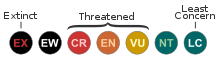
IUCN Red List of Threatened Plants Status : Lower Risk/near threatened.
| Related Plants
|
| Latin Name | Common Name | Habit | Height | Hardiness | Growth | Soil | Shade | Moisture | Edible | Medicinal | Other |
| Ilex aculeolata | | Shrub | 3.0 |
-
| | LMH | SN | M | 1 | 0 | |
| Ilex aquifolium | Holly, English holl, Christmas Holly, Common Holly, English Holly | Shrub | 9.0 |
5-9
| S | LMH | FSN | DM | 2 | 2 | 4 |
| Ilex asprella | | Shrub | 3.0 |
-
| | LMH | SN | M | 0 | 2 | |
| Ilex cassine | Cassine, Dahoon, Cassine Holly | Tree | 10.0 |
7-11
| S | LMH | SN | M | 1 | 1 | 2 |
| Ilex chapaensis | | Shrub | 10.0 |
-
| | LMH | SN | M | 1 | 0 | |
| Ilex coriacea | Large Gallberry | Shrub | 3.0 |
6-9
| | LMH | SN | M | 1 | 0 | |
| Ilex cornuta | Horned Holly, Chinese holly | Shrub | 4.0 |
7-9
| M | LMH | SN | M | 1 | 2 | |
| Ilex crenata | Japanese Holly, Box Leaved Holly | Shrub | 5.0 |
6-8
| S | LMH | SN | M | 1 | 0 | 3 |
| Ilex glabra | Inkberry | Shrub | 3.0 |
3-7
| S | LMH | SN | M | 1 | 0 | 2 |
| Ilex integra | Mochi Tree | Tree | 6.0 |
6-9
| | LMH | SN | M | 1 | 0 | |
| Ilex latifolia | Tarajo | Tree | 10.0 |
6-9
| | LMH | SN | M | 1 | 0 | |
| Ilex macropoda | | Tree | 13.0 |
6-9
| | LMH | SN | M | 1 | 0 | |
| Ilex opaca | American Holly | Shrub | 15.0 |
4-8
| S | LMH | SN | M | 2 | 2 | 3 |
| Ilex pedunculosa | | Shrub | 10.0 |
4-8
| | LMH | SN | M | 1 | 1 | 3 |
| Ilex pubescens | | Shrub | 3.5 |
7-10
| | LMH | SN | M | 0 | 2 | |
| Ilex purpurea | | Tree | 12.0 |
7-10
| | LMH | SN | M | 0 | 2 | |
| Ilex rotunda | Kurogane holly | Tree | 20.0 |
6-9
| | LMH | SN | M | 0 | 1 | |
| Ilex verticillata | Winterberry, Common winterberry | Shrub | 2.0 |
3-7
| S | LMH | SN | MWe | 1 | 3 | |
| Ilex vomitoria | Yaupon Holly, | Shrub | 6.0 |
6-9
| S | LMH | SN | M | 1 | 1 | 3 |
| Ilex x altaclerensis | Holly | Shrub | 4.0 |
5-9
| S | LMH | SN | M | 0 | 0 | 3 |
| Ilex yunnanensis | | Shrub | 4.0 |
5-9
| | LMH | SN | M | 0 | 1 | |
| Quercus ilex | Holly Oak, Evergreen Oak | Tree | 25.0 |
7-10
| S | LMH | SN | M | 5 | 2 | 3 |
| Quercus ilex ballota | Holm Oak | Tree | 25.0 |
6-9
| S | LMH | SN | M | 5 | 2 | 3 |
|
Growth: S = slow M = medium F = fast. Soil: L = light (sandy) M = medium H = heavy (clay). pH: A = acid N = neutral B = basic (alkaline). Shade: F = full shade S = semi-shade N = no shade. Moisture: D = dry M = Moist We = wet Wa = water.
Now available:
Food Forest Plants for Mediterranean Conditions
350+ Perennial Plants For Mediterranean and Drier Food Forests and Permaculture Gardens.
[Paperback and eBook]
This is the third in Plants For A Future's series of plant guides for food forests tailored to
specific climate zones. Following volumes on temperate and tropical ecosystems, this book focuses
on species suited to Mediterranean conditions—regions with hot, dry summers and cool, wet winters,
often facing the added challenge of climate change.
Read More
Expert comment
Author
A.St.-Hil.
Botanical References
Links / References
For a list of references used on this page please go here
A special thanks to Ken Fern for some of the information used on this page.
Readers comment
| Add a comment |
|
If you have important information about this plant that may help other users please add a comment or link below. Only comments or links that are felt to be directly relevant to a plant will be included. If you think a comment/link or information contained on this page is inaccurate or misleading we would welcome your feedback at [email protected]. If you have questions about a plant please use the Forum on this website as we do not have the resources to answer questions ourselves.
* Please note: the comments by website users are not necessarily those held by PFAF and may give misleading or inaccurate information.
|
Subject : Ilex paraguariensis
|
|
|
|