 |
|
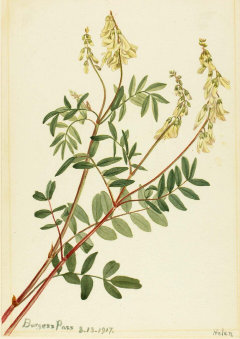
Mary Vaux Walcott. Public domain |
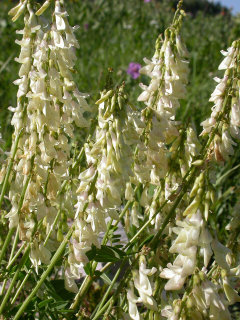 |
| Matt Lavin from Bozeman, Montana, USA. Creative Commons Attribution-Share Alike 2.0 |
Translate this page:
Summary
White sweetvetch (Hedysarum sulphurescens), also known as yellow or sulphur sweetvetch, is one of the rarest members of the North American Hedysarum genus. Native primarily to the central Rocky Mountains, it grows in mountain meadows, open forests and subalpine grasslands where cold winters, deep snow and short growing seasons favour hardy perennial wildflowers. Like its close relatives, it belongs to the pea family (Fabaceae), enriching soils through nitrogen fixation while producing attractive spikes of pale yellow to creamy-white flowers that support a wide variety of native pollinating insects. Although seldom mentioned in modern foraging literature, the roots have traditionally been regarded as edible and appear to share many characteristics with the better-known Alpine chainpod (Hedysarum alpinum) and Western chainpod (Hedysarum occidentale). However, very little detailed information has been published regarding their flavour, texture or historical importance. Most ethnobotanical references simply list the roots as edible without further comment. Today, white sweetvetch is valued primarily as a native mountain wildflower, restoration species and pollinator plant rather than as a food crop. Nevertheless, its edible roots, attractive flowers and ecological importance make it an interesting species for native food gardens and conservation plantings throughout suitable climates.
Physical Characteristics

 Hedysarum sulphurescens is a PERENNIAL growing to 0.7 m (2ft 4in) by 0.3 m (1ft) at a slow rate.
See above for USDA hardiness. It is hardy to UK zone 5. The flowers are pollinated by Bees, Insects.
It can fix Nitrogen.
It is noted for attracting wildlife.
Suitable for: light (sandy) and medium (loamy) soils, prefers well-drained soil and can grow in nutritionally poor soil. Suitable pH: mildly acid, neutral and basic (mildly alkaline) soils. It can grow in semi-shade (light woodland) or no shade. It prefers moist soil and can tolerate drought.
UK Hardiness Map
US Hardiness Map
Synonyms
Hedysarum boreale var. flavescens B.Fedtsch. Hedysarum flavescens J.M.Coult. & Fisher
Plant Habitats
Edible Uses
Among North America’s four native Hedysarum species, white sweetvetch is perhaps the least studied from a culinary perspective. Ethnobotanical references consistently describe the roots as edible, yet provide remarkably little detail regarding their preparation or importance compared with the extensive documentation available for Alpine chainpod [2-3]. The edible portion is the fleshy perennial taproot. Like other members of the genus, the roots are richest in stored carbohydrates during autumn after the growing season has ended and again during early spring before new shoots emerge. These seasons have traditionally been considered the best times for harvesting perennial root crops [2-3]. Although published descriptions of flavor are scarce, the roots are generally believed to resemble those of other edible Hedysarum species. Fresh roots are likely to possess a mild, slightly sweet, and pleasantly starchy flavor with subtle earthy notes typical of perennial legumes. Cooking probably softens the texture further while enhancing their natural sweetness. The roots may be eaten raw when young, although cooking would generally be expected to improve both digestibility and flavor. Boiling, roasting or baking are likely to produce the best results, as with other chainpods [2-3]. Unlike northern chainpod (Hedysarum boreale), there are no published reports suggesting that white sweetvetch possesses toxic properties or has caused illness following traditional consumption. Likewise, there are no accounts describing exceptional culinary qualities comparable to those of Alpine chainpod. Because relatively few detailed field studies have examined this species, its true food value remains somewhat uncertain. It is entirely possible that its restricted geographical distribution, rather than any deficiency in flavor, accounts for the limited historical documentation. Overall, white sweetvetch appears to be a genuinely edible native root crop with moderate food potential, although considerably more research would be valuable. Until additional information becomes available, it should be regarded as a minor edible rather than a significant staple food [2-3]. Edibility Rating of 2/5 seems appropriate. The species is edible and apparently safe, but the lack of detailed ethnobotanical information, modest root size and limited traditional use prevent a higher rating.
References More on Edible Uses
Medicinal Uses
Plants For A Future can not take any responsibility for any adverse effects from the use of plants. Always seek advice from a professional before using a plant medicinally.
There are no officially documented medical properties or uses for Hedysarum sulphurescens. However, the broader genus Hedysarum includes plants used in traditional medicine. These related species are studied for compounds that may fight bacteria and inflammation, act as antioxidants, and boost immunity. Do not consume Hedysarum sulphurescens or use it for medical treatment. Some plants in this family contain toxins that can cause severe illness.
References More on Medicinal Uses
The Bookshop: Edible Plant Books
Our Latest books on Perennial Plants For Food Forests and Permaculture Gardens in paperback or digital formats.
Edible Tropical Plants
Food Forest Plants for Hotter Conditions: 250+ Plants For Tropical Food Forests & Permaculture Gardens.
More
Edible Temperate Plants
Plants for Your Food Forest: 500 Plants for Temperate Food Forests & Permaculture Gardens.
More
More Books
PFAF have eight books available in paperback and digital formats. Browse the shop for more information.
Shop Now
Other Uses
Valued primarily as a native mountain wildflower, restoration species, and pollinator plant. Its attractive flowers and ecological importance make it an interesting species for native food gardens and conservation plantings throughout suitable climates. Rarely cultivated outside native plant collections but has considerable potential for ecological landscaping and restoration projects. Its attractive pale flowers, drought tolerance, and nitrogen-fixing ability make it well suited to mountain gardens and naturalistic plantings. Wildlife and Ecology: White sweetvetch plays an important ecological role within Rocky Mountain meadows and open forests. Its nitrogen-fixing roots contribute to soil fertility while its flowers provide valuable forage for native pollinating insects throughout the growing season. The foliage is browsed by deer, elk and other herbivores, while the seeds provide food for small mammals and birds. Like other perennial legumes, the plant contributes to healthy mountain grassland ecosystems by improving soil quality and increasing botanical diversity. Although its edible qualities remain less thoroughly documented than those of Alpine chainpod, white sweetvetch represents another example of the remarkable diversity within the Hedysarum genus. Its combination of attractive flowers, ecological value, cold hardiness and edible roots makes it an interesting native perennial deserving greater study. Future ethnobotanical and horticultural research may yet demonstrate that this uncommon mountain species has greater food potential than historical records presently suggest.
Special Uses
References More on Other Uses
Cultivation details
White sweetvetch is adapted to cool mountain climates where snow cover protects dormant plants throughout winter. It grows best in full sun or light shade on well-drained soils ranging from sandy loams to gravelly mountain substrates. Like other legumes, it forms nitrogen-fixing nodules that allow successful growth on relatively infertile soils. Established plants tolerate periods of summer drought surprisingly well despite their occurrence in relatively moist mountain environments. Cold winters appear essential for long-term performance, making the species most suitable for temperate and continental climates. Habitat and Distribution: White sweetvetch has one of the smallest distributions within the genus. It occurs primarily in Wyoming, Montana, and Idaho, with scattered populations extending into adjacent portions of the Rocky Mountains. Typical habitats include mountain meadows, open conifer forests, subalpine grasslands, rocky slopes, and woodland edges where snow persists well into spring. Flowering generally occurs from June through August, depending upon elevation. Cultivation: White sweetvetch is rarely cultivated outside native plant collections but has considerable potential for ecological landscaping and restoration projects. Its attractive pale flowers, drought tolerance, and nitrogen-fixing ability make it well suited to mountain gardens and naturalistic plantings. Plants establish slowly from seed while developing deep taproots and become increasingly drought-tolerant with age. Once established, they require little maintenance beyond protection from aggressive perennial weeds during the first few years. As with other Hedysarum species, mature plants resent disturbance because of their deep perennial root systems. Size: White sweetvetch typically grows between 30 and 70 cm tall, producing upright flowering stems from a perennial crown and deep taproot. The plant gradually forms small clumps but does not spread aggressively, making it well suited to mixed native plantings. Identification: White sweetvetch shares the pinnate leaves, papilionaceous flowers and segmented chain-like seed pods that distinguish all members of the genus. Its most distinctive feature is the pale yellow to creamy-white flowers, which immediately separate it from the pink- and purple-flowered species commonly encountered elsewhere in western North America. The mature loments consist of several flattened seed-bearing segments joined into characteristic chains that readily break apart at maturity. Like all Hedysarum species, the chain-like fruits distinguish it from superficially similar locoweeds (Astragalus and Oxytropis), which produce ordinary legumes rather than loments. Pollinators: The flowers provide abundant nectar and pollen for native bees, particularly bumblebees and other long-tongued species adapted to pollinating pea flowers. Butterflies occasionally visit the flowers, while honeybees readily forage where populations occur. Successful seed production depends primarily upon insect pollination.
References Carbon Farming Information and Carbon Sequestration Information
Temperature Converter
Type a value in the Celsius field to convert the value to Fahrenheit:
Fahrenheit:
The PFAF Bookshop
Plants For A Future have a number of books available in paperback and digital form. Book titles include Edible Plants, Edible Perennials, Edible Trees,Edible Shrubs, Woodland Gardening, and Temperate Food Forest Plants. Our new book is Food Forest Plants For Hotter Conditions (Tropical and Sub-Tropical).
Shop Now
Plant Propagation
Propagation is normally from seed. Like most legumes, the seeds possess hard seed coats that benefit from scarification before sowing. Cold stratification following scarification generally improves germination. Young seedlings should be transplanted while small to avoid damaging the developing taproot. Division is generally unsuccessful because mature plants resent disturbance.
Other Names
If available other names are mentioned here
Yellow sweetvetch or sulphur sweetvetch
Native Range
US. USA. Alberta, British Columbia, Idaho, Montana, Oregon, Washington, Wyoming.
Weed Potential
Right plant wrong place. We are currently updating this section.
Please note that a plant may be invasive in one area but may not in your area so it's worth checking.
White sweetvetch has essentially no weed potential. It spreads slowly, establishes gradually, and remains confined to suitable mountain habitats. Its relatively slow growth and specialized habitat requirements prevent it from becoming invasive.
Conservation Status
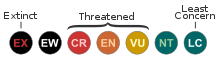
IUCN Red List of Threatened Plants Status : Not listed.
Growth: S = slow M = medium F = fast. Soil: L = light (sandy) M = medium H = heavy (clay). pH: A = acid N = neutral B = basic (alkaline). Shade: F = full shade S = semi-shade N = no shade. Moisture: D = dry M = Moist We = wet Wa = water.
Now available:
Food Forest Plants for Mediterranean Conditions
350+ Perennial Plants For Mediterranean and Drier Food Forests and Permaculture Gardens.
[Paperback and eBook]
This is the third in Plants For A Future's series of plant guides for food forests tailored to
specific climate zones. Following volumes on temperate and tropical ecosystems, this book focuses
on species suited to Mediterranean conditions—regions with hot, dry summers and cool, wet winters,
often facing the added challenge of climate change.
Read More
Expert comment
Author
Rydb.
Botanical References
Links / References
For a list of references used on this page please go here
Readers comment
| Add a comment |
|
If you have important information about this plant that may help other users please add a comment or link below. Only comments or links that are felt to be directly relevant to a plant will be included. If you think a comment/link or information contained on this page is inaccurate or misleading we would welcome your feedback at [email protected]. If you have questions about a plant please use the Forum on this website as we do not have the resources to answer questions ourselves.
* Please note: the comments by website users are not necessarily those held by PFAF and may give misleading or inaccurate information.
|
Subject : Hedysarum sulphurescens
|
|
|
|