 |
|
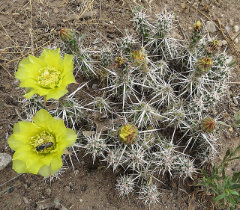
JerryFriedman. Creative Commons Attribution-Share Alike 3.0 |
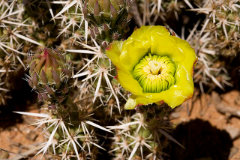 |
| Patrick Alexander. Creative Commons Zero, Public Domain Dedication |
Translate this page:
Summary
Dagger club cholla is a low-growing, ground-hugging cactus of the Southwest that differs noticeably from the more upright Cylindropuntia species. Its club-shaped stem joints and compact habit give it a distinctive architectural form, though its formidable glochids make close encounters memorable. Historically, it was regarded as an emergency food rather than a preferred resource. Both stems and fruits are edible after careful preparation, but the plant’s relative scarcity and small biomass limit its practical value to foragers.
Physical Characteristics

 Grusonia clavata is an evergreen Shrub growing to 0.4 m (1ft 4in) by 0.4 m (1ft 4in) at a medium rate.
See above for USDA hardiness. It is hardy to UK zone 7. The flowers are pollinated by Bees, Insects.
It is noted for attracting wildlife.
Suitable for: light (sandy) and medium (loamy) soils, prefers well-drained soil and can grow in nutritionally poor soil. Suitable pH: neutral and basic (mildly alkaline) soils. It cannot grow in the shade. It prefers dry soil and can tolerate drought.
UK Hardiness Map
US Hardiness Map
Synonyms
Cactus clavatus (Engelm.) Lem. Corynopuntia clavata (Engelm.) F.M.Knuth. Cylindropuntia clavata (Engelm.) F.M.Knuth. Opuntia clavata Engelm.
Plant Habitats
Edible Uses
Edible stems and fruits provide emergency nourishment after careful preparation, but small yields and hazardous spines restrict this species to occasional use [2-3]. Edible Uses & Rating: The stems and fruits are edible after de-spining. However, the stems contain relatively little flesh due to the plant’s compact growth habit. Fruits provide somewhat more usable material but still require substantial effort to process safely. Overall rating: Minor survival food; not a primary foraging target [2-3]. Taste, Processing & Kitchen Notes: Flavor is typical of many chollas — mildly vegetal with faint sweetness when cooked — but not remarkable. The primary challenge is mechanical rather than culinary. Glochids must be completely removed before preparation. Traditional abrasion methods, such as burning or repeated brushing, are necessary steps. Cooking softens the tissues and reduces mucilage, making the plant more palatable. Straining cooked pulp is strongly recommended to prevent hidden spines from entering the final food. Given the effort required, dagger club cholla is best viewed as a contingency resource rather than a staple [2-3]. Seasonality (Phenology): Flowering typically occurs from May through June, with fruits maturing from August through October. As with many desert cacti, fruit production varies depending on rainfall patterns [2-3]. Safety & Cautions (Food Use): Glochids represent a serious hazard and can remain embedded even after cooking if not removed beforehand. Always harvest with tongs and thick gloves. Given its limited edible mass, unnecessary harvesting should be avoided where populations are sparse [2-3]. Harvest & Processing Workflow: Harvest stems or fruits using tools. Remove glochids through abrasion, burning, or brushing. Cook thoroughly before consumption, and strain any pulp to ensure spine removal. Because yields are low, harvesting is best reserved for situations in which more productive species are unavailable [2-3]. Traditional / Indigenous Use Summary: Dagger club cholla was historically utilized by the Acoma and Laguna peoples, primarily when preferred foods were scarce. This pattern reinforces its role as a fallback resource rather than a staple. Cultivar/Selection Notes: No cultivars exist. Wild populations display modest variation in spine density and growth form. Look-Alikes & Confusion Risks: Distinguished from Cylindropuntia species by its club-shaped joints rather than cylindrical ones. Confusion is unlikely once this feature is recognized. As with most chollas, misidentification rarely poses toxicological risk — only physical discomfort [2-3].
References More on Edible Uses
Medicinal Uses
Plants For A Future can not take any responsibility for any adverse effects from the use of plants. Always seek advice from a professional before using a plant medicinally.
Grusonia clavata (formerly Opuntia clavata), known commonly as the club cholla, has traditional, ethnobotanical, and potential pharmacological uses within its native range in New Mexico and surrounding regions. It belongs to the Cactaceae family, which is widely recognized for medicinal applications. Traditional and Potential Medical Uses: 1. Wound Healing and Skin Care: Historically, Native American peoples have utilized the flesh of various, often local, prickly pear types (including members of the Opuntia and Grusonia genera) by applying it to wounds, burns, and cuts to promote healing and reduce swelling. 2. Pain Relief: The sap and pads are often used as a poultice to treat localized pain, such as muscle aches and toothaches. 3. General Health and Nutrition: As part of the Opuntia complex (often referred to broadly in folk medicine contexts), the plant is considered a source of antioxidants. 4. Respiratory Issues: Similar species of prickly pear are used in traditional medicine to help with respiratory tract infections. Scientific Context: While specific, in-depth, modern clinical trials on Grusonia clavata itself are scarce in the provided search results, it shares chemical properties (such as high fiber and antioxidant content) with other Opuntia species that have been studied for their ability to: 1. Regulate blood sugar levels. 2. Lower cholesterol. 3. Provide antiviral properties.
References More on Medicinal Uses
The Bookshop: Edible Plant Books
Our Latest books on Perennial Plants For Food Forests and Permaculture Gardens in paperback or digital formats.
Edible Tropical Plants
Food Forest Plants for Hotter Conditions: 250+ Plants For Tropical Food Forests & Permaculture Gardens.
More
Edible Temperate Plants
Plants for Your Food Forest: 500 Plants for Temperate Food Forests & Permaculture Gardens.
More
More Books
PFAF have eight books available in paperback and digital formats. Browse the shop for more information.
Shop Now
Other Uses
An excellent candidate for dry gardens and collector landscapes where unusual cactus forms are desired. The dense spines provide protective shelter for small desert animals. Like many cacti, it contributes to microhabitat formation in otherwise exposed landscapes. Fruits may occasionally serve as moisture sources for wildlife.
Special Uses
References More on Other Uses
Cultivation details
Dagger club cholla is a resilient but modest cactus whose ecological value exceeds its culinary importance. Its compact habit and defensive armament define both its identity and its limitations as a food source. Growing Conditions: Dagger club cholla prefers full sun, extremely well-drained soils, and arid climates. It is well adapted to temperature extremes and tolerates moderate winter cold. Excess moisture is the plant’s primary enemy. Habitat & Range: This species is primarily found in New Mexico, often in desert flats, rocky soils, and open upland habitats. Its distribution is narrower than many chollas, contributing to its limited importance as a food plant. Size & Landscape Performance: Typically remaining under 40 cm tall, dagger club cholla spreads laterally, sometimes forming wide colonies over time. In desert landscaping, it functions more as a sculptural groundcover than a vertical accent. However, placement should always take into account the hazard posed by its spines. Cultivation (Horticulture): An excellent candidate for dry gardens and collector landscapes where unusual cactus forms are desired. Provide sharp drainage and avoid irrigation once established. Handling during planting should always involve tools. Pollinators: The yellow flowers attract native solitary bees, particularly cactus-specialist pollinators. Beetles and occasional flies may also visit the blooms. Because the flowers sit close to the ground, they are especially accessible to ground-foraging insects. Pests & Problems: Generally pest-resistant. Root rot can occur in poorly drained soils, and mechanical damage from animals may detach segments — often resulting in vegetative spread. Identification & Habit: This species forms spreading mats of thick, club-shaped stem segments that lie close to the ground. The joints are stout and densely armed with spines and glochids, creating an almost impenetrable defensive surface. Unlike taller chollas, dagger club cholla rarely forms shrub-like structures. Instead, it expands outward, rooting where segments contact the soil. During bloom, bright yellow flowers contrast sharply with the armored stems, followed by fleshy yellow fruits. Its compact form makes it unmistakable once learned. Family: Cactus family (Cactaceae). Genus: Grusonia. Common names: Dagger club cholla, devil’s club cholla. USDA Hardiness Zones: Approx. Zones 6–9. Typical Height: 10–40 cm. Typical Spread: 0.5–1.5 m (often wider than tall).
References Carbon Farming Information and Carbon Sequestration Information
Temperature Converter
Type a value in the Celsius field to convert the value to Fahrenheit:
Fahrenheit:
The PFAF Bookshop
Plants For A Future have a number of books available in paperback and digital form. Book titles include Edible Plants, Edible Perennials, Edible Trees,Edible Shrubs, Woodland Gardening, and Temperate Food Forest Plants. Our new book is Food Forest Plants For Hotter Conditions (Tropical and Sub-Tropical).
Shop Now
Plant Propagation
Propagation occurs easily through detached stem segments, which root upon contact with suitable soil. Seed propagation is possible but slow.
Other Names
If available other names are mentioned here
Dagger club cholla, devil’s club cholla. Cylindropuntia clavata. Opuntia clavata. Corynopuntia clavata.
Native Range
US. USA. New Mexico.
Weed Potential
Right plant wrong place. We are currently updating this section.
Please note that a plant may be invasive in one area but may not in your area so it's worth checking.
Low. Expansion is gradual and predictable.
Conservation Status
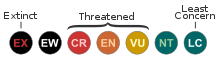
IUCN Red List of Threatened Plants Status : Not available
Growth: S = slow M = medium F = fast. Soil: L = light (sandy) M = medium H = heavy (clay). pH: A = acid N = neutral B = basic (alkaline). Shade: F = full shade S = semi-shade N = no shade. Moisture: D = dry M = Moist We = wet Wa = water.
Now available:
Food Forest Plants for Mediterranean Conditions
350+ Perennial Plants For Mediterranean and Drier Food Forests and Permaculture Gardens.
[Paperback and eBook]
This is the third in Plants For A Future's series of plant guides for food forests tailored to
specific climate zones. Following volumes on temperate and tropical ecosystems, this book focuses
on species suited to Mediterranean conditions—regions with hot, dry summers and cool, wet winters,
often facing the added challenge of climate change.
Read More
Expert comment
Author
(Engelm.) H.Rob.
Botanical References
Links / References
For a list of references used on this page please go here
Readers comment
| Add a comment |
|
If you have important information about this plant that may help other users please add a comment or link below. Only comments or links that are felt to be directly relevant to a plant will be included. If you think a comment/link or information contained on this page is inaccurate or misleading we would welcome your feedback at [email protected]. If you have questions about a plant please use the Forum on this website as we do not have the resources to answer questions ourselves.
* Please note: the comments by website users are not necessarily those held by PFAF and may give misleading or inaccurate information.
|
Subject : Grusonia clavata
|
|
|
|