 |
|
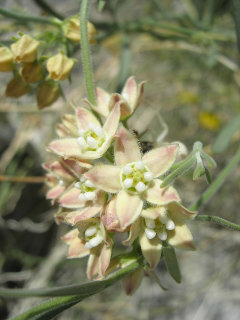
joedecruyenaere. Creative Commons Attribution-Share Alike 2.0 |
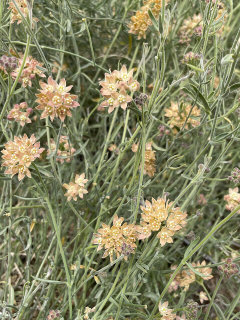 |
| Matt Berger. Creative Commons Attribution 4.0 |
Translate this page:
Summary
Hairy milkvine is a widespread desert species of the Mojave and Colorado deserts. Although not one of the most desirable wild vegetables, its cooked leaves can provide a useful seasonal green. Hairy milkvine (Funastrum hirtellum) belongs to the Dogbane family (Apocynaceae). Common names include hairy milkvine, hairy twinevine, and hairy rope-star. It is a perennial desert vine generally suited to USDA Zones 8–11.
Physical Characteristics

 Funastrum hirtellum is a PERENNIAL CLIMBER growing to 1.2 m (4ft) by 0.3 m (1ft in) at a medium rate.
See above for USDA hardiness. It is hardy to UK zone 9. The flowers are pollinated by Bees, Insects.
Suitable for: light (sandy), medium (loamy) and heavy (clay) soils, prefers well-drained soil and can grow in nutritionally poor soil. Suitable pH: mildly acid, neutral and basic (mildly alkaline) soils. It cannot grow in the shade. It prefers dry or moist soil and can tolerate drought.
UK Hardiness Map
US Hardiness Map
Synonyms
Philibertella hirtella (A.Gray) Vail. Philibertia hirtella (A.Gray) Parish. Philibertia linearis var. hirtella (A.Gray) A.Gray. Sarcostemma heterophyllum var. hirtellum A.Gray. Sarcostemma hirtellum (A.Gray) R.Holm.
Plant Habitats
Edible Uses
The leaves are edible after cooking. Raw consumption is not recommended [2-3]. Edible Uses & Rating: Low to moderate food value. The leaves are usable but relatively small and labor-intensive to gather [2-3]. Taste, Processing & Kitchen Notes: Cooked leaves have a reasonably pleasant flavor. Unfortunately, the hairy leaf surfaces create a raspy texture that remains noticeable even after cooking. The flowers are also palatable but are not widely documented as edible. Boiling reduces bitterness and latex-related flavors [2-3]. Seasonality (Phenology): Blooms primarily from February through May. Tender leaves are available during the active growing season. Safety & Cautions (Food Use): Contains milky latex like all milkvines. Thorough cooking is essential. Consume only in moderation [2-3]. Harvest & Processing Workflow: Collect young leaves, rinse thoroughly, boil until tender, and discard the cooking water if desired. Cultivar/Selection Notes: No cultivated forms are known. Look-Alikes & Confusion Risks: Closely resembles other milkvines, especially when not in flower. Traditional and Historical Uses: Limited use of food has been recorded compared with other desert vegetables [2-3].
References More on Edible Uses
Medicinal Uses
Plants For A Future can not take any responsibility for any adverse effects from the use of plants. Always seek advice from a professional before using a plant medicinally.
Funastrum hirtellum, commonly known as rambling milkweed or hairy milkweed, has no documented modern or traditional medicinal uses. Like many plants in the dogbane or milkweed family (Apocynaceae), it contains toxic latex and should be considered poisonous rather than medicinal
References More on Medicinal Uses
Other Uses
Supports numerous native pollinators including bees, butterflies, and wasps.
Special Uses
References More on Other Uses
Cultivation details
A serviceable cooked green, but not among the better edible plants of the desert Southwest US. Growing Conditions: Prefers dry desert habitats, rocky slopes, washes, and open shrublands. Habitat & Range: Primarily found in the Mojave and Colorado deserts of California, Nevada, Arizona, and adjacent regions. Size & Growth Habit: A perennial twining or sprawling vine reaching up to several meters in length. Pollinators: Supports numerous native pollinators, including bees, butterflies, and wasps. Weed Potential: Low. Identification Features; Twining stems with milky sap, opposite hairy leaves, clusters of attractive flowers, and elongated seedpods typical of milkweed relatives. Hairy milkvine (Funastrum hirtellum) belongs to the Dogbane family (Apocynaceae). Common names include hairy milkvine, hairy twinevine, and hairy rope-star. It is a perennial desert vine generally suited to USDA Zones 8–11.
References Carbon Farming Information and Carbon Sequestration Information
Temperature Converter
Type a value in the Celsius field to convert the value to Fahrenheit:
Fahrenheit:
Plant Propagation
Seed.
Other Names
If available other names are mentioned here
Hairy milkvine, hairy twinevine, and hairy rope-star.
Native Range
US. USA. Arizona, California, Mexico Northwest, Nevada.
Weed Potential
Right plant wrong place. We are currently updating this section.
Please note that a plant may be invasive in one area but may not
in your area so it's worth checking.
Low. Native and generally well-behaved within its natural range.
Conservation Status
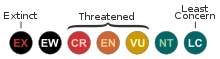
IUCN Red List of Threatened Plants Status : Not listed.
IUCN Red List
Growth: S = slow M = medium F = fast. Soil: L = light (sandy) M = medium H = heavy (clay). pH: A = acid N = neutral B = basic (alkaline). Shade: F = full shade S = semi-shade N = no shade. Moisture: D = dry M = Moist We = wet Wa = water.
Support Plants For A Future
Plants For A Future relies on regular donations to keep our free database and search facilities going, to pay for ongoing research, improvements and enhancements, and to develop and publish new books.
Read more
Choose Currency
Donate in £ GBP
Donate in $ USD
Donate in € EUR
Securely pay via PayPal or Credit/Debit Card without an account.
Expert comment
Author
(A.Gray) Schltr.
Botanical References
Links / References
For a list of references used on this page please go here
Readers comment
| Add a comment |
|
If you have important information about this plant that may help other users please add a comment or link below. Only comments or links that are felt to be directly relevant to a plant will be included. If you think a comment/link or information contained on this page is inaccurate or misleading we would welcome your feedback at [email protected]. If you have questions about a plant please use the Forum on this website as we do not have the resources to answer questions ourselves.
* Please note: the comments by website users are not necessarily those held by PFAF and may give misleading or inaccurate information.
|
Subject : Funastrum hirtellum
|
|
|
|