 |
|
http://www.flickr.com/people/93452909@N00 |
 |
|
Translate this page:
Summary
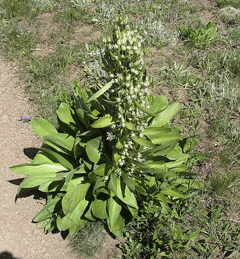
Elkweed is one of the most dramatic wildflowers of western North America. For many years it grows quietly as a large leafy rosette, storing energy in a substantial taproot. Then, after sufficient reserves are built, it sends up a tall flowering stalk, produces seed, and often dies. This life history gives rise to the name “monument plant.” Although the roots are reported edible, their extreme bitterness and unpleasant flavor make them one of the least appealing wild foods. Elkweed, Frasera speciosa, belongs to the gentian family (Gentianaceae) and the genus Frasera. Common names include elkweed, monument plant, green gentian, and deer’s ears. It is a long-lived perennial of western mountain meadows, generally suited to USDA Zones 3–7. Young plants remain as basal rosettes for years, while flowering plants may reach about 70–220 cm tall, with rosettes usually spreading 30–80 cm across.
Physical Characteristics

 Frasera speciosa is a BIENNIAL/PERENNIAL growing to 1.5 m (5ft) by 0.7 m (2ft 4in) at a slow rate.
See above for USDA hardiness. It is hardy to UK zone 3. It is in flower from July to August. The species is hermaphrodite (has both male and female organs) and is pollinated by Bees, insects.
It is noted for attracting wildlife.
Suitable for: light (sandy) and medium (loamy) soils and prefers well-drained soil. Suitable pH: mildly acid and neutral soils. It can grow in semi-shade (light woodland) or no shade. It prefers moist soil.
UK Hardiness Map
US Hardiness Map
Synonyms
Swertia radiata. Kuntze.
Plant Habitats
Woodland Garden Dappled Shade; Shady Edge;
Edible Uses
Edible Parts: Root
Edible Uses:
The root is the only reported edible part. Other parts should be considered inedible. Even the root is of very poor culinary quality and should not be treated as a desirable food [2-3]. Edible Uses & Rating: Elkweed ranks very low as a food plant. The root is large and starchy-looking, but the flavor is powerfully bitter and gentian-like. Its food value is mostly historical or survival-related rather than practical [2-3]. Taste, Processing & Kitchen Notes: The root can be carrot-sized, white inside, and covered with dark brown skin. Texture may soften with cooking, but the flavor remains intensely unpleasant. Boiling produces yellow, bitter water similar to gentian tea. Baking in earth ovens or fire pits may soften the root, but it does not remove the strong bitterness. It should not be cooked with other foods because it can ruin the whole dish [2-3]. Seasonality (Phenology): Young rosettes are present for years before flowering. Flowering occurs mainly from June to August. Roots are best gathered, if at all, from younger non-flowering rosettes, before the plant invests its stored energy into the tall flowering stalk [2-3]. Safety & Cautions (Food Use): Use caution. The gentian family contains many bitter, medicinally active plants. The root is reported edible but is not pleasant and may be physiologically active. Avoid eating large amounts, and do not use the aerial parts as food [2-3]. Harvest & Processing Workflow: If harvested in a survival or experimental context, select only abundant young rosettes, dig the taproot carefully, peel or clean the dark outer skin, slice, and cook separately from all other foods. Boiling water should be discarded. Because the plant is long-lived and slow to flower, harvesting should be extremely conservative [2-3]. Cultivar/Selection Notes: No food cultivars are known. In horticulture, it is grown or admired for its spectacular flowering habit rather than edibility [2-3]. Look-Alikes & Confusion Risks: Young rosettes may be confused with other large-leaved mountain forbs. Flowering plants are distinctive because of their tall unbranched stems, whorled leaves, greenish-yellow purple-spotted flowers, and fringed nectary pits. Traditional/Indigenous Use Summary: The roots were reportedly baked in fire pits in some traditional contexts, but this does not mean they were widely favoured. The plant appears to have been used more as a difficult emergency or medicinal food than as a preferred staple [2-3]. Root[105, 106, 155, 161]. It has been reported that the N. American Indians ate the fleshy root of this plant, but caution is advised since the roots of closely related plants are used medicinally as emetics and cathartics[212]. See the notes above on toxicity.
References More on Edible Uses
Medicinal Uses
Plants For A Future can not take any responsibility for any adverse effects from the use of plants. Always seek advice from a professional before using a plant medicinally.
Contraceptive Febrifuge Laxative Parasiticide Stomachic Tonic
The whole plant is febrifuge, pectoral, laxative and tonic[155, 257]. An infusion of the dried, powdered leaves, or the root, has been used in the treatment of diarrhoea[257]. A cooled decoction of the roots has been used in the treatment of asthma, colds, digestive complaints etc[257]. An infusion of the plant has been used as a contraceptive[213]. Caution is advised in the use of this plant, see the notes above on toxicity.
References More on Medicinal Uses
The Bookshop: Edible Plant Books
Our Latest books on Perennial Plants For Food Forests and Permaculture Gardens in paperback or digital formats.
Edible Tropical Plants
Food Forest Plants for Hotter Conditions: 250+ Plants For Tropical Food Forests & Permaculture Gardens.
More
Edible Temperate Plants
Plants for Your Food Forest: 500 Plants for Temperate Food Forests & Permaculture Gardens.
More
More Books
PFAF have eight books available in paperback and digital formats. Browse the shop for more information.
Shop Now
Other Uses
Parasiticide
The root, when ground into a powder and mixed with oil, has been used as a parasiticide to kill lice [155]. Ecology & Wildlife: Elkweed provides structural complexity and nectar resources to mountain meadows. Its large rosettes and dramatic flowering stalks are part of the seasonal character of western high-country plant communities.
Special Uses
References More on Other Uses
Cultivation details
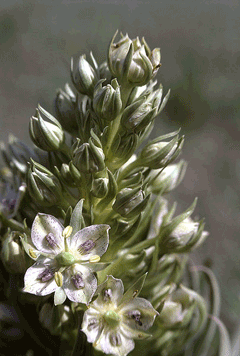
Elkweed is visually magnificent but culinarily poor. Its ecological and ornamental value greatly exceed its food value. It is a plant to admire, study, and protect rather than seek out for eating. Growing Conditions: It prefers cool mountain climates, full sun to light shade, and moist but well-drained meadow soils. It grows best where snowmelt or seasonal moisture supports spring growth. Habitat & Range: Elkweed occurs widely in the western United States, especially in mountain meadows, open forests, and high-elevation grasslands. Size & Landscape Performance: As a rosette, it is bold and architectural. When flowering, it becomes a towering meadow accent. Its flowering event can dominate a planting visually. Cultivation (Horticulture): It can be grown in cool-climate native gardens or meadow plantings, but patience is required. Plants may take many years to flower. It is unsuitable for hot lowland gardens. Pests & Problems: Generally, few serious pest problems. The main difficulties are slow growth, habitat specificity, and poor tolerance of hot, dry lowland conditions. Identification & Habit: A robust perennial with large basal rosettes, whorled stem leaves, and tall flowering stalks. Flowers are light greenish-yellow with purple spots, each corolla lobe bearing two fringed nectary glands. Pollinators: The large flowering stalks attract flies, bees, beetles, and other meadow insects. The exposed nectary glands make the flowers accessible to a range of pollinators. Requires a moist but well-drained position and a stony peaty soil[1, 200]. Requires an acidic soil[200]. A very ornamental plant[1]. Elkweed, Frasera speciosa, belongs to the gentian family (Gentianaceae) and the genus Frasera. Common names include elkweed, monument plant, green gentian, and deer’s ears. It is a long-lived perennial of western mountain meadows, generally suited to USDA Zones 3–7. Young plants remain as basal rosettes for years, while flowering plants may reach about 70–220 cm tall, with rosettes usually spreading 30–80 cm across.
References Carbon Farming Information and Carbon Sequestration Information
Temperature Converter
Type a value in the Celsius field to convert the value to Fahrenheit:
Fahrenheit:
The PFAF Bookshop
Plants For A Future have a number of books available in paperback and digital form. Book titles include Edible Plants, Edible Perennials, Edible Trees,Edible Shrubs, Woodland Gardening, and Temperate Food Forest Plants. Our new book is Food Forest Plants For Hotter Conditions (Tropical and Sub-Tropical).
Shop Now
Plant Propagation
Propagation is by seed. Seedlings may take many years to reach flowering size. Division in late winter[200].
Other Names
If available other names are mentioned here
Elk weed, monument plant, green gentian, and deer’s ears.
Native Range
NORTHERN AMERICA: United States (South Dakota, Colorado, Montana, Oregon, Washington, Wyoming, New Mexico, Texas (west), Arizona, California, Nevada, Utah), Mexico (Coahuila de Zaragoza, Nuevo León)
Weed Potential
Right plant wrong place. We are currently updating this section.
Please note that a plant may be invasive in one area but may not
in your area so it's worth checking.
Low. Elkweed is slow-growing, habitat-specific, and not invasive.
Conservation Status
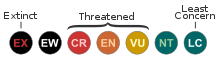
IUCN Red List of Threatened Plants Status : Not listed.
IUCN Red List
Growth: S = slow M = medium F = fast. Soil: L = light (sandy) M = medium H = heavy (clay). pH: A = acid N = neutral B = basic (alkaline). Shade: F = full shade S = semi-shade N = no shade. Moisture: D = dry M = Moist We = wet Wa = water.
Now available:
Food Forest Plants for Mediterranean Conditions
350+ Perennial Plants For Mediterranean and Drier Food Forests and Permaculture Gardens.
[Paperback and eBook]
This is the third in Plants For A Future's series of plant guides for food forests tailored to
specific climate zones. Following volumes on temperate and tropical ecosystems, this book focuses
on species suited to Mediterranean conditions—regions with hot, dry summers and cool, wet winters,
often facing the added challenge of climate change.
Read More
Expert comment
Author
Douglas.
Botanical References
71200
Links / References
For a list of references used on this page please go here
Readers comment
© 2010, Plants For A Future. Plants For A Future is a charitable company limited by guarantee, registered in England and Wales. Charity No. 1057719, Company No. 3204567.