 |
|
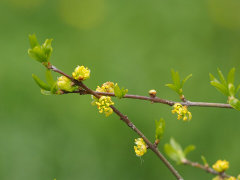
Agnieszka Kwiecien, Nova. Creative Commons Attribution-Share Alike 4.0 |
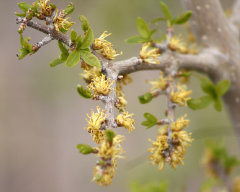 |
| Petrified Forest National Park. Creative Commons Attribution 2.0 |
Translate this page:
Summary
Desert olive is a tough native shrub of washes, canyons, desert edges, and dry stream corridors across the Southwest and south-central United States. It flowers very early, often before the leaves emerge, making it valuable for early insects and useful in native landscapes. Its bluish-purple fruits are technically edible in small amounts, but they are generally considered poor or questionable food. The fruits can be sweet when fully ripe, but bitterness, limited ethnobotanical use, and possible safety uncertainty make this a cautious-use plant rather than a recommended wild fruit. Desert olive, Forestiera pubescens var. pubescens, belongs to the olive family (Oleaceae) and the genus Forestiera. Common names include desert olive, stretchberry, wild privet, elbow bush, New Mexico privet, tanglewood, and spring herald. It is a deciduous shrub or small multi-stemmed tree, generally hardy in USDA Zones 4–9. Plants commonly grow about 1–4 m tall, sometimes taller in sheltered washes or canyon bottoms, with a spread of about 1–3 m. Oregon State describes Forestiera pubescens as a rounded, upright, thorny deciduous shrub 0.9–3 m tall, with purple-black fruits 5–8 mm long.
Physical Characteristics

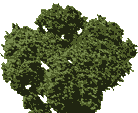 Forestiera pubescens var. pubescens is a SHRUB growing to 3 m (9ft) by 3 m (9ft) at a medium rate.
See above for USDA hardiness. It is hardy to UK zone 5. The flowers are pollinated by Bees, Insects.
It is noted for attracting wildlife.
Suitable for: light (sandy) and medium (loamy) soils, prefers well-drained soil and can grow in nutritionally poor soil. Suitable pH: mildly acid, neutral and basic (mildly alkaline) soils and can grow in very alkaline soils.
It can grow in semi-shade (light woodland) or no shade. It prefers dry or moist soil and can tolerate drought.
UK Hardiness Map
US Hardiness Map
Synonyms
Forestiera pubescens var. glabrifolia Shinners
Plant Habitats
Edible Uses
The ripe fruits are the only food part worth considering. They should be eaten only when fully ripe and only in small quantities. Unripe fruits are unpleasant and should be avoided. The fruit has been suggested as a substitute for true olive in some edible-plant references, but other sources describe it as bitter or generally inedible, so caution is warranted [2-3]. Edible Uses & Rating: Desert olive ranks as a low-to-moderate wild fruit. The best ripe fruits can be sweet, juicy, and fruit-like, but bitterness and uncertainty reduce its value. It is not a staple fruit and should not be eaten in large amounts. A fair rating would be 2/5 for food value, mainly because the fruit can be pleasant but remains questionable and minor [2-3]. Taste, Processing & Kitchen Notes: Fully ripe fruits are small, dusty, bluish-purple to purple-black drupes with thin flesh around a soft pit. The flavor may combine sweetness, moderate bitterness, and a faint olive-like quality, though it is fruitier than that of cultivated olives. Cooking does not significantly improve the fruit, and unripe fruit remains poor even after cooking. The best use is cautious fresh sampling of fully ripe fruits from productive shrubs. Processing into sauces, relishes, or olive-like preparations would be experimental [2-3]. Seasonality (Phenology): Desert olive flowers from late winter into spring, often February to May, before or as leaves appear. Fruits mature from mid-summer into autumn. A USDA NRCS fact sheet notes that stretchberry is dioecious, blooms in late March to mid-April in Montana trial conditions, and its dark bluish-black fruits mature in late August to September, with fruit often taken by birds before falling. Safety & Cautions (Food Use): Use caution. The fruits are probably nontoxic in small amounts but are often described as inedible or of minor value. Only fully ripe fruits should be sampled. Avoid meal-sized consumption, especially because the fruit’s limited traditional use suggests it was not considered an important or consistently safe food. Do not consume leaves, bark, or other plant parts as food [2-3]. Harvest & Processing Workflow: Harvest only fully ripe, bluish-purple or purple-black fruits that detach easily and taste sweet enough to justify use. Avoid green, hard, or strongly bitter fruits. Remove debris, rinse, and sample in small quantities. Because birds readily eat the fruit, the harvest window may be brief. Leave plenty for wildlife. Cultivar/Selection Notes: No food cultivars are widely known. For native landscaping, female plants are needed for fruit, and male plants are needed nearby for pollination because the species is often dioecious. Selection for gardens usually focuses on drought tolerance, early bloom, wildlife value, and screening form rather than fruit quality. Look-Alikes & Confusion Risks: Desert olive may be confused with privets, olives, or other opposite-leaved shrubs. The early petal-less flowers, opposite narrow leaves, often spine-tipped branches, and small purple-black drupes help identify it. It should not be confused with true olive, Olea europaea, which has a very different fruit chemistry and long-established food-processing methods [2-3]. Traditional/Indigenous Use Summary: Documented Indigenous food use appears limited. The fruits were reportedly eaten occasionally by Apache people, but they did not form an important food. This limited use is one of the main reasons to treat desert olive as a cautious minor fruit rather than a recommended staple [2-3].
References More on Edible Uses
Medicinal Uses
Plants For A Future can not take any responsibility for any adverse effects from the use of plants. Always seek advice from a professional before using a plant medicinally.
Desert Olive (Forestiera pubescens var. pubescens) is primarily a landscape and wildlife plant. While its leaves were used in some traditional Native American ceremonial practices as an emetic to induce vomiting, the plant has no widely recognized modern medicinal uses.
References More on Medicinal Uses
The Bookshop: Edible Plant Books
Our Latest books on Perennial Plants For Food Forests and Permaculture Gardens in paperback or digital formats.
Edible Tropical Plants
Food Forest Plants for Hotter Conditions: 250+ Plants For Tropical Food Forests & Permaculture Gardens.
More
Edible Temperate Plants
Plants for Your Food Forest: 500 Plants for Temperate Food Forests & Permaculture Gardens.
More
More Books
PFAF have eight books available in paperback and digital formats. Browse the shop for more information.
Shop Now
Other Uses
Ecology & Wildlife: Desert olive is valuable for birds and wildlife. The fruits are eaten by birds and may disappear before they fall, while dense branching provides cover and nesting structure. The shrub is useful in wildlife-friendly hedgerows and low-water native plantings. It is suitable for native hedgerows, dry streambeds, canyon gardens, and wildlife plantings. Plant both male and female individuals if fruit is desired.
Special Uses
References More on Other Uses
Cultivation details
Desert olive is a valuable native shrub but a questionable edible fruit. It is excellent for wildlife, early flowers, drought-tolerant landscaping, hedgerows, and erosion control. Its fruits are worth knowing but not worth relying on. The plant’s ecological and landscape value clearly exceeds its food value. Growing Conditions: Desert olive prefers full sun to partial shade, dry to moderately moist soils, and good drainage. It tolerates heat, drought, poor soils, alkaline conditions, and seasonal dryness. Oregon State notes that it grows best in sandy soil and has low water requirements. Habitat & Range: The accepted species Forestiera pubescens is native from the west-central and southwestern United States to northern Mexico. Plants of the World Online recognizes Forestiera pubescens as an accepted shrub species that grows primarily in the subtropical biome. Size & Landscape Performance: It performs well as a rugged native screen, wildlife hedge, erosion-control shrub, or dryland thicket-forming plant. It is not a lush ornamental, but its early yellowish flowers and purple-black fruits give seasonal interest. It may form thickets in moister parts of otherwise dry landscapes. Cultivation (Horticulture): Grow it in sun, lean soil, and low-water conditions once established. It is suitable for native hedgerows, dry streambeds, canyon gardens, and wildlife plantings. Plant both male and female individuals if fruit is desired. Pests & Problems: Few major pest issues are expected in suitable climates. Browsing, drought stress during establishment, and bird competition for fruit are more important practical issues. Its twiggy, thorny habit may require placement away from tight paths. Identification & Habit: Desert olive is a deciduous shrub or small tree with opposite or clustered narrow leaves, often spine-tipped branches, and small early flowers lacking obvious petals. Fruits are small, stalked, dark bluish-purple drupes with a waxy bloom and thin flesh. Pollinators: The small early flowers can support early-season insects. Gardenia describes desert olive as blooming on bare stems when the landscape is still mostly dormant, with flowers that attract early pollinators.
References Carbon Farming Information and Carbon Sequestration Information
Temperature Converter
Type a value in the Celsius field to convert the value to Fahrenheit:
Fahrenheit:
The PFAF Bookshop
Plants For A Future have a number of books available in paperback and digital form. Book titles include Edible Plants, Edible Perennials, Edible Trees,Edible Shrubs, Woodland Gardening, and Temperate Food Forest Plants. Our new book is Food Forest Plants For Hotter Conditions (Tropical and Sub-Tropical).
Shop Now
Plant Propagation
Propagation is by seed or cuttings. Seedlings may vary in sex, so fruit production requires female plants and a compatible pollen source nearby.
Other Names
If available other names are mentioned here
Desert olive, stretchberry, wild privet, elbow bush, New Mexico privet, tanglewood, and spring herald.
Native Range
US. USA. Mexico Northeast, Oklahoma, Texas.
Weed Potential
Right plant wrong place. We are currently updating this section.
Please note that a plant may be invasive in one area but may not in your area so it's worth checking.
Low to moderate. It may form thickets in suitable moist washes or riparian edges, but it is native and generally desirable in its range. It is not usually treated as an invasive weed.
Conservation Status
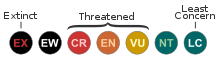
IUCN Red List of Threatened Plants Status : Not listed.
Growth: S = slow M = medium F = fast. Soil: L = light (sandy) M = medium H = heavy (clay). pH: A = acid N = neutral B = basic (alkaline). Shade: F = full shade S = semi-shade N = no shade. Moisture: D = dry M = Moist We = wet Wa = water.
Now available:
Food Forest Plants for Mediterranean Conditions
350+ Perennial Plants For Mediterranean and Drier Food Forests and Permaculture Gardens.
[Paperback and eBook]
This is the third in Plants For A Future's series of plant guides for food forests tailored to
specific climate zones. Following volumes on temperate and tropical ecosystems, this book focuses
on species suited to Mediterranean conditions—regions with hot, dry summers and cool, wet winters,
often facing the added challenge of climate change.
Read More
Expert comment
Author
Nutt.
Botanical References
Links / References
For a list of references used on this page please go here
Readers comment
| Add a comment |
|
If you have important information about this plant that may help other users please add a comment or link below. Only comments or links that are felt to be directly relevant to a plant will be included. If you think a comment/link or information contained on this page is inaccurate or misleading we would welcome your feedback at [email protected]. If you have questions about a plant please use the Forum on this website as we do not have the resources to answer questions ourselves.
* Please note: the comments by website users are not necessarily those held by PFAF and may give misleading or inaccurate information.
|
Subject : Forestiera pubescens var. pubescens
|
|
|
|