 |
|
John Owens (talk). Creative Commons Attribution 2.5 |
 |
| Bernard Gagnon Creative Commons Attribution-Share Alike 3.0 |
Translate this page:
Summary
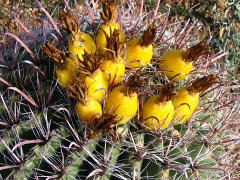
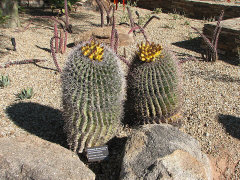
Arizona barrel cactus is one of the most famous and useful barrel cacti of the Southwest. It is often called compass barrel because older plants may lean southward. It has edible fruits, seeds, and stem tissue, though seeds and fruits are far more appropriate than destructive stem harvest. Its yellow fruits are persistent, conspicuous, and important to desert wildlife. Arizona barrel cactus, Ferocactus wislizeni, belongs to the cactus family (Cactaceae). Common names include Arizona barrel cactus, compass barrel, candy barrel, fishhook barrel cactus, and barrel cactus. It is generally suited to USDA Zones 8–11. Mature plants commonly reach about 40–120 cm tall and 25–60 cm wide, with some old individuals becoming larger. It is distributed from southeastern Arizona into southern New Mexico, El Paso County in Texas, and south into Mexico.
Physical Characteristics

 Ferocactus wislizeni is a SHRUB growing to 1.2 m (4ft) by 0.6 m (2ft in) at a slow rate.
See above for USDA hardiness. It is hardy to UK zone 9. The flowers are pollinated by Bees, Insects.
It is noted for attracting wildlife.
Suitable for: light (sandy) and medium (loamy) soils, prefers well-drained soil and can grow in nutritionally poor soil. Suitable pH: mildly acid, neutral and basic (mildly alkaline) soils and can grow in very alkaline soils.
It cannot grow in the shade. It prefers dry soil and can tolerate drought.
UK Hardiness Map
US Hardiness Map
Synonyms
Echinocactus wislizeni Engelm.
Plant Habitats
Edible Uses
The fruits, seeds, and processed stem tissue are edible. Seeds are the best and most sustainable food part. Fruits are edible but slimy and often vegetable-like. Stem tissue can be made into cactus candy but should not be harvested except in true survival situations because it kills the plant and may be unlawful [2-3]. Edible Uses & Rating: Arizona barrel cactus ranks as one of the better barrel cactus food plants, especially for seeds. Fruits are useful and often persistent. Stem candy is historically important but not an appropriate modern foraging use in most contexts [2-3]. Fruit[338 ]. Very acidic[1991 ]. The bright yellow, oblong fruit is around 35 - 60mm long and 18 - 40cm in diameter[270 , 411 ]. Seed[338 , 1987 ]. Ground into a powder and used to make a mush or as a flour[257 , 1438 ]. The seeds are rich in oil and protein, and can be ground into an oily paste[1991 ]. Stem[411 ]. It is said to taste like a cross between a potato and a cucumber[1991 ]. The pulp of the plant is cut into strips and boiled or baked[411 , 1991 ]. It is used to make a candy[1438 ]. A sweet dish is made by some native peoples. It is prepared by removing the top of the plant and the spines, then cutting the cactus into large slices, These slices were carried home and cut into small pieces, like potatoes, and, while fresh, were placed on top of dry mesquite beans in a pot with a little water and slowly boiled for a long time[1987 ]. The cooked buds and flowers have a flavour somewhat like that of Brussels sprouts. Sometimes the buds were eaten fresh, although they are bitter unless cooked[1991 ]. The liquid obtained by crushing the pulp inside the stem can be used as an emergency source of fluid[1987 , 1991 ]. It is said to be at least refreshing, though unpleasant and slimy to the taste[1987 ] Taste, Processing & Kitchen Notes: The fruits are yellow, scaly, slimy, juicy, and full of seeds. They can be tart or mildly sweet and may taste more like a vegetable than a fruit. Seeds should be separated, cleaned, dried, and gently toasted. Toasted barrel cactus seeds can be excellent, with a nutty, roasted grain-like character [2-3]. Seasonality (Phenology): Arizona barrel cactus blooms in mid to late summer, with yellow, orange, or red flowers near the crown. Fruits mature later, often becoming a late autumn to winter resource. PlantMaster notes yellow or red summer flowers followed by yellow pineapple-shaped fruits eaten by deer. Safety & Cautions (Food Use): Legal protection may apply. Do not cut stems or remove plants. Cactus juice from barrel stems is not true drinking water and can cause nausea or other distress. Fruits and seeds should be harvested lightly and legally. Spines are formidable and require tools. Harvest & Processing Workflow: Use tongs to collect ripe yellow fruits from the crown area without damaging the growing tip. Split the fruits, separate the seeds from the pulp, rinse if needed, dry well, and toast gently over low heat. Cook fruit pulp with savory foods if desired. Cultivar/Selection Notes: No food cultivars are widely used. Horticultural selection is usually based on spine color, plant form, flower color, and cold tolerance. Look-Alikes & Confusion Risks: It resembles California barrel cactus and other large Ferocactus species. Southward-leaning growth, fishhook-like central spines, yellow fruits, and the Arizona-Chihuahuan range help with recognition [2-3]. Traditional/Indigenous Use Summary: Arizona barrel cactus and related barrel cacti were long used by desert peoples for fruits, seeds, and processed stem tissue. Cactus candy was traditionally sweetened with desert syrups from other plants, not by the cactus itself [2-3].
References More on Edible Uses
Medicinal Uses
Plants For A Future can not take any responsibility for any adverse effects from the use of plants. Always seek advice from a professional before using a plant medicinally.
Ferocactus wislizeni (commonly known as the Arizona barrel cactus or fishhook barrel cactus) has a history of traditional medicinal uses. Salivary Gland Treatment: Indigenous groups, such as the Mahuna Native Americans, used cactus extracts to prevent and treat swelling of the salivary glands.General Medicinal Value: Like many cactus varieties, ethnobotanical research indicates that the plant exhibits bioactive properties often used to treat diverse ailments. While it is culturally known for these historical applications, in modern times, it is far more commonly valued as an emergency source of hydration and a nutrient-rich food, as the pulp, seeds, and flowers are rich in vitamins.
References More on Medicinal Uses
The Bookshop: Edible Plant Books
Our Latest books on Perennial Plants For Food Forests and Permaculture Gardens in paperback or digital formats.
Edible Tropical Plants
Food Forest Plants for Hotter Conditions: 250+ Plants For Tropical Food Forests & Permaculture Gardens.
More
Edible Temperate Plants
Plants for Your Food Forest: 500 Plants for Temperate Food Forests & Permaculture Gardens.
More
More Books
PFAF have eight books available in paperback and digital formats. Browse the shop for more information.
Shop Now
Other Uses
An outstanding desert specimen plant with strong architectural form, dramatic spines, and colorful summer flowers. The flowers are highly fragrant [1991]. It is also legally and illegally used for landscaping[2-6]. A yellow pigmentis obtained from the flowers by cooking them until they become foamy; sugar or honey and white ashes are added, and the mixture is used as a face paint [1987]. Ecology & Wildlife: Arizona barrel cactus is an important structural and food plant in desert ecosystems, providing pollen, nectar, fruits, seeds, and shelter around its spiny body.
Special Uses
References More on Other Uses
Cultivation details
The Arizona barrel cactus is one of the most important barrel cacti for food knowledge, but modern use should focus on fruits and seeds. It is also a major desert plant and should be treated with respect in conservation. Growing Conditions: It requires full sun, excellent drainage, and hot, dry conditions. It tolerates drought and rocky soils but not prolonged wetness. Habitat & Range: It occurs in southeastern Arizona, southern New Mexico, western Texas, and northern Mexico, especially in desert scrub and rocky desert slopes. Size & Landscape Performance: It is an outstanding desert specimen plant with strong architectural form, dramatic spines, and colorful summer flowers. Cultivation (Horticulture): Grow from seed or nursery-propagated plants in mineral cactus mix. Water sparingly and keep dry in cool seasons. Pests & Problems: Root rot from overwatering is the main issue. Fruits may be eaten rapidly by wildlife. Identification & Habit: A large solitary barrel cactus with vertical ribs, stiff annulate spines, thick central spines, crown flowers in yellow, orange, or red, and yellow scaly fruits. Pollinators: The flowers support native bees and other desert insects. Fruits feed deer, birds, rodents, and other wildlife. Arizona barrel cactus, Ferocactus wislizeni, belongs to the cactus family (Cactaceae). Common names include Arizona barrel cactus, compass barrel, candy barrel, fishhook barrel cactus, and barrel cactus. It is generally suited to USDA Zones 8–11. Mature plants commonly reach about 40–120 cm tall and 25–60 cm wide, with some old individuals becoming larger. It is distributed from southeastern Arizona into southern New Mexico, El Paso County in Texas, and south into Mexico.
References Carbon Farming Information and Carbon Sequestration Information
Temperature Converter
Type a value in the Celsius field to convert the value to Fahrenheit:
Fahrenheit:
The PFAF Bookshop
Plants For A Future have a number of books available in paperback and digital form. Book titles include Edible Plants, Edible Perennials, Edible Trees,Edible Shrubs, Woodland Gardening, and Temperate Food Forest Plants. Our new book is Food Forest Plants For Hotter Conditions (Tropical and Sub-Tropical).
Shop Now
Plant Propagation
By seed.
Other Names
If available other names are mentioned here
Arizona barrel cactus, compass barrel, candy barrel, fishhook barrel cactus, and barrel cactus.
Native Range
US. USA. Arizona, Mexico Northeast, Mexico Northwest, New Mexico, Texas.
Weed Potential
Right plant wrong place. We are currently updating this section.
Please note that a plant may be invasive in one area but may not in your area so it's worth checking.
None. It is slow-growing and noninvasive.
Conservation Status
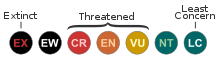
IUCN Red List of Threatened Plants Status : Vulnerable A2ac
Growth: S = slow M = medium F = fast. Soil: L = light (sandy) M = medium H = heavy (clay). pH: A = acid N = neutral B = basic (alkaline). Shade: F = full shade S = semi-shade N = no shade. Moisture: D = dry M = Moist We = wet Wa = water.
Now available:
Food Forest Plants for Mediterranean Conditions
350+ Perennial Plants For Mediterranean and Drier Food Forests and Permaculture Gardens.
[Paperback and eBook]
This is the third in Plants For A Future's series of plant guides for food forests tailored to
specific climate zones. Following volumes on temperate and tropical ecosystems, this book focuses
on species suited to Mediterranean conditions—regions with hot, dry summers and cool, wet winters,
often facing the added challenge of climate change.
Read More
Expert comment
Author
(Engelm.) Britton & Rose
Botanical References
Links / References
For a list of references used on this page please go here
Readers comment
| Add a comment |
|
If you have important information about this plant that may help other users please add a comment or link below. Only comments or links that are felt to be directly relevant to a plant will be included. If you think a comment/link or information contained on this page is inaccurate or misleading we would welcome your feedback at [email protected]. If you have questions about a plant please use the Forum on this website as we do not have the resources to answer questions ourselves.
* Please note: the comments by website users are not necessarily those held by PFAF and may give misleading or inaccurate information.
|
Subject : Ferocactus wislizeni
|
|
|
|