 |
|
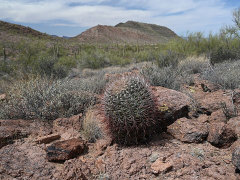
Krzysztof Ziarnek, Kenraiz Creative Commons Attribution-Share Alike 4.0 |
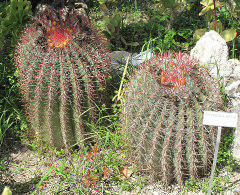 |
| Public domain |
Translate this page:
Summary
Emory’s barrel cactus is a southwestern desert barrel cactus with edible fruits, seeds, and flowers. Like other barrel cacti, it is better valued for fruits and seeds than for stem tissue. Its red flowers and yellow slimy fruits make it distinctive and attractive, and it has strong landscape value in hot desert gardens. Emory’s barrel cactus, Ferocactus emoryi, belongs to the cactus family (Cactaceae). Common names include Emory’s barrel cactus, Coville’s barrel cactus, and traveler’s friend. It is generally suited to USDA Zones 9–11. Mature plants commonly reach about 30–90 cm tall and 30–60 cm wide, though some forms can become larger. It is native to a small area of southern Arizona from around Ajo southward and also occurs in Sonora and nearby Mexican desert regions.
Physical Characteristics

 Ferocactus emoryi is a SHRUB growing to 0.9 m (3ft) by 0.6 m (2ft in) at a slow rate.
See above for USDA hardiness. It is hardy to UK zone 10. The flowers are pollinated by Bees, Insects.
It is noted for attracting wildlife.
Suitable for: light (sandy) and medium (loamy) soils, prefers well-drained soil and can grow in nutritionally poor soil. Suitable pH: mildly acid, neutral and basic (mildly alkaline) soils and can grow in very alkaline soils.
It cannot grow in the shade. It prefers dry soil and can tolerate drought.
UK Hardiness Map
US Hardiness Map
Synonyms
Echinocactus emoryi Engelm.
Plant Habitats
Edible Uses
The fruits, seeds, and flowers are edible. The flowers can be cooked as vegetables. The fruits are edible but slimy. Seeds are likely the best food part [2-3]. Edible Uses & Rating: Emory’s barrel cactus ranks as a moderate wild food. The seeds are valuable, the fruits are edible but texturally challenging, and the flowers are seasonal vegetables. It is not a plant to harvest in a destructive way [2-3]. Taste, Processing & Kitchen Notes: The fruits are yellow, fleshy, juicy, slimy, scaly, and filled with seeds. They are best cooked or mixed into savory dishes rather than eaten as sweet fruits. Seeds can be cleaned, dried, and toasted gently. Flowers may be boiled, sautéed, or added to cooked vegetable mixtures, though the scales and mucilage may affect texture. Seasonality (Phenology): Emory’s barrel cactus blooms from summer into autumn. Fruits develop after bloom and are most useful once mature. Native plant references describe its desert habitat in flats, scrubland, and hillsides up to about 4,000 feet. Safety & Cautions (Food Use): Protected-plant rules may apply. Do not harvest stems or remove plants. Heavy spines create injury risk. Use fruits and flowers conservatively, and leave enough for wildlife [2-3]. Harvest & Processing Workflow: Harvest ripe fruits using tongs. Split fruits, remove seeds, rinse and dry the seeds, then toast over low heat. Cook fruit pulp in savory dishes if used. Flowers should be gathered sparingly and cooked. Cultivar/Selection Notes: Subspecies and regional forms are recognized in some treatments. Horticultural selection emphasizes spine length, flower color, and form rather than food use. Look-Alikes & Confusion Risks: Emory’s barrel cactus may be confused with other barrel cacti of southern Arizona and northern Mexico. Red flowers, yellow fruits, and spine structure help distinguish it. Traditional/Indigenous Use Summary: Barrel cacti were generally used by desert peoples for seeds, fruits, flowers, and processed stem tissue. Emory’s barrel cactus fits that broader pattern, though seeds and fruits are the most sustainable uses [2-3].
References More on Edible Uses
Medicinal Uses
Plants For A Future can not take any responsibility for any adverse effects from the use of plants. Always seek advice from a professional before using a plant medicinally.
Ferocactus emoryi (Emory's barrel cactus) has a history of traditional medicinal uses. Indigenous groups, such as the Seri people of the Sonoran Desert, traditionally salted and roasted pieces of the cactus to extract juices, which were then used as a topical wash for sores and wounds.Historically, different species of barrel cacti were also utilized in traditional folk medicine in the following ways:Skin ailments: Pulp was applied topically to soothe cuts, burns, and insect bites.Pain relief: The cactus gel was sometimes used externally as an analgesic.Digestive issues: The pulp was occasionally consumed as a mild laxative to relieve constipation.Modern phytochemical studies indicate that Ferocactus extracts contain considerable amounts of polyphenols and flavonoids (such as rutin), which are known for their biological potential as antioxidants, antimicrobials, and anti-inflammatory agents.
References More on Medicinal Uses
The Bookshop: Edible Plant Books
Our Latest books on Perennial Plants For Food Forests and Permaculture Gardens in paperback or digital formats.
Edible Tropical Plants
Food Forest Plants for Hotter Conditions: 250+ Plants For Tropical Food Forests & Permaculture Gardens.
More
Edible Temperate Plants
Plants for Your Food Forest: 500 Plants for Temperate Food Forests & Permaculture Gardens.
More
More Books
PFAF have eight books available in paperback and digital formats. Browse the shop for more information.
Shop Now
Other Uses
Cultivated as an ornamental. A strong specimen cactus with red flowers and imposing spines. It works well in desert gardens where winter cold is limited. Ecology & Wildlife: It provides nectar, pollen, and fruit in desert habitats, and its spiny body offers microhabitat protection. A deep rose-coloured face paint is obtained from the young, newly emerging central spines of the plant. These spines are pulled from the plant and chewed at the base; the juice obtained is then dabbed on the cheeks[1987].
Special Uses
References More on Other Uses
Cultivation details
Emory’s barrel cactus is a useful but limited food cactus and an excellent desert landscape plant. Its edible parts should be harvested lightly and legally. Growing Conditions: It prefers full sun, hot desert conditions, and sharply drained rocky, gravelly, or sandy soils. It is intolerant of prolonged wet soils. Habitat & Range: It grows in desert flats, scrubland, hillsides, and rocky or sandy soils in southwestern Arizona and Sonora. Size & Landscape Performance: It is a strong specimen cactus with red flowers and imposing spines. It works well in desert gardens where winter cold is limited. Cultivation (Horticulture): Grow in cactus soil, full sun, and low water. Avoid cold wet winters. Pests & Problems: Root rot from overwatering is the main issue. Wildlife may eat fruits. Identification & Habit: A solitary globe- to barrel-shaped cactus with vertical ribs, rigid spines, red flowers, and yellow slimy scaly fruits. Pollinators: Flowers attract desert bees and other insects. Fruits support birds and small mammals. Emory’s barrel cactus, Ferocactus emoryi, belongs to the cactus family (Cactaceae). Common names include Emory’s barrel cactus, Coville’s barrel cactus, and traveler’s friend. It is generally suited to USDA Zones 9–11. Mature plants commonly reach about 30–90 cm tall and 30–60 cm wide, though some forms can become larger. It is native to a small area of southern Arizona from around Ajo southward and also occurs in Sonora and nearby Mexican desert regions.
References Carbon Farming Information and Carbon Sequestration Information
Temperature Converter
Type a value in the Celsius field to convert the value to Fahrenheit:
Fahrenheit:
The PFAF Bookshop
Plants For A Future have a number of books available in paperback and digital form. Book titles include Edible Plants, Edible Perennials, Edible Trees,Edible Shrubs, Woodland Gardening, and Temperate Food Forest Plants. Our new book is Food Forest Plants For Hotter Conditions (Tropical and Sub-Tropical).
Shop Now
Plant Propagation
By seed.
Other Names
If available other names are mentioned here
Emory’s barrel cactus, Coville’s barrel cactus, and traveler’s friend.
Native Range
US. USA. Arizona, Mexico Northeast, Mexico Northwest.
Weed Potential
Right plant wrong place. We are currently updating this section.
Please note that a plant may be invasive in one area but may not in your area so it's worth checking.
None. It is slow-growing and noninvasive.
Conservation Status
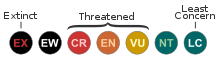
IUCN Red List of Threatened Plants Status : Least Concern (Population stable)
Growth: S = slow M = medium F = fast. Soil: L = light (sandy) M = medium H = heavy (clay). pH: A = acid N = neutral B = basic (alkaline). Shade: F = full shade S = semi-shade N = no shade. Moisture: D = dry M = Moist We = wet Wa = water.
Now available:
Food Forest Plants for Mediterranean Conditions
350+ Perennial Plants For Mediterranean and Drier Food Forests and Permaculture Gardens.
[Paperback and eBook]
This is the third in Plants For A Future's series of plant guides for food forests tailored to
specific climate zones. Following volumes on temperate and tropical ecosystems, this book focuses
on species suited to Mediterranean conditions—regions with hot, dry summers and cool, wet winters,
often facing the added challenge of climate change.
Read More
Expert comment
Author
(Engelm.) Orcutt
Botanical References
Links / References
For a list of references used on this page please go here
Readers comment
| Add a comment |
|
If you have important information about this plant that may help other users please add a comment or link below. Only comments or links that are felt to be directly relevant to a plant will be included. If you think a comment/link or information contained on this page is inaccurate or misleading we would welcome your feedback at [email protected]. If you have questions about a plant please use the Forum on this website as we do not have the resources to answer questions ourselves.
* Please note: the comments by website users are not necessarily those held by PFAF and may give misleading or inaccurate information.
|
Subject : Ferocactus emoryi
|
|
|
|