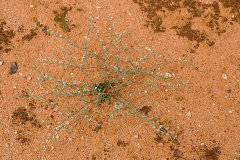
 |
|
Patrick Alexander from Las Cruces, NM. Creative Commons Zero, Public Domain Dedication |
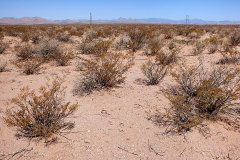 |
| Patrick Alexander from Las Cruces, NM. Creative Commons Zero, Public Domain Dedication |
Translate this page:
Summary
Roundleaf buckwheat is a small buckwheat with edible stems. Its food value is minor, but it may be locally useful when young and tender. Like many small buckwheats, it is more ecologically interesting than nutritionally important. Roundleaf buckwheat, Eriogonum rotundifolium, belongs to the buckwheat family (Polygonaceae). Common names include roundleaf buckwheat. It is a small western wild buckwheat, generally suited to USDA Zones 5–9 in dry, rocky sites. Plants are usually low to moderate, about 5–30 cm tall and 10–30 cm wide.
Physical Characteristics

 Eriogonum rotundifolium is a PERENNIAL growing to 0.3 m (1ft) by 0.3 m (1ft in) at a fast rate.
See above for USDA hardiness. It is hardy to UK zone 6. The flowers are pollinated by Bees, Insects.
It is noted for attracting wildlife.
Suitable for: light (sandy) and medium (loamy) soils, prefers well-drained soil and can grow in nutritionally poor soil. Suitable pH: mildly acid, neutral and basic (mildly alkaline) soils. It cannot grow in the shade. It prefers dry or moist soil and can tolerate drought.
UK Hardiness Map
US Hardiness Map
Synonyms
Eriogonum cernuum subsp. rotundifolium (Benth.) S.Stokes. Eriogonum rotundifolium var. typicum Goodman.
Plant Habitats
Edible Uses
The edible part is the stem [2-3]. Edible Uses & Rating: Roundleaf buckwheat ranks as a low-value wild food. Young stems may be edible, but the plant is small and not usually productive enough for a substantial harvest [2-3]. Taste, Processing & Kitchen Notes: Young stems are the only practical part. They are likely tangy or slightly astringent, and older stems quickly become fibrous. Cooking may improve texture and reduce harshness [2-3]. Seasonality (Phenology): Young stems are best during active spring or early summer growth. After flowering and drying, food value declines. Safety & Cautions (Food Use): Use in small amounts. Avoid old fibrous material and plants from contaminated soils [2-3]. Harvest & Processing Workflow: Gather only tender, young stems from abundant plants, rinse, and eat them sparingly, fresh or cooked. Cultivar/Selection Notes: No cultivars are known. Look-Alikes & Confusion Risks: Small buckwheats can be difficult to identify. Round leaves help, but flowers and fruiting structures are important [2-3]. Traditional/Indigenous Use Summary: Roundleaf buckwheat is a minor edible species in the broader western buckwheat food tradition [2-3].
References More on Edible Uses
Medicinal Uses
Plants For A Future can not take any responsibility for any adverse effects from the use of plants. Always seek advice from a professional before using a plant medicinally.
Eriogonum rotundifolium (round-leaf wild buckwheat) has documented medicinal uses, particularly within Native American traditional medicine. Key Medicinal Uses and Traditional Applications: Emetic: The Navajo (Diné) people have used the plant as an emetic to induce vomiting. Throat Aid: It has been used to treat sore throats.Internal Ailments: The Navajo have considered this species a "life medicine" for treating various internal issues. Stomach Ache Remedy: The Zuni people have used it as an emetic for stomachaches.Psychological/Sedative.
References More on Medicinal Uses
The Bookshop: Edible Plant Books
Our Latest books on Perennial Plants For Food Forests and Permaculture Gardens in paperback or digital formats.
Edible Tropical Plants
Food Forest Plants for Hotter Conditions: 250+ Plants For Tropical Food Forests & Permaculture Gardens.
More
Edible Temperate Plants
Plants for Your Food Forest: 500 Plants for Temperate Food Forests & Permaculture Gardens.
More
More Books
PFAF have eight books available in paperback and digital formats. Browse the shop for more information.
Shop Now
Other Uses
Small but potentially attractive in rock gardens or native dryland collections. Ecology & Wildlife: Provides small-scale nectar and seed resources in rocky dryland habitats.
Special Uses
References More on Other Uses
Cultivation details
Roundleaf buckwheat is edible but not highly useful. It is best known as a small dryland plant with limited use of the stem. Growing Conditions: Dry rocky soils, full sun, and low water. Habitat & Range: Western drylands and rocky upland habitats. Size & Landscape Performance: Small but potentially attractive in rock gardens or native dryland collections. Cultivation (Horticulture): Possible from seed in sharply drained soils. Pests & Problems: Overwatering and poor drainage. Identification & Habit: A small buckwheat with rounded leaves and typical Eriogonum flower clusters. Pollinators: Likely visited by small native bees and flies. Roundleaf buckwheat, Eriogonum rotundifolium, belongs to the buckwheat family (Polygonaceae). Common names include roundleaf buckwheat. It is a small western wild buckwheat, generally suited to USDA Zones 5–9 in dry, rocky sites. Plants are usually low to moderate, about 5–30 cm tall and 10–30 cm wide.
References Carbon Farming Information and Carbon Sequestration Information
Temperature Converter
Type a value in the Celsius field to convert the value to Fahrenheit:
Fahrenheit:
The PFAF Bookshop
Plants For A Future have a number of books available in paperback and digital form. Book titles include Edible Plants, Edible Perennials, Edible Trees,Edible Shrubs, Woodland Gardening, and Temperate Food Forest Plants. Our new book is Food Forest Plants For Hotter Conditions (Tropical and Sub-Tropical).
Shop Now
Plant Propagation
Seed.
Other Names
If available other names are mentioned here
Round-leaf wild buckwheat
Native Range
US. USA. Arizona, Mexico Northeast, New Mexico, Texas.
Weed Potential
Right plant wrong place. We are currently updating this section.
Please note that a plant may be invasive in one area but may not
in your area so it's worth checking.
Low.
Conservation Status
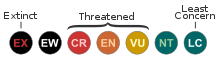
IUCN Red List of Threatened Plants Status : Not listed.
IUCN Red List
Growth: S = slow M = medium F = fast. Soil: L = light (sandy) M = medium H = heavy (clay). pH: A = acid N = neutral B = basic (alkaline). Shade: F = full shade S = semi-shade N = no shade. Moisture: D = dry M = Moist We = wet Wa = water.
Now available:
Food Forest Plants for Mediterranean Conditions
350+ Perennial Plants For Mediterranean and Drier Food Forests and Permaculture Gardens.
[Paperback and eBook]
This is the third in Plants For A Future's series of plant guides for food forests tailored to
specific climate zones. Following volumes on temperate and tropical ecosystems, this book focuses
on species suited to Mediterranean conditions—regions with hot, dry summers and cool, wet winters,
often facing the added challenge of climate change.
Read More
Expert comment
Author
Benth.
Botanical References
Links / References
For a list of references used on this page please go here
Readers comment
| Add a comment |
|
If you have important information about this plant that may help other users please add a comment or link below. Only comments or links that are felt to be directly relevant to a plant will be included. If you think a comment/link or information contained on this page is inaccurate or misleading we would welcome your feedback at [email protected]. If you have questions about a plant please use the Forum on this website as we do not have the resources to answer questions ourselves.
* Please note: the comments by website users are not necessarily those held by PFAF and may give misleading or inaccurate information.
|
Subject : Eriogonum rotundifolium
|
|
|
|