 |
|
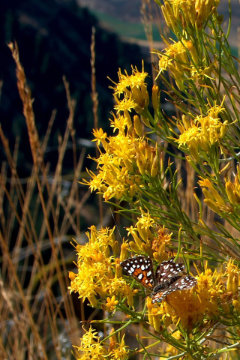
Jason Hollinger. Creative Commons Attribution 2.0 |
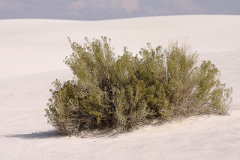 |
| Patrick Alexander from Las Cruces, NM. Creative Commons Zero, Public Domain Dedication |
Translate this page:
Summary
This subspecies shares the same limitations as other gray rabbitbrushes. Although flower buds were eaten by San Felipe Pueblo Indians in rare circumstances, the plant remains a low-quality food source dominated by resins and bitter compounds.
Physical Characteristics

 Ericameria nauseosa ssp. consimilis is an evergreen Shrub growing to 1 m (3ft 3in) by 1 m (3ft 3in) at a medium rate.
See above for USDA hardiness. It is hardy to UK zone 5. The flowers are pollinated by Bees, Insects.
It is noted for attracting wildlife.
Suitable for: light (sandy), medium (loamy) and heavy (clay) soils, prefers well-drained soil and can grow in nutritionally poor soil. Suitable pH: mildly acid, neutral and basic (mildly alkaline) soils and can grow in very alkaline soils.
It cannot grow in the shade. It prefers dry or moist soil and can tolerate drought.
UK Hardiness Map
US Hardiness Map
Synonyms
None
Plant Habitats
Edible Uses
A marginal survival food at best, with significant drawbacks and limited historical use. Flower buds have been eaten historically but only in small amounts. Overall food value is extremely low [2-3]. Taste, Processing & Kitchen Notes: Flower buds are bitter and resinous. Boiling slightly reduces harshness but does not improve palatability enough to justify use. Safety & Cautions (Food Use): Potentially harmful compounds present. Avoid regular or large consumption.
References More on Edible Uses
Medicinal Uses
Plants For A Future can not take any responsibility for any adverse effects from the use of plants. Always seek advice from a professional before using a plant medicinally.
See Ericameria nauseosa
References More on Medicinal Uses
The Bookshop: Edible Plant Books
Our Latest books on Perennial Plants For Food Forests and Permaculture Gardens in paperback or digital formats.
Edible Tropical Plants
Food Forest Plants for Hotter Conditions: 250+ Plants For Tropical Food Forests & Permaculture Gardens.
More
Edible Temperate Plants
Plants for Your Food Forest: 500 Plants for Temperate Food Forests & Permaculture Gardens.
More
More Books
PFAF have eight books available in paperback and digital formats. Browse the shop for more information.
Shop Now
Other Uses
The main species (Ericameria nauseosa ) is a source of latex, used in making rubber[46 , 61 , 95 ]. There is no commercially viable method of extracting it as yet[212 ]. This species has been identified as one of the more promising species from western N. America for the production of biocrude (hydrocarbon and hydrocarbon-like chemical fraction of plants which may be extracted by organic solvents and upgraded to liquid fuels and chemical feedstocks). Finding the cyclohexane extract to be 15.1%, the ethanol extract 20.8%, McLaughlin and Hoffmann (1982) calculated 13.2 kBTU/lb. in the extractables, a biomass yield of ca 4.5 MT/ha or 12.5 bbls, at a per barrel cost of $50.00 or $13.10/million BTU[269 ]. The leaves have been used as a sanitary towel, especially after childbirth[257 ]. A green dye is obtained from the bark[168 ]. A yellow-gold dye is obtained from the flowers[95 , 168 ]. The growing plant repels insects[99 ]. The cottony fruiting heads are used as a stuffing material for pillows etc[99 ]. Along with associated species, like big sage and western wheat grass, rubber rabbitbrush is a significant source of food for browsing wildlife on winter ranges. An ornamental xeriscaping shrub. Carbon Farming - Industrial Crop: hydrocarbon.
Special Uses
References More on Other Uses
Cultivation details
Identification & Habit: A gray-felted shrub with narrow leaves and clustered yellow discoid flowers. Growth form is upright and broom-like. This species (Ericameria nauseosa ) thrives on poor soils and so is an indication that the land is poor, has been allowed to erode, has been overgrazed or in other ways neglected[212 ]. It is also reported to tolerate alkaline conditions, drought, heavy clays and poor soils[269 ]. The following notes are based on the general needs of the genus. Requires a sunny position and prefers a well-drained sandy soil[1 , 11 ]. Plants do not require a rich soil[11 ]. They tolerate alkaline soils[200 ]. The sub-species C. nauseosus ssp.. consimilis, is characteristic of sites with highly saline soils[269 ]. Climate: boreal to warm temperate. Humidity: semi-arid. Carbon Farming - Cultivation: experimental. Management: coppice. Identification & Habit: This variety forms a medium-sized shrub with densely felted gray stems and leaves. Leaves are narrow, linear, and soft-hairy, giving the plant a silvery appearance. Flower heads are yellow, discoid, and clustered at branch tips. The overall plant often emits a strong, resinous odor, especially when crushed.
References Carbon Farming Information and Carbon Sequestration Information
Temperature Converter
Type a value in the Celsius field to convert the value to Fahrenheit:
Fahrenheit:
The PFAF Bookshop
Plants For A Future have a number of books available in paperback and digital form. Book titles include Edible Plants, Edible Perennials, Edible Trees,Edible Shrubs, Woodland Gardening, and Temperate Food Forest Plants. Our new book is Food Forest Plants For Hotter Conditions (Tropical and Sub-Tropical).
Shop Now
Plant Propagation
Seed.
Other Names
If available other names are mentioned here
Gray rabbitbrush
Native Range
US. USA. Arizona, Colorado, New Mexico, Utah.
Weed Potential
Right plant wrong place. We are currently updating this section.
Please note that a plant may be invasive in one area but may not in your area so it's worth checking.
None Known
Conservation Status
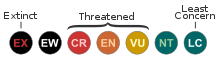
IUCN Red List of Threatened Plants Status : Not available
Growth: S = slow M = medium F = fast. Soil: L = light (sandy) M = medium H = heavy (clay). pH: A = acid N = neutral B = basic (alkaline). Shade: F = full shade S = semi-shade N = no shade. Moisture: D = dry M = Moist We = wet Wa = water.
Now available:
Food Forest Plants for Mediterranean Conditions
350+ Perennial Plants For Mediterranean and Drier Food Forests and Permaculture Gardens.
[Paperback and eBook]
This is the third in Plants For A Future's series of plant guides for food forests tailored to
specific climate zones. Following volumes on temperate and tropical ecosystems, this book focuses
on species suited to Mediterranean conditions—regions with hot, dry summers and cool, wet winters,
often facing the added challenge of climate change.
Read More
Expert comment
Author
Botanical References
Links / References
For a list of references used on this page please go here
Readers comment
| Add a comment |
|
If you have important information about this plant that may help other users please add a comment or link below. Only comments or links that are felt to be directly relevant to a plant will be included. If you think a comment/link or information contained on this page is inaccurate or misleading we would welcome your feedback at [email protected]. If you have questions about a plant please use the Forum on this website as we do not have the resources to answer questions ourselves.
* Please note: the comments by website users are not necessarily those held by PFAF and may give misleading or inaccurate information.
|
Subject : Ericameria nauseosa ssp. consimilis
|
|
|
|