 |
|
http://www.hear.org/starr/ |
 |
| http://commons.wikimedia.org/wiki/User:Mbc |
Translate this page:
Summary
Common barnyard grass is one of the most widespread and agriculturally important grasses in the world, both as a cultivated grain relative and as a notorious weed. That dual identity is important. It is easy to dismiss as a noxious field grass, but historically it also functioned as a useful grain in parts of Europe, Asia, and Africa, and its continued cultivation in some regions reflects genuine food value. In North America, especially in the Southwest, it is more often encountered as a weedy annual in wet, fertile, or disturbed places than as a deliberately used grain. Even so, where large stands occur in clean habitat, it can be a meaningful seed food and one of the more productive small wild cereals available.
Physical Characteristics

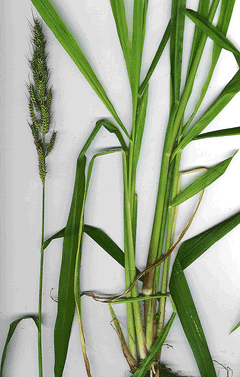
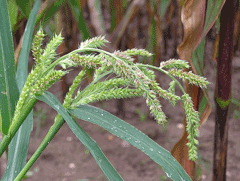
 Echinochloa crus-galli is a ANNUAL growing to 1.2 m (4ft) by 0.2 m (0ft 8in).
See above for USDA hardiness. It is hardy to UK zone 4. It is in flower from July to September, and the seeds ripen from August to October. The species is hermaphrodite (has both male and female organs) and is pollinated by Wind.
Suitable for: light (sandy), medium (loamy) and heavy (clay) soils and prefers well-drained soil. Suitable pH: mildly acid, neutral and basic (mildly alkaline) soils and can grow in very alkaline soils.
It cannot grow in the shade. It prefers moist or wet soil. The plant can tolerates strong winds but not maritime exposure.
UK Hardiness Map
US Hardiness Map
Synonyms
Panicum crus-galli
Plant Habitats
Cultivated Beds;
Edible Uses
Edible Parts: Leaves Seed Shoots
Edible Uses: Coffee
The grains are edible and are the main food resource. Young shoots are also edible, though secondary. As a practical wild food, this is first and foremost a grain plant [2-3]. Edible Uses & Rating: Common barnyard grass ranks as a good wild grain where harvesting is practical, and the habitat is clean. Its abundance can compensate for the small size of individual seeds, and in some places it is sufficiently productive to approach the usefulness of minor cultivated millets. It is still labor-intensive compared with true domesticated cereals, but among wild grasses, it is a strong candidate [2-3]. Taste, Processing & Kitchen Notes: The grains function like other tiny millet-like seeds: they are best cleaned, dried, and then boiled as porridge or ground into meal. Toasting before cooking improves flavor and aroma, giving a more rounded cereal taste. Whole grains can be cooked if properly cleaned, though milling or cracking may improve texture and speed up cooking. Shoots are best used very young, before they become fibrous, and should be cooked. In kitchen terms, the grains are far more important than the vegetative parts [2-3]. Seasonality (Phenology): Common barnyard grass generally flowers from July to September, with grains maturing from about August to November. In warmer climates or irrigated agricultural areas, growth and maturity may extend somewhat beyond this pattern. Safety & Cautions (Food Use): Because this species thrives in disturbed agricultural and wetland margins, contamination is the key caution. Plants growing in crop fields, ditch edges, sewage-affected ground, or pesticide-treated areas should not be harvested for food. Wet conditions also mean that harvested material may carry mold or dirt if not dried carefully. From a plant-toxicity standpoint, the grain is well established as edible, but the cleanliness of the site matters enormously [2-3]. Harvest & Processing Workflow: Wait until the seed heads are mature and beginning to dry. Cut or strip the heads into a bag, dry them fully if necessary, then thresh and winnow. Store the cleaned grain dry. It can then be toasted and boiled as porridge or ground into a meal. Shoots, if used, should be gathered only when very young, rinsed thoroughly, and cooked soon after harvest. Cultivar/Selection Notes: Although not usually cultivated in North America for food, common barnyard grass has a cultivated history elsewhere, which explains its reasonably good grain quality. In wild harvesting, the best “selection” is a uniform stand with heavy seed set, clean water or soil conditions, and minimal shattering before harvest. Look-Alikes & Confusion Risks: It may resemble jungle rice and rough barnyard grass. However, this is usually a practical rather than a dangerous confusion because the main Echinochloa species in this context are all edible. Distinguishing exact species is still helpful because habitat, abundance, and grain yield can differ [2-3]. Traditional/Indigenous Use Summary: Common barnyard grass entered Indigenous diets in North America after becoming available as part of the post-contact flora. More broadly, its ancient cultivation elsewhere confirms that it is not merely an emergency weed but a legitimate grain species with a long human history [2-3]. Seed - cooked[35, 55, 105, 171]. Used as a millet, it can be cooked whole or be ground into a flour before use[183, 257]. It has a good flavour[85] and can be used in porridges, macaroni, dumplings etc[183]. The seed is rather small[159], though fairly easy to harvest. It has a somewhat bitter flavour[178]. Young shoots, stem tips and the heart of the culm - raw or cooked[144, 177]. A nutritional analysis is available[218]. The roasted seed is a coffee substitute[177].
References More on Edible Uses
| Composition
|
| Figures in grams (g) or miligrams (mg) per 100g of food.
|
|
|
Leaves (Dry weight)
|
|
- 0 Calories per 100g
- Water : 0%
- Protein: 7.4g; Fat: 2.9g; Carbohydrate: 81.1g; Fibre: 31.3g; Ash: 8.6g;
- Minerals - Calcium: 0mg; Phosphorus: 0mg; Iron: 0mg; Magnesium: 0mg; Sodium: 0mg; Potassium: 0mg; Zinc: 0mg;
- Vitamins - A: 0mg; Thiamine (B1): 0mg; Riboflavin (B2): 0mg; Niacin: 0mg; B6: 0mg; C: 0mg;
- Reference: [ 218]
- Notes:
|
|
Medicinal Uses
Plants For A Future can not take any responsibility for any adverse effects from the use of plants. Always seek advice from a professional before using a plant medicinally.
Styptic Tonic
Echinochloa crus-galli (barnyard grass) is traditionally used in folk medicine as a preventative, tonic, and treatment for ailments including spleen issues, wounds, sores, and hemorrhages. Modern studies suggest it has potential medicinal properties, such as antioxidant, antimicrobial, and blood sugar-modulating effects, and it is traditionally used to treat digestive issues. Traditional and Potential Medicinal Uses: Digestive Health: Used traditionally in the Philippines as a root decoction for indigestion and to treat spleen issues. Skin and Wound Care: Used for treating sores, carbuncles, and wound healing. Blood Sugar Management: Shows potential in moderating blood sugar levels, making it of interest for diet-managed diabetes. Nutritional Support: The seeds are edible and used as a nutritious food source, high in fiber and minerals. Other Applications: It has been used for managing hemorrhages and in traditional anticancer preparations. Reported to be preventative and tonic, barnyard grass is a folk remedy for treating carbuncles, haemorrhages, sores, spleen trouble, cancer and wounds[269]. The shoots and/or the roots are applied as a styptic to wounds[218, 240]. The plant is a tonic, acting on the spleen[218, 240].
References More on Medicinal Uses
The Bookshop: Edible Plant Books
Our Latest books on Perennial Plants For Food Forests and Permaculture Gardens in paperback or digital formats.
Edible Tropical Plants
Food Forest Plants for Hotter Conditions: 250+ Plants For Tropical Food Forests & Permaculture Gardens.
More
Edible Temperate Plants
Plants for Your Food Forest: 500 Plants for Temperate Food Forests & Permaculture Gardens.
More
More Books
PFAF have eight books available in paperback and digital formats. Browse the shop for more information.
Shop Now
Other Uses
Soil reclamation
The plant is sometimes used, especially in Egypt, for the reclamation of saline and alkaline areas[269]. Its seeds feed birds and small animals, and its dense annual stands can provide cover in disturbed wet places. Ecologically, however, it is best known for its aggressive colonizing ability rather than for supporting diverse native habitat structure. This is a coarse, vigorous annual grass with little ornamental value in most designed landscapes. It can look lush and vigorous, but it is usually unwelcome due to its aggressive, weedy nature. This grass is used as cattle fodder and is sometimes cultivated for this purpose. It is also suited for silage but not for hay. It is fed to animals as green fodder throughout the year [2-6].
Special Uses
References More on Other Uses
Cultivation details
Common barnyard grass is one of the better examples of a plant that can be both a major weed and a real food. In clean, harvestable stands it is a useful small cereal. In fields and ditches, however, its value is often reduced by contamination concerns and its reputation as an agricultural pest. Growing Conditions: It thrives in warm weather, full sun, fertile soils, and especially moist or wet disturbed ground. It is highly adaptable and can grow in everything from muddy field margins to richer garden or farm soils. Habitat & Range: It is nearly worldwide in distribution and can be found across the entire United States. In the Southwest, it occurs especially where seasonal or artificial moisture supports summer growth. Size & Landscape Performance: This is a coarse, vigorous annual grass with little ornamental value in most designed landscapes. It can look lush and vigorous, but it is usually unwelcome due to its aggressive, weedy nature. Cultivation (Horticulture): It is rarely cultivated intentionally in home settings, though it could be grown as a minor grain if someone wished to experiment. In most contexts, people spend more effort trying to remove it than encourage it. Pests & Problems: The principal problem is its own competitive vigor. It can become a serious weed in crops, gardens, and irrigated systems. Uneven ripening and muddy harvest conditions can also complicate grain use. Identification & Habit: Common barnyard grass is a robust annual grass with broadish leaves for a weedy annual, coarse stems, and dense seed-bearing panicles. It typically looks heavier-bodied and more aggressive than finer native meadow grasses. Pollinators: Like most grasses, it is wind-pollinated. Common barnyard grass, now best referred to as Echinochloa crus-galli, belongs to the grass family (Poaceae) and the genus Echinochloa. Common names include common barnyard grass and cockspur grass. It is a warm-season annual found through tropical, subtropical, and temperate regions and behaves as a summer annual across a wide climatic range, roughly USDA Zones 3–11 where enough warm-season growth occurs. Plants commonly grow about 30–150 cm tall, occasionally more in rich wet soils, and spread 20–70 cm across. An easily grown plant, it is adapted to nearly all types of wet places, and is often a common weed in paddy fields, roadsides, cultivated areas, and fallow fields[269]. It succeeds on a variety of wet sites such as ditches, low areas in fertile croplands and wet wastes, often growing in water[269]. It succeeds in cool regions, but is better adapted to areas where the average annual temperature is 14-16°C[269]. Tolerant of most soil types, including saline conditions, plants are not restricted by soil pH[269]. Prefers a rich moist soil[85] but succeeds in ordinary garden soil[1]. The sub-species E. crus-galli zelayensis (HBK)Hitchc. is often found growing wild in alkaline soils[236]. The plant is reported to tolerate an annual precipitation in the range of 31 to 250cm, an annual temperature range of 5.7 to 27.8°C and a pH in the range of 4.8 to 8.2[269]. Barnyard millet is sometimes cultivated for its edible seed in India[171]. It has a relatively long growing season and does not always ripen its seed in Britain, though it should do better in the eastern half of the country[K]. The plant is considered to be a very serious weed of many cultivated crops[269].
References Carbon Farming Information and Carbon Sequestration Information
Temperature Converter
Type a value in the Celsius field to convert the value to Fahrenheit:
Fahrenheit:
The PFAF Bookshop
Plants For A Future have a number of books available in paperback and digital form. Book titles include Edible Plants, Edible Perennials, Edible Trees,Edible Shrubs, Woodland Gardening, and Temperate Food Forest Plants. Our new book is Food Forest Plants For Hotter Conditions (Tropical and Sub-Tropical).
Shop Now
Plant Propagation
Seed - sow early spring in a greenhouse and only just cover the seed. When they are large enough to handle, prick the seedlings out into individual pots and plant them out into their permanent positions in early summer. A sowing in situ in late spring might also succeed but is unlikely to ripen a crop of seed if the summer is cool and wet.
Other Names
If available other names are mentioned here
Common barnyard grass and cockspur grass.
Native Range
EUROPE: Russian Federation (Kalmykija, Respublika, Astrakhan, Saratov, Volgogradskaja oblast)
Weed Potential
Right plant wrong place. We are currently updating this section.
Please note that a plant may be invasive in one area but may not in your area so it's worth checking.
Very high. It is one of the most notorious grass weeds in agriculture and disturbed wet habitats.
Conservation Status
IUCN Red List of Threatened Plants Status : Least Concern.

Growth: S = slow M = medium F = fast. Soil: L = light (sandy) M = medium H = heavy (clay). pH: A = acid N = neutral B = basic (alkaline). Shade: F = full shade S = semi-shade N = no shade. Moisture: D = dry M = Moist We = wet Wa = water.
Now available:
Food Forest Plants for Mediterranean Conditions
350+ Perennial Plants For Mediterranean and Drier Food Forests and Permaculture Gardens.
[Paperback and eBook]
This is the third in Plants For A Future's series of plant guides for food forests tailored to
specific climate zones. Following volumes on temperate and tropical ecosystems, this book focuses
on species suited to Mediterranean conditions—regions with hot, dry summers and cool, wet winters,
often facing the added challenge of climate change.
Read More
Expert comment
Author
(L.)P.Beauv.
Botanical References
50200236
Links / References
For a list of references used on this page please go here
Readers comment
| Add a comment |
|
If you have important information about this plant that may help other users please add a comment or link below. Only comments or links that are felt to be directly relevant to a plant will be included. If you think a comment/link or information contained on this page is inaccurate or misleading we would welcome your feedback at [email protected]. If you have questions about a plant please use the Forum on this website as we do not have the resources to answer questions ourselves.
* Please note: the comments by website users are not necessarily those held by PFAF and may give misleading or inaccurate information.
|
Subject : Echinochloa crus-galli
|
|
|
|