 |
|
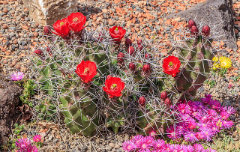
Llez. Creative Commons Attribution-Share Alike 3.0 |
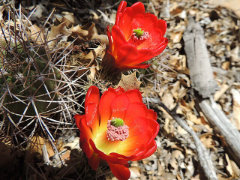 |
| BLM Nevada. Creative Commons Attribution 2.0 |
Translate this page:
Summary
Claretcup hedgehog cactus is one of the iconic spring-flowering Echinocereus of the interior Southwest and is frequently singled out for fruit quality, along with scarlet and strawberry hedgehog cacti. As a food plant it remains snack-class rather than harvest-class because ant excavation and fruit variability often eliminate usable fruit before humans arrive.
Physical Characteristics

 Echinocereus triglochidiatus is an evergreen Shrub growing to 0.3 m (1ft) by 0.9 m (3ft in) at a medium rate.
See above for USDA hardiness. It is hardy to UK zone 6. The flowers are pollinated by Birds, Bees.
It is noted for attracting wildlife.
Suitable for: light (sandy) and medium (loamy) soils, prefers well-drained soil and can grow in nutritionally poor soil. Suitable pH: neutral and basic (mildly alkaline) soils. It cannot grow in the shade. It prefers dry soil and can tolerate drought.
UK Hardiness Map
US Hardiness Map
Synonyms
Cereus triglochidiatus (Engelm.) Engelm. E. paucispinus var. triglochidiatus (Engelm.) K.Schum.
Plant Habitats
Edible Uses
Fruits are edible and often considered among the best of hedgehog cacti; reliability remains the major constraint [2-3]. Edible Uses & Rating. Fruits; rating: excellent potential fruit quality, low-to-moderate harvest reliability depending on local ant pressure and fruit set [2-3]. Taste, Processing & Kitchen Notes. The best strategy is fresh eating with minimal processing: brush off spines, open, inspect, eat. Any attempt at batch processing should begin with inspection, because empty fruits waste time and contaminate your workflow with dry shells and spines [2-3]. Seasonality (Phenology). Blooms in spring and typically fruits in early to mid-summer, with strong year-to-year variability driven by moisture and site conditions (consistent with your genus-level description). Safety & Cautions (Food Use). Mechanical spine hazard; local protections may apply. In some areas claretcup forms are conservation-sensitive, so treat harvest as inappropriate unless you are certain collection is legal and sustainable [2-3]. Harvest & Processing Workflow. Harvest ripe fruits, brush, open to confirm intact pulp and seeds, then eat fresh. If you strain pulp, do so only after you have fully de-spined and you can keep spines out of the edible stream [2-3]. Cultivar/Selection Notes. This is widely used ornamentally; many garden selections focus on flower color and cold tolerance. For foraging outcomes, the practical “selection” is finding sites where fruits are not routinely excavated by ants. Look-Alikes & Confusion Risks. Claretcup is recognizable as a hedgehog cactus by ribbed stems and lateral flowers/fruits; confusion is mainly among closely related Echinocereus species and varieties. Traditional/Indigenous Use Summary. Claretcup-type hedgehog fruits sit within the broader tradition of Southwest cactus fruit use, typically as seasonal treats rather than bulk staples [2-3].
References More on Edible Uses
Medicinal Uses
Plants For A Future can not take any responsibility for any adverse effects from the use of plants. Always seek advice from a professional before using a plant medicinally.
Echinocereus triglochidiatus, commonly known as the Kingcup or Claret Cup cactus, has documented traditional medical uses and nutritional benefits among indigenous peoples in the southwestern United States. Key information regarding its medical and practical applications includes: Ethnobotanical/Medicinal Use: The Navajo have historically used this cactus as a heart medication and, in some contexts, it has been noted for having poisonous properties if not used correctly. Nutritional Value: The plant produces juicy, edible red fruits that are safe for human consumption and have a mildly sweet taste. Other Uses: It is primarily known as an ornamental plant in rock gardens and for its ability to attract pollinators like hummingbirds. Note: While some sources mention potential hallucinogenic or intoxicating effects within this genus (Echinocereus/similar cacti), the primary recorded uses for E. triglochidiatus are medicinal (heart-related) and nutritional.
References More on Medicinal Uses
The Bookshop: Edible Plant Books
Our Latest books on Perennial Plants For Food Forests and Permaculture Gardens in paperback or digital formats.
Edible Tropical Plants
Food Forest Plants for Hotter Conditions: 250+ Plants For Tropical Food Forests & Permaculture Gardens.
More
Edible Temperate Plants
Plants for Your Food Forest: 500 Plants for Temperate Food Forests & Permaculture Gardens.
More
More Books
PFAF have eight books available in paperback and digital formats. Browse the shop for more information.
Shop Now
Other Uses
Claretcup hedgehog cactus is one of the most rewarding hedgehog cacti aesthetically with low clumps that can widen; strong structural accent and a major spring bloom event; good container plant where drainage is controlled. High nectar value in spring; fruits feed animals when intact; spines provide micro-refuge; ants strongly shape fruit survival and therefore the plant’s realized food value for larger foragers.
Special Uses
References More on Other Uses
Cultivation details
Claretcup hedgehog cactus is one of the most rewarding hedgehog cacti aesthetically and potentially one of the best for fruit flavor, but its food value is fundamentally opportunistic because ants and variability often win the harvest. Growing Conditions. Full sun, dry air, very sharp drainage; notable cold tolerance when crowns are kept dry. Habitat & Range. Rocky deserts and pinyon–juniper edges across the Southwest and adjacent regions, with variety-level distributions. Size & Landscape Performance. Low clumps that can widen; strong structural accent and a major spring bloom event; good container plant where drainage is controlled. Cultivation (Horticulture). Gritty soils, minimal watering once established, and strong drainage; raised beds or slopes are ideal. Pests & Problems. Ant excavation is the signature “food problem”; rot is the signature cultivation problem in wet soils. Identification & Habit. Ribbed, non-jointed stems; spines not hooked; flowers lateral; fruits spiny and small. Pollinators. Claretcup hedgehog cactus is well documented as an important hummingbird plant in parts of its range, with hummingbirds acting as primary pollinators while bees also visit the flowers. Kingcup or Claretcup Hedgehog Cactus (Echinocereus triglochidiatus). Family: Cactus family (Cactaceae). Genus: Echinocereus. Common names: Kingcup cactus, claretcup hedgehog cactus. USDA Hardiness Zones and size: Commonly cited as cold hardy into Zone 5, typically about 15–30 cm tall with clumps spreading about 30–90+ cm (approximate).
References Carbon Farming Information and Carbon Sequestration Information
Temperature Converter
Type a value in the Celsius field to convert the value to Fahrenheit:
Fahrenheit:
The PFAF Bookshop
Plants For A Future have a number of books available in paperback and digital form. Book titles include Edible Plants, Edible Perennials, Edible Trees,Edible Shrubs, Woodland Gardening, and Temperate Food Forest Plants. Our new book is Food Forest Plants For Hotter Conditions (Tropical and Sub-Tropical).
Shop Now
Plant Propagation
Seed and offsets; seed is best for maintaining locally adapted, cold-hardy traits.
Other Names
If available other names are mentioned here
Kingcup or Claretcup Hedgehog Cactus, Mound Hedgehog Cactus
Native Range
US. USA. Arizona, California, Colorado, Mexico Northwest, Nevada, New Mexico, Utah.
Weed Potential
Right plant wrong place. We are currently updating this section.
Please note that a plant may be invasive in one area but may not in your area so it's worth checking.
Very low.
Conservation Status
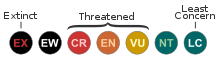
IUCN Red List of Threatened Plants Status : Least Concern.
Growth: S = slow M = medium F = fast. Soil: L = light (sandy) M = medium H = heavy (clay). pH: A = acid N = neutral B = basic (alkaline). Shade: F = full shade S = semi-shade N = no shade. Moisture: D = dry M = Moist We = wet Wa = water.
Now available:
Food Forest Plants for Mediterranean Conditions
350+ Perennial Plants For Mediterranean and Drier Food Forests and Permaculture Gardens.
[Paperback and eBook]
This is the third in Plants For A Future's series of plant guides for food forests tailored to
specific climate zones. Following volumes on temperate and tropical ecosystems, this book focuses
on species suited to Mediterranean conditions—regions with hot, dry summers and cool, wet winters,
often facing the added challenge of climate change.
Read More
Expert comment
Author
Engelm.
Botanical References
Links / References
For a list of references used on this page please go here
Readers comment
| Add a comment |
|
If you have important information about this plant that may help other users please add a comment or link below. Only comments or links that are felt to be directly relevant to a plant will be included. If you think a comment/link or information contained on this page is inaccurate or misleading we would welcome your feedback at [email protected]. If you have questions about a plant please use the Forum on this website as we do not have the resources to answer questions ourselves.
* Please note: the comments by website users are not necessarily those held by PFAF and may give misleading or inaccurate information.
|
Subject : Echinocereus triglochidiatus
|
|
|
|