 |
|
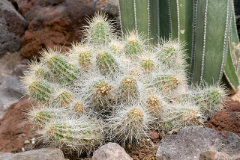
André Karwath aka Aka. Creative Commons Attribution-Share Alike 2.5 |
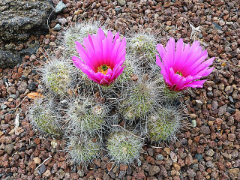 |
| James Steakley. Creative Commons Attribution-Share Alike 3.0 |
Translate this page:
Summary
Strawberry hedgehog cactus is repeatedly cited as one of the best-tasting hedgehog-cactus fruits, which is exactly why the ant problem matters: the best fruit in theory can still be unavailable in practice if fruits are excavated before harvest.
Physical Characteristics

 Echinocereus stramineus is an evergreen Shrub growing to 0.4 m (1ft 4in) by 0.9 m (3ft) at a medium rate.
See above for USDA hardiness. It is hardy to UK zone 8. The flowers are pollinated by Bees, Insects.
It is noted for attracting wildlife.
Suitable for: light (sandy) and medium (loamy) soils, prefers well-drained soil and can grow in nutritionally poor soil. Suitable pH: neutral and basic (mildly alkaline) soils. It cannot grow in the shade. It prefers dry soil and can tolerate drought.
UK Hardiness Map
US Hardiness Map
Synonyms
Cereus stramineus Engelm. Echinocereus enneacanthus var. stramineus (Engelm.) L.D.Benson
Plant Habitats
Edible Uses
Fruits are edible and often considered excellent; harvestability is variable [2-3]. Edible Uses & Rating. Fruits: rating: potentially top-tier flavor, moderate-to-low reliability [2-3]. Taste, Processing & Kitchen Notes. When intact and ripe, fruits are widely praised; processing is simple but unforgiving—brush off spines carefully, open and inspect, then eat fresh. If you are trying to save pulp, work over a clean surface and avoid driving spines into the edible portion [2-3]. Seasonality (Phenology). Late spring bloom; early to mid-summer fruiting, shifting with elevation and rainfall. Safety & Cautions (Food Use). Avoid collecting where protected; manage spines carefully; avoid damaged/rotted fruits [2-3]. Harvest & Processing Workflow. Harvest ripe fruits, brush, open and inspect, then eat; strain only if you can keep spines fully excluded. Cultivar/Selection Notes. In horticulture, “best fruit” reputations are common, but for food outcomes you are effectively selecting for sites where fruits persist long enough to harvest. Look-Alikes & Confusion Risks. Similar to other clumping hedgehog cacti; confirm identification before relying on any species-level food claims. Traditional/Indigenous Use Summary. Hedgehog-cactus fruits have a long history as seasonal desert fruits; the main traditional advantage is knowing the right places and timing to harvest before competitors [2-3].
References More on Edible Uses
Medicinal Uses
Plants For A Future can not take any responsibility for any adverse effects from the use of plants. Always seek advice from a professional before using a plant medicinally.
Echinocereus stramineus, commonly known as the straw-colored hedgehog cactus or strawberry cactus, has recognized medical uses, particularly in traditional medicine for diabetes management. Key, documented uses include: Diabetes Treatment: The fruit of the Echinocereus stramineus is used in modern science for the treatment of diabetes. Nutritional Support: The fruit is highly edible and often used in traditional diets, providing vitamins and nutrients with potential anti-inflammatory properties. Traditional Remedies: Historically, the plant’s sap has been used for healing purposes. General Cactus Health Benefits (Applicable to Echinocereus): Antioxidants: Cactus fruits are rich in antioxidants, which help reduce oxidative stress. Blood Sugar/Cholesterol Management: Components in various cacti are studied for their ability to lower blood glucose and cholesterol levels. Note: While traditionally used, it is not a substitute for professional medical advice.
References More on Medicinal Uses
The Bookshop: Edible Plant Books
Our Latest books on Perennial Plants For Food Forests and Permaculture Gardens in paperback or digital formats.
Edible Tropical Plants
Food Forest Plants for Hotter Conditions: 250+ Plants For Tropical Food Forests & Permaculture Gardens.
More
Edible Temperate Plants
Plants for Your Food Forest: 500 Plants for Temperate Food Forests & Permaculture Gardens.
More
More Books
PFAF have eight books available in paperback and digital formats. Browse the shop for more information.
Shop Now
Other Uses
Clumping mounds; strong flower display and textural spines; good xeriscape accent. Pollinators. Primarily native bees and other insects; pollinator profile varies with flower traits and local community. Supports pollinators and provides shelter; fruits feed fauna when not excavated.
Special Uses
References More on Other Uses
Cultivation details
Strawberry hedgehog cactus is a “high reward, low guarantee” fruit cactus: potentially superb fruit, often lost to ants and variability. Growing Conditions. Full sun, very fast drainage, minimal winter moisture. Habitat & Range. Rocky desert and desert edge habitats in the Southwest and adjacent regions depending on taxonomy and variety. Size & Landscape Performance. Clumping mounds; strong flower display and textural spines; good xeriscape accent. Cultivation (Horticulture). Dry, mineral soils; protect from winter wet; let it bake in sun. Pests & Problems. Ants on fruits; rot in wet soils. Identification & Habit. Ribbed, clumping stems; lateral flowers; spiny fruits. Pollinators. Primarily native bees and other insects; pollinator profile varies with flower traits and local community. Strawberry Hedgehog Cactus (Echinocereus stramineus). Family: Cactus family (Cactaceae). Genus: Echinocereus. Common names: Strawberry hedgehog cactus. USDA Hardiness Zones and size: Some forms are reported cold resistant to about -12 °C (about 10 °F), suggesting roughly Zone 8a if kept very dry; typically about 15–40 cm tall and 30–90+ cm wide by clumping (approximate).
References Carbon Farming Information and Carbon Sequestration Information
Temperature Converter
Type a value in the Celsius field to convert the value to Fahrenheit:
Fahrenheit:
The PFAF Bookshop
Plants For A Future have a number of books available in paperback and digital form. Book titles include Edible Plants, Edible Perennials, Edible Trees,Edible Shrubs, Woodland Gardening, and Temperate Food Forest Plants. Our new book is Food Forest Plants For Hotter Conditions (Tropical and Sub-Tropical).
Shop Now
Plant Propagation
Seed and offsets.
Other Names
If available other names are mentioned here
Strawberry Hedgehog Cactus (Echinocereus stramineus).
Native Range
US. USA. Mexico Northeast, New Mexico, Texas.
Weed Potential
Right plant wrong place. We are currently updating this section.
Please note that a plant may be invasive in one area but may not in your area so it's worth checking.
Very low.
Conservation Status
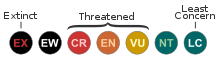
IUCN Red List of Threatened Plants Status : Least Concern.
Growth: S = slow M = medium F = fast. Soil: L = light (sandy) M = medium H = heavy (clay). pH: A = acid N = neutral B = basic (alkaline). Shade: F = full shade S = semi-shade N = no shade. Moisture: D = dry M = Moist We = wet Wa = water.
Now available:
Food Forest Plants for Mediterranean Conditions
350+ Perennial Plants For Mediterranean and Drier Food Forests and Permaculture Gardens.
[Paperback and eBook]
This is the third in Plants For A Future's series of plant guides for food forests tailored to
specific climate zones. Following volumes on temperate and tropical ecosystems, this book focuses
on species suited to Mediterranean conditions—regions with hot, dry summers and cool, wet winters,
often facing the added challenge of climate change.
Read More
Expert comment
Author
(Engelm.) Haage
Botanical References
Links / References
For a list of references used on this page please go here
Readers comment
| Add a comment |
|
If you have important information about this plant that may help other users please add a comment or link below. Only comments or links that are felt to be directly relevant to a plant will be included. If you think a comment/link or information contained on this page is inaccurate or misleading we would welcome your feedback at [email protected]. If you have questions about a plant please use the Forum on this website as we do not have the resources to answer questions ourselves.
* Please note: the comments by website users are not necessarily those held by PFAF and may give misleading or inaccurate information.
|
Subject : Echinocereus stramineus
|
|
|
|