 |
|
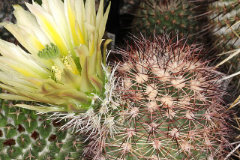
Peter A. Mansfeld. Creative Commons Attribution 3.0 |
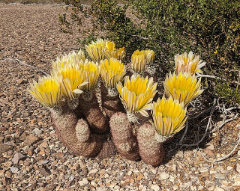 |
| Nick Block. Creative Commons Attribution 4.0 |
Translate this page:
Summary
Spiny hedgehog cactus is a larger, more upright hedgehog cactus with conspicuous spination and showy flowers. Like other Echinocereus, it can produce edible fruit, but fruit harvest is frequently undermined by ants and by irregular fruiting.
Physical Characteristics

 Echinocereus dasyacanthus is an evergreen Shrub growing to 0.6 m (2ft) by 0.6 m (2ft in) at a medium rate.
See above for USDA hardiness. It is hardy to UK zone 7. The flowers are pollinated by Bees, Insects.
It is noted for attracting wildlife.
Suitable for: light (sandy) and medium (loamy) soils, prefers well-drained soil and can grow in nutritionally poor soil. Suitable pH: neutral and basic (mildly alkaline) soils. It cannot grow in the shade. It prefers dry soil and can tolerate drought.
UK Hardiness Map
US Hardiness Map
Synonyms
E. pectinatus var. dasyacanthus (Engelm.) W.H.Earle ex N.P.Taylor
Plant Habitats
Edible Uses
Spiny hedgehog cactus is a larger, more upright hedgehog cactus with conspicuous spination and showy flowers. Like other Echinocereus, it can produce edible fruit, but fruit harvest is frequently undermined by ants and by irregular fruiting [2-3]. Edibility Summary. Fruits are edible but inconsistent as a dependable yield; treat them as a seasonal snack rather than a core resource. Edible Uses & Rating. Fruits are the edible target; overall rating is “good when found intact, low reliability.” [2-3] Taste, Processing & Kitchen Notes. Reports generally place hedgehog cactus fruits in the “pleasant-to-delicious” range, but your project’s practical constraint still applies: many fruits may be hollowed. Spine clusters on fruits often detach, making careful brushing the first-line processing step [2-3]. Seasonality (Phenology). Typically, flowers in spring and fruits in early to mid-summer, with timing shifting by elevation and rainfall. Safety & Cautions (Food Use). Avoid harvesting where populations are protected. Handle fruits and plants with tools/gloves as needed; spines can detach and embed easily [2-3]. Harvest & Processing Workflow. Check fruits for maturity and for ant excavation by opening before committing time. Brush off spines, open, scoop edible pulp/seed mass, and keep spines out of the food stream [2-3]. Cultivar/Selection Notes. Often grown ornamentally for its impressive spination and flowers, fruit selection is generally informal (local provenances that actually fruit well). Look-Alikes & Confusion Risks. Confusion mainly within Echinocereus; use the ribbed stem and laterally borne flower/fruit pattern to separate from similar-sized cacti. Traditional/Indigenous Use Summary. Echinocereus fruits were used traditionally in parts of the Southwest. They are valued, yet not always dependable in quantity.
References More on Edible Uses
Medicinal Uses
Plants For A Future can not take any responsibility for any adverse effects from the use of plants. Always seek advice from a professional before using a plant medicinally.
Echinocereus dasyacanthus (commonly known as the Texas Rainbow Cactus or Spiny Hedgehog Cactus) is primarily valued as an ornamental plant for landscaping and indoor pot cultivation due to its vibrant flowers and unique, spiny appearance. Based on the available search results, specific, documented medical uses for Echinocereus dasyacanthus are not explicitly listed in the same way they are for other Echinocereus species, such as E. enneacanthus or E. stramineus (which are known for their edible fruit) or E. viridiflorus. However, the following can be noted regarding its context: Safety: It is reported to be non-toxic to humans and pets. General Echinocereus Uses: While E. dasyacanthus is not specifically highlighted, the Echinocereus genus is generally known for producing edible fruit that tastes similar to strawberries. Therapeutic Value: Like many succulents, it is often kept for its aesthetic, stress-reducing, and therapeutic, "zen-like" gardening benefits. It is important to distinguish this species from other, more specialized medicinal cacti, such as Peniocereus greggii (used for respiratory ailments) or Lophocereus schottii (used in studies for cancer and diabetes), which are often mentioned in the same regional contexts.
References More on Medicinal Uses
The Bookshop: Edible Plant Books
Our Latest books on Perennial Plants For Food Forests and Permaculture Gardens in paperback or digital formats.
Edible Tropical Plants
Food Forest Plants for Hotter Conditions: 250+ Plants For Tropical Food Forests & Permaculture Gardens.
More
Edible Temperate Plants
Plants for Your Food Forest: 500 Plants for Temperate Food Forests & Permaculture Gardens.
More
More Books
PFAF have eight books available in paperback and digital formats. Browse the shop for more information.
Shop Now
Other Uses
The species is sold as an ornamental, and intra and interstate trade exists in Texas (Robbins and Bárcenas Luna 2003). [2-6]. Provides nectar/pollen resources and microhabitat; fruits interact strongly with ants and other small consumers that can remove pulp and seed.
Special Uses
References More on Other Uses
Cultivation details
A high-ornamental, drought-adapted cactus with edible fruit potential, but a foraging target that rewards opportunism rather than planning. Growing Conditions. Full sun, heat tolerant, very sharp drainage, and minimal winter moisture. Habitat & Range. Rocky desert and desert grassland/transition habitats across parts of the Southwest and adjacent regions (species-level range varies with taxonomy). Size & Landscape Performance. Upright to clumping habit; strong presence in xeriscapes; spines and flowers provide year-round structure and seasonal color. Cultivation (Horticulture). Best in mineral soils, raised beds, or slopes; protect from winter wet in colder climates. Pests & Problems. Ants commonly compromise fruit; rot is the big cultivation problem where drainage is poor. Identification & Habit. Ribbed stems with strong spine clusters; flowers borne laterally; fruits spiny and small. Pollinators. Typically visited by native bees and other insects; yellow-flowered forms are especially associated with bee visitation, though local pollinator assemblages vary with habitat. Spiny Hedgehog Cactus (Echinocereus dasyacanthus). Family: Cactus family (Cactaceae). Genus: Echinocereus. Common names: Spiny hedgehog cactus (often encountered in horticulture as a yellow-flowered hedgehog cactus). USDA Hardiness Zones and size: Commonly cited for garden use around Zones 6–9; typically about 30–60 cm tall and 30–60 cm wide (clumping with age).
References Carbon Farming Information and Carbon Sequestration Information
Temperature Converter
Type a value in the Celsius field to convert the value to Fahrenheit:
Fahrenheit:
The PFAF Bookshop
Plants For A Future have a number of books available in paperback and digital form. Book titles include Edible Plants, Edible Perennials, Edible Trees,Edible Shrubs, Woodland Gardening, and Temperate Food Forest Plants. Our new book is Food Forest Plants For Hotter Conditions (Tropical and Sub-Tropical).
Shop Now
Plant Propagation
Seed and offsets (where clumping produces divisions); seed is preferred for conservation-minded plantings.
Other Names
If available other names are mentioned here
Spiny hedgehog cactus (often encountered in horticulture as a yellow-flowered hedgehog cactus).
Native Range
US. USA. Mexico Northeast, Mexico Northwest, New Mexico, Texas
Weed Potential
Right plant wrong place. We are currently updating this section.
Please note that a plant may be invasive in one area but may not in your area so it's worth checking.
Very low.
Conservation Status
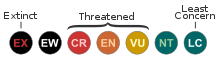
IUCN Red List of Threatened Plants Status : Least Concern.
Growth: S = slow M = medium F = fast. Soil: L = light (sandy) M = medium H = heavy (clay). pH: A = acid N = neutral B = basic (alkaline). Shade: F = full shade S = semi-shade N = no shade. Moisture: D = dry M = Moist We = wet Wa = water.
Now available:
Food Forest Plants for Mediterranean Conditions
350+ Perennial Plants For Mediterranean and Drier Food Forests and Permaculture Gardens.
[Paperback and eBook]
This is the third in Plants For A Future's series of plant guides for food forests tailored to
specific climate zones. Following volumes on temperate and tropical ecosystems, this book focuses
on species suited to Mediterranean conditions—regions with hot, dry summers and cool, wet winters,
often facing the added challenge of climate change.
Read More
Expert comment
Author
Engelm.
Botanical References
Links / References
For a list of references used on this page please go here
Readers comment
| Add a comment |
|
If you have important information about this plant that may help other users please add a comment or link below. Only comments or links that are felt to be directly relevant to a plant will be included. If you think a comment/link or information contained on this page is inaccurate or misleading we would welcome your feedback at [email protected]. If you have questions about a plant please use the Forum on this website as we do not have the resources to answer questions ourselves.
* Please note: the comments by website users are not necessarily those held by PFAF and may give misleading or inaccurate information.
|
Subject : Echinocereus dasyacanthus
|
|
|
|