 |
|
Andrey Zharkikh from Salt Lake City, USA. Creative Commons Attribution 2.0 |
 |
| Miwasatoshi. Creative Commons Attribution-Share Alike 4.0 |
Translate this page:
Summary
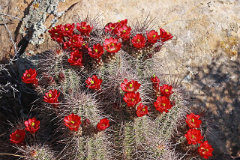
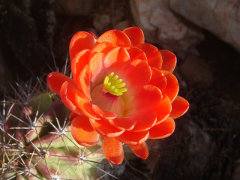
Scarlet hedgehog cactus is a clumping, ribbed, spiny Echinocereus best known for its showy red-orange flowers and small, spiny fruits. In the Southwest it can be common in rocky settings, but as a food plant it is more of an opportunistic snack because fruit set can be inconsistent and the fruits are frequently excavated by ants before people ever get to them.
Physical Characteristics

 Echinocereus coccineus is an evergreen Shrub growing to 0.3 m (1ft) by 0.6 m (2ft in) at a medium rate.
See above for USDA hardiness. It is hardy to UK zone 7. The flowers are pollinated by Birds, Bees.
It is noted for attracting wildlife.
Suitable for: light (sandy) and medium (loamy) soils, prefers well-drained soil and can grow in nutritionally poor soil. Suitable pH: neutral and basic (mildly alkaline) soils. It cannot grow in the shade. It prefers dry soil and can tolerate drought.
UK Hardiness Map
US Hardiness Map
Synonyms
Cereus aggregatus J.M.Coult. Cereus coccineus (Engelm.) Engelm. Cereus phoeniceus Engelm. E. aggregatus Rydb. E. coccineus subsp. aggregatus W.Blum, Mich.Lange & Rutow. E. phoeniceus (Engelm.) Lem. E. triglochidiatus subsp. coccineus (Engelm.) U.Guzmán. E. triglochidiatus var. coccineus (Engelm.) W.T.Marshall & T.M.Bock.
Plant Habitats
Edible Uses
The fruits are edible and widely reported as good, but they are not reliably harvestable at scale because many fruits are emptied by ants and fruiting can be erratic [2-3]. Edible Uses & Rating. Fruits are the primary edible part; treat it as an occasional forager’s bonus rather than a dependable staple. Overall food rating: good fruit quality when you beat the ants, low reliability as a “harvest-class” resource (matching your project framing) [2-3]. Taste, Processing & Kitchen Notes. When intact and fully ripe, hedgehog cactus fruits are commonly described as pleasant and sweet, with scarlet/claret types often singled out as among the best in the genus. Practical handling is dominated by de-spining: spine clusters on Echinocereus fruits tend to detach readily, so careful brushing and minimal handling usually work better than aggressive scraping (which can drive spines into pulp). In real use, the “kitchen note” is simple: always open the fruit to check whether ants have hollowed it out, because an intact-looking fruit can be an empty shell [2-3]. Seasonality (Phenology). Typically flowers in late spring and fruits from early to mid-summer in much of the Southwest, with timing shifting earlier at low elevations and later at higher elevations (this follows your genus-level note that Echinocereus fruits are generally early–mid summer after spring bloom) [2-3]. Safety & Cautions (Food Use). The core safety issue is mechanical rather than chemical: spines on the fruit and plant can cause injury, and spines may persist even after brushing. A second “safety” issue is conservation—some Echinocereus populations/varieties are protected in parts of their range, so harvest should be avoided where collection is restricted [2-3]. Harvest & Processing Workflow. Harvest only fruits that are clearly mature and colored, then immediately inspect by splitting or opening; if the interior is dry and hollowed, discard. Gently brush off detachable spine clusters before opening further. Eat fresh as a snack, or scoop pulp and seeds and strain if you want a smoother product, keeping spines out of the edible portion at every step. Cultivar/Selection Notes. In horticulture, scarlet-flowering forms are often selected for flower color and cold tolerance rather than fruit yield. For food value, selection is mostly about finding local colonies that actually set intact fruit despite ants, rather than named cultivars. Look-Alikes & Confusion Risks. Within cactus communities, confusion is more likely among Echinocereus species than with other genera: the diagnostic “package” is ribbed stems plus laterally borne, spiny flowers and spiny fruits. Unlike some Mammillaria (fishhook cacti), Echinocereus central spines are not hooked (a helpful field separator based on your genus notes). Traditional/Indigenous Use Summary. Fruits of several Echinocereus species were traditionally eaten in parts of the Southwest and adjacent regions, they are better viewed as supplemental seasonal fruits rather than major staples because of inconsistent harvestability.
References More on Edible Uses
Medicinal Uses
Plants For A Future can not take any responsibility for any adverse effects from the use of plants. Always seek advice from a professional before using a plant medicinally.
Echinocereus coccineus, commonly known as the Scarlet Hedgehog Cactus or Claret-cup Cactus, has a history of traditional medicinal uses, particularly among Native American tribes in the Southwestern United States. Traditional Medicinal Uses: Heart Medicine: The Navajo used this plant as a heart stimulant. Topical Applications: The pulp of the cactus was used as a poultice to treat wounds or as a cooling agent for skin irritations. Veterinary Use: In some regions, it has been used in local veterinary medicine for treating broken bones. Other Uses: Edible Fruit: The red, strawberry-flavored fruit is edible and was collected by indigenous peoples. Ornamental: It is widely grown in rock gardens due to its bright red-orange flowers. Note of Caution: Some sources indicate that while used medicinally, the plant is also considered poisonous in some contexts or may cause intoxication, so it should be used with caution. It is not a substitute for professional medical advice.
References More on Medicinal Uses
The Bookshop: Edible Plant Books
Our Latest books on Perennial Plants For Food Forests and Permaculture Gardens in paperback or digital formats.

Edible Tropical Plants
Food Forest Plants for Hotter Conditions: 250+ Plants For Tropical Food Forests & Permaculture Gardens.
More

Edible Temperate Plants
Plants for Your Food Forest: 500 Plants for Temperate Food Forests & Permaculture Gardens.
More

More Books
PFAF have eight books available in paperback and digital formats. Browse the shop for more information.
Shop Now
Other Uses
The species is used as an ornamental. It is found in interstate trade in the USA (Robbins 2003) [2-6]. In horticulture, scarlet-flowering forms are often selected for flower color and cold tolerance rather than fruit yield. Flowers support spring pollinators; fruits (when present) can feed insects and small animals; dense spines provide micro-shelter in harsh sites. The ant–fruit interaction is a real ecological filter on seed/pulp availability and is central to its foraging reliability.
Special Uses
References More on Other Uses
Cultivation details
Scarlet hedgehog cactus is an excellent wildlife-and-garden value in the right dry, rocky niche and can provide genuinely tasty fruit, when the season, fruit set, and ants allow. As a foraging target, it is “worth checking” rather than “worth relying on.” Growing Conditions. Full sun to very bright exposure, heat tolerant, and strongly dependent on fast drainage; in cultivation, winter wet is the common failure point for cold-hardy Echinocereus. Habitat & Range. Rocky slopes, desert edges, and open woodland/desert transition settings across portions of the Southwest, with local distribution depending on the taxonomic concept used for this variable complex. Size & Landscape Performance. Typically a low, clustering cactus forming mounds over time; strong ornamental performance when sited dry and sunny, with seasonal flower display as the main landscape feature. Cultivation (Horticulture). Plant in mineral, sharply drained soils; avoid rich irrigation regimes; use slope/berm planting or gritty mixes in colder/wetter climates to keep crowns dry. Pests & Problems. Ants are the defining “problem” for fruit harvest, often excavating fruits to empty shells (your project’s key field observation). In cultivation, rot from winter moisture is a frequent issue; rodents may occasionally damage plants. Identification & Habit. Ribbed, non-jointed stems; plants solitary or clustered; spines in areoles; flowers borne on the side of stems rather than strictly at the apex; fruits spiny and small, becoming dry as they age. Pollinators. Red-flowering hedgehog cacti are commonly serviced by hummingbirds and native bees in the Southwest, with the showy, nectar-rich flowers acting as strong spring resources (pattern consistent with red Echinocereus pollination ecology; claret-cup forms are especially associated with hummingbirds). Scarlet Hedgehog Cactus (Echinocereus coccineus). Family: Cactus family (Cactaceae). Genus: Echinocereus. Common names: Scarlet hedgehog cactus. USDA Hardiness Zones and size: Often grown as a cold-hardy cactus where well drained; a conservative working range is about Zones 6–9, with local forms sometimes hardier in very dry, protected sites; typically about 10–30 cm tall, spreading 20–60+ cm by clustering over time (approximate, highly form- and site-dependent).
References Carbon Farming Information and Carbon Sequestration Information
Temperature Converter
Type a value in the Celsius field to convert the value to Fahrenheit:
Fahrenheit:
The PFAF Bookshop
Plants For A Future have a number of books available in paperback and digital form. Book titles include Edible Plants, Edible Perennials, Edible Trees,Edible Shrubs, Woodland Gardening, and Temperate Food Forest Plants. Our new book is Food Forest Plants For Hotter Conditions (Tropical and Sub-Tropical).
Shop Now
Plant Propagation
Seed is the standard route for maintaining genetic diversity; offsets can be rooted where clumping forms produce detachable stems. Seed-grown plants are slower but often more resilient long-term.
Other Names
If available other names are mentioned here
Scarlet Hedgehog Cactus (Echinocereus coccineus).
Native Range
US. USA. Colorado, Mexico Northeast, New Mexico, Texas.
Weed Potential
Right plant wrong place. We are currently updating this section.
Please note that a plant may be invasive in one area but may not in your area so it's worth checking.
Very low; this is not a spreading weed in managed landscapes and spreads mainly by slow clumping and seed near parent plants under suitable desert conditions.
Conservation Status
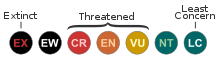
IUCN Red List of Threatened Plants Status : Least Concern.
Growth: S = slow M = medium F = fast. Soil: L = light (sandy) M = medium H = heavy (clay). pH: A = acid N = neutral B = basic (alkaline). Shade: F = full shade S = semi-shade N = no shade. Moisture: D = dry M = Moist We = wet Wa = water.
Now available:
Food Forest Plants for Mediterranean Conditions
350+ Perennial Plants For Mediterranean and Drier Food Forests and Permaculture Gardens.
[Paperback and eBook]
This is the third in Plants For A Future's series of plant guides for food forests tailored to
specific climate zones. Following volumes on temperate and tropical ecosystems, this book focuses
on species suited to Mediterranean conditions—regions with hot, dry summers and cool, wet winters,
often facing the added challenge of climate change.
Read More
Expert comment
Author
Engelm.
Botanical References
Links / References
For a list of references used on this page please go here
Readers comment
| Add a comment |
|
If you have important information about this plant that may help other users please add a comment or link below. Only comments or links that are felt to be directly relevant to a plant will be included. If you think a comment/link or information contained on this page is inaccurate or misleading we would welcome your feedback at [email protected]. If you have questions about a plant please use the Forum on this website as we do not have the resources to answer questions ourselves.
* Please note: the comments by website users are not necessarily those held by PFAF and may give misleading or inaccurate information.
|
Subject : Echinocereus coccineus
|
|
|
|