 |
|
http://commons.wikimedia.org/wiki/User:Stan_Shebs |
 |
|
Translate this page:
Summary
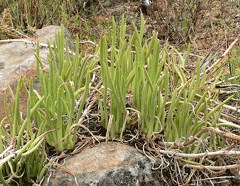
Mission lettuce is one of the most immediately food-like Dudleya species because its leaves are long, fleshy, smooth, and bean-like rather than broad and chalky. It has a long history of being noticed as a succulent emergency or supplementary food plant in southern California, where it grows on rocky slopes and coastal bluffs in landscapes that can be dry for much of the year. Its chief value lies in its moist, water-rich leaves, which can be gathered without uprooting the plant, though local protection and conservation concerns may override any practical food use outside a true emergency
Physical Characteristics

 Dudleya edulis is an evergreen Perennial growing to 0.3 m (1ft) by 0.6 m (2ft in).
See above for USDA hardiness. It is hardy to UK zone 9. It is in leaf all year, in flower from June to July. The species is hermaphrodite (has both male and female organs) and is pollinated by Insects.
It is noted for attracting wildlife.
Suitable for: light (sandy) and medium (loamy) soils and prefers well-drained soil. Suitable pH: mildly acid, neutral and basic (mildly alkaline) soils. It cannot grow in the shade. It prefers dry or moist soil and can tolerate drought.
UK Hardiness Map
US Hardiness Map
Synonyms
Cotyledon edulis. (Nutt.)Brewer.&Wats. Echeveria edulis. Stylophyllum edulis.
Plant Habitats
Cultivated Beds;
Edible Uses
Edible Parts: Leaves Stem
Edible Uses:
The edible part is the leaf. The leaves are thick, moist, fleshy, and somewhat bean-like in shape, with flavor reported as either refreshing and delicious or simply bland. The species is therefore best treated as a succulent leaf vegetable or moisture source rather than as a calorie-dense food [2-3]. Edible Uses & Rating: Mission lettuce is a modest but practical edible succulent that grows abundantly, and collection is lawful. Its food value lies mainly in hydration, freshness, and mildness rather than in strong flavor or bulk nutrition. In genuine coastal-desert or rocky-hillside scarcity, that can still be valuable. Because the leaves are perennial and can be harvested without killing the whole plant if taken sparingly, it is one of the more practical Dudleya food plants from a sustainability standpoint, though wild collection should still be conservative [2-3]. Taste, Processing & Kitchen Notes: The leaves are best understood as succulent salad material or trail food rather than a cooking staple. Reports of a bland to refreshing taste are consistent with their role as moisture-bearing leaves rather than as strongly flavored greens. In practical kitchen use, they would be most suitable fresh, chopped into mixed salads, or eaten plain in small quantities. Older leaves are often more substantial than younger ones, though very old leaves may become tougher or weathered. Because they are fleshy and low in bitterness compared with many stonecrop relatives, they are among the more approachable wild succulents [2-3]. Seasonality (Phenology): Mission lettuce can be gathered in any season because the succulent leaves persist year-round, though the species typically blooms in spring. This perennial availability of leaves is one of the reasons it was historically notable in dry landscapes. Safety & Cautions (Food Use): The main caution is conservation rather than toxicity. Many Dudleya species are protected or vulnerable to poaching, and collection may be prohibited in many places except in a true survival situation. Plants should never be taken from parks, preserves, or known protected populations. Also, avoid gathering from roadcuts, contaminated slopes, or landscaped specimens that may have been treated [2-3]. Harvest & Processing Workflow: If leaves are lawfully and ethically gathered, the least damaging approach is to remove only a few mature outer leaves from each rosette rather than uprooting whole plants. Leaves should be rinsed thoroughly to remove grit, then eaten fresh. Because this species is more of a moisture-rich food than a starchy or protein-rich food, there is little reason for elaborate cooking unless it is incorporated into a mixed dish [2-3]. Cultivar/Selection Notes: Mission lettuce is grown in succulent horticulture, and ornamental selection tends to favor compactness, attractive clustering, and clean leaf color rather than food traits. In practical edible terms, the best “selection” would simply be healthy, well-hydrated plants with plump, mature leaves. Look-Alikes & Confusion Risks: Mission lettuce is one of the easier Dudleya species to recognize because of its narrow, cylindrical to bean-like leaves. It differs strongly from the broader lanceolate or chalky-leaved species in this group. Confusion is still possible with other narrow-leaved succulents in cultivation, but in the wild, its clustered “fingertip” rosettes are distinctive. Traditional/Indigenous Use Summary: Mission lettuce as a recognized edible leaf plant of southwestern California. That role is consistent with its perennial succulence and easy-to-use, fresh leaves in landscapes where green, moisture-bearing plants are scarce for much of the year [2-3]. Leaves - raw. Fleshy[183]. They are considered to be a delicacy[183]. Stems - slightly sweet and refreshing to chew, though they leave a chalky taste in the mouth[183].
References More on Edible Uses
Medicinal Uses
Plants For A Future can not take any responsibility for any adverse effects from the use of plants. Always seek advice from a professional before using a plant medicinally.
Dudleya edulis (Mission Lettuce/Fingertips) has limited documented medicinal uses, primarily historical applications by Indigenous peoples in Baja California to treat skin conditions such as corns and calluses with its succulent leaves, and sometimes using the roots for asthma. While it was historically consumed as a fresh food source, it is now mostly used as a native ornamental plant. Traditional and Potential Uses: Skin Care: Indigenous peoples used the fleshy leaves topically to remove or treat calluses and corns. Thirst Quencher: The succulent leaves were chewed to alleviate thirst. Astringent Properties: Related Dudleya species have roots used as a decoction for asthma or as an astringent. Note: While some succulents are used in traditional medicine, it is important to distinguish this species from others. There are no significant modern clinical applications listed for Dudleya edulis.
References More on Medicinal Uses
The Bookshop: Edible Plant Books
Our Latest books on Perennial Plants For Food Forests and Permaculture Gardens in paperback or digital formats.

Edible Tropical Plants
Food Forest Plants for Hotter Conditions: 250+ Plants For Tropical Food Forests & Permaculture Gardens.
More

Edible Temperate Plants
Plants for Your Food Forest: 500 Plants for Temperate Food Forests & Permaculture Gardens.
More

More Books
PFAF have eight books available in paperback and digital formats. Browse the shop for more information.
Shop Now
Other Uses
It forms elegant, low clumps of finger-like leaves and sends up slender, flowering stalks above the foliage. It is excellent for rock gardens, coastal succulent plantings, and crevice gardens where its compact habit can be appreciated year-round. Mission lettuce contributes succulent cover and seasonal nectar resources to rocky coastal ecosystems. Its rosettes help occupy shallow-soil niches on rock faces and exposed slopes where few broader-leaved perennials can persist.
Special Uses
References More on Other Uses
Cultivation details
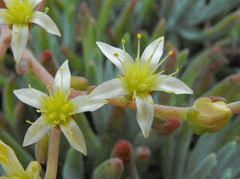
Mission lettuce is one of the more directly edible Dudleya species, mainly because its leaves are mild, fleshy, and available year-round. It is still not a major staple plant, but as a lawful, sparingly harvested succulent green, it has more practical value than many of its rarer relatives. Growing Conditions: This species prefers fast-draining rocky or sandy soils, coastal or near-coastal influence, bright sun to light shade, and minimal summer irrigation once established. It performs best where winter moisture drains quickly and where intense inland humidity is limited. Habitat & Range. Mission lettuce is native to southern California and extends only slightly beyond the state. It is strongly associated with rocky coastal slopes, bluffs, and other dry, exposed habitats. Size & Landscape Performance: In landscapes, it forms elegant, low clumps of finger-like leaves and sends up slender, flowering stalks above the foliage. It is excellent for rock gardens, coastal succulent plantings, and crevice gardens where its compact habit can be appreciated year-round. Cultivation (Horticulture): Mission lettuce is widely admired as a dry-garden succulent and generally performs well if overwatering is avoided. It should be planted in sharply drained soil and protected from excessive summer irrigation. Container culture is also suitable if drainage is excellent. Pests & Problems: The main horticultural problem is rot from poor drainage or excessive moisture. Snails, slugs, or opportunistic chewing pests may damage leaves in moister gardens, but overwatering remains the most serious cultivation risk. Identification & Habit: Mission lettuce is a small perennial succulent forming clustered basal rosettes of smooth, fleshy, cylindrical-to-rounded leaves, with flowering stalks rising above the clumps during the blooming season. Pollinators. Like other Dudleya, the flowers are likely visited by generalist insects such as bees and flies, especially because the elevated inflorescences make them conspicuous above the surrounding rock vegetation. Mission lettuce, now accepted as Dudleya edulis, belongs to the stonecrop family (Crassulaceae) and the genus Dudleya. Common names include mission lettuce and fingertips. It is a perennial succulent native primarily to southern California's coastal and near-coastal regions, extending slightly beyond the state line. In cultivation, it is generally best suited to USDA Zones about 9–11, especially where winter drainage is excellent, and summer humidity is not extreme. Mature plants usually form clustered rosettes roughly 10–30 cm tall and 20–60 cm across, with flowering stalks rising well above the leaves. Requires a very sunny position in a well-drained soil[200]. Plants enter a semi-dormant state in late summer and they should be kept fairly dry at this time[200]. There must be some doubt over the hardiness of this species. One report says that it is hardy to zone 8 which suggests that it should tolerate occasional cold periods down to between -5 and -10°c, but the report also says that the plants should be protected from frost, with a winter temperatures no lower than 7°c[200].
References Carbon Farming Information and Carbon Sequestration Information
Temperature Converter
Type a value in the Celsius field to convert the value to Fahrenheit:
Fahrenheit:
The PFAF Bookshop
Plants For A Future have a number of books available in paperback and digital form. Book titles include Edible Plants, Edible Perennials, Edible Trees,Edible Shrubs, Woodland Gardening, and Temperate Food Forest Plants. Our new book is Food Forest Plants For Hotter Conditions (Tropical and Sub-Tropical).
Shop Now
Plant Propagation
Propagation is usually by seed or by careful division of offsets in cultivation. Seed-grown plants are slower but often more resilient long-term. Cuttings of side shoots in the summer. Dry the stem for 24 hours before planting in a very sandy soil mix[200]. The main stem can also be used, the parent plant will then produce new plantlets at the cut edge[200].
Other Names
If available other names are mentioned here
Mission Lettuce, Fingertips
Native Range
NORTHERN AMERICA: United States (California (southwest)), Mexico (Baja California (Norte) (northwest))
Weed Potential
Right plant wrong place. We are currently updating this section.
Please note that a plant may be invasive in one area but may not in your area so it's worth checking.
Mission lettuce has very low weed potential. It is slow-growing, habitat-specific, and not invasive.
Conservation Status
IUCN Red List of Threatened Plants Status : Not listed.
Growth: S = slow M = medium F = fast. Soil: L = light (sandy) M = medium H = heavy (clay). pH: A = acid N = neutral B = basic (alkaline). Shade: F = full shade S = semi-shade N = no shade. Moisture: D = dry M = Moist We = wet Wa = water.
Now available:
Food Forest Plants for Mediterranean Conditions
350+ Perennial Plants For Mediterranean and Drier Food Forests and Permaculture Gardens.
[Paperback and eBook]
This is the third in Plants For A Future's series of plant guides for food forests tailored to
specific climate zones. Following volumes on temperate and tropical ecosystems, this book focuses
on species suited to Mediterranean conditions—regions with hot, dry summers and cool, wet winters,
often facing the added challenge of climate change.
Read More
Expert comment
Author
(Nutt.)Moran.
Botanical References
71200
Links / References
For a list of references used on this page please go here
Readers comment