 |
|
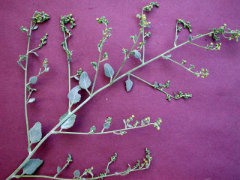
Mike wikimedia.org Creative Commons Attribution-Share Alike 3.0 |
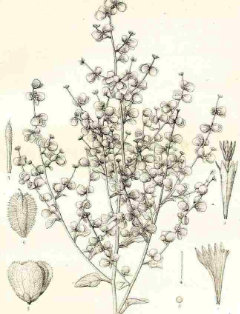 |
| edibleplants.org |
Translate this page:
Summary
Dicoria canescens is a perennial plant growing up to 0.75 metres tall. It is harvested from the wild for local use as a food. They are native to Arizona, California, Colorado, Mexico Northwest, Nevada, New Mexico, Utah in the US. une dicoria produces edible flowers and seeds, but both are difficult to use and largely unpalatable. Seeds have good flavor but are too small and encased in sharp shells, making them impractical for human food. Best adapted to USDA Zones 7–10; not invasive.
Physical Characteristics

 Dicoria canescens is a PERENNIAL growing to 0.8 m (2ft 7in) by 0.8 m (2ft 7in).
See above for USDA hardiness. It is hardy to UK zone 8 and is not frost tender. The flowers are pollinated by Wind.
Suitable for: light (sandy) and medium (loamy) soils, prefers well-drained soil and can grow in nutritionally poor soil. Suitable pH: neutral and basic (mildly alkaline) soils and can grow in very alkaline soils.
It cannot grow in the shade. It prefers dry or moist soil and can tolerate drought.
UK Hardiness Map
US Hardiness Map
Synonyms
D. canescens subsp. brandegeei (A.Gray) Kartesz. D. canescens subsp. canescens. D. canescens subsp. clarkiae (P.B.Kenn.) D.D.Keck. D. canescens subsp. hispidula (Rydb.) D.D.Keck. D. canescens subsp. wetherillii (Eastw.) Cronquist.
Plant Habitats
Edible Uses
The flowers and the seed are ground up and eaten[216 ]. Dune dicoria (Dicoria canescens ssp. brandegeei), also called desert twinbugs, is a shrub-like annual of the sunflower family (Asteraceae), native to the Mojave Desert and adapted to sandy habitats. Both the flowers and seeds are edible, though neither is particularly palatable. The small flowers, produced from August to November, are sticky, aromatic, and easily chewed, but their flavor is bitter and resinous, far less pleasant than their fruity, evergreen-like fragrance. Boiling can reduce some of the bitterness, but it also removes much of the pollen and does little to improve palatability. The seeds develop in winter, when few other wild foods are available. They are tiny and enclosed in hard, sharp-edged cypselae that make harvesting and processing very difficult. The sharp wings present a choking hazard if eaten whole, as chewing does not effectively soften them. While the seeds themselves have a good flavor and a pleasant aroma, they are nearly impossible to separate from the tough shells. Charring the cypselae can improve flavor slightly, but overall, this plant is not a practical or reliable food source. For survival, the seeds are probably better left for small animals, which in turn may provide nourishment to foragers [2-3].
References More on Edible Uses
Medicinal Uses
Plants For A Future can not take any responsibility for any adverse effects from the use of plants. Always seek advice from a professional before using a plant medicinally.
None known
References More on Medicinal Uses
The Bookshop: Edible Plant Books
Our Latest books on Perennial Plants For Food Forests and Permaculture Gardens in paperback or digital formats.
Edible Tropical Plants
Food Forest Plants for Hotter Conditions: 250+ Plants For Tropical Food Forests & Permaculture Gardens.
More
Edible Temperate Plants
Plants for Your Food Forest: 500 Plants for Temperate Food Forests & Permaculture Gardens.
More
More Books
PFAF have eight books available in paperback and digital formats. Browse the shop for more information.
Shop Now
Other Uses
References More on Other Uses
Cultivation details
We have very little information on this species and do not know if it will be hardy in Britain. It is only likely to succeed outdoors where conditions can be made to suit its native desert-like environment[K ]. It the wild is grows in Alkaline soils, desert washes, and flats at elevations of 20 - 1700 metres.
References Carbon Farming Information and Carbon Sequestration Information
Temperature Converter
Type a value in the Celsius field to convert the value to Fahrenheit:
Fahrenheit:
The PFAF Bookshop
Plants For A Future have a number of books available in paperback and digital form. Book titles include Edible Plants, Edible Perennials, Edible Trees,Edible Shrubs, Woodland Gardening, and Temperate Food Forest Plants. Our new book is Food Forest Plants For Hotter Conditions (Tropical and Sub-Tropical).
Shop Now
Plant Propagation
We have no knowledge of this species and would suggest sowing the seed in spring in a greenhouse in a very well-drained compost. Only just cover the seed, but do not allow to dry out. Pot up the seedlings as soon as they are large enough to handle and grow on in the greenhouse for at least a year before planting out in early summer. Consider giving winter protection for at leat the first couple of winters after the plant has been planted out.
Other Names
If available other names are mentioned here
Dune dicoria (Dicoria canescens ssp. brandegeei), also called desert twinbugs
Native Range
Native to: Arizona, California, Colorado, Mexico Northwest, Nevada, New Mexico, Utah.
Weed Potential
Right plant wrong place. We are currently updating this section.
Please note that a plant may be invasive in one area but may not in your area so it's worth checking.
It is not generally considered invasive, though as a hardy desert annual it can spread readily in sandy or disturbed soils within its natural range.
Conservation Status
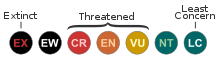
IUCN Red List of Threatened Plants Status : Not available
Growth: S = slow M = medium F = fast. Soil: L = light (sandy) M = medium H = heavy (clay). pH: A = acid N = neutral B = basic (alkaline). Shade: F = full shade S = semi-shade N = no shade. Moisture: D = dry M = Moist We = wet Wa = water.
Now available:
Food Forest Plants for Mediterranean Conditions
350+ Perennial Plants For Mediterranean and Drier Food Forests and Permaculture Gardens.
[Paperback and eBook]
This is the third in Plants For A Future's series of plant guides for food forests tailored to
specific climate zones. Following volumes on temperate and tropical ecosystems, this book focuses
on species suited to Mediterranean conditions—regions with hot, dry summers and cool, wet winters,
often facing the added challenge of climate change.
Read More
Expert comment
Author
A.Gray.
Botanical References
Links / References
For a list of references used on this page please go here
A special thanks to Ken Fern for some of the information used on this page.
Readers comment
| Add a comment |
|
If you have important information about this plant that may help other users please add a comment or link below. Only comments or links that are felt to be directly relevant to a plant will be included. If you think a comment/link or information contained on this page is inaccurate or misleading we would welcome your feedback at [email protected]. If you have questions about a plant please use the Forum on this website as we do not have the resources to answer questions ourselves.
* Please note: the comments by website users are not necessarily those held by PFAF and may give misleading or inaccurate information.
|
Subject : Dicoria canescens
|
|
|
|