 |
|
http://davesgarden.com/members/dave/ |
 |
| http://de.wikipedia.org/wiki/Benutzer:Rebou |
Translate this page:
Summary
Texas sotol is the smaller, greener relative of common sotol, occupying the Chihuahuan Desert and adjacent drylands of southern Texas. It has the same basic food pattern as other sotols: edible sap, crown, and flowering stalk, with likely similar utility in flowers where present. The species is especially notable for its bright green foliage, which helps distinguish it from the more bluish or dusty foliage of common sotol. It is a useful perennial food reserve in dry country, though less widely discussed than common sotol in ethnobotanical literature.
Physical Characteristics

 Dasylirion texanum is a PERENNIAL growing to 1.2 m (4ft) by 1.8 m (6ft in).
See above for USDA hardiness. It is hardy to UK zone 9. It is in flower from June to July. The species is hermaphrodite (has both male and female organs).
Suitable for: light (sandy), medium (loamy) and heavy (clay) soils. Suitable pH: mildly acid, neutral and basic (mildly alkaline) soils. It can grow in semi-shade (light woodland) or no shade. It prefers moist soil.
UK Hardiness Map
US Hardiness Map
Synonyms
D. texanum var. aberrans Trel.
Plant Habitats
Cultivated Beds;
Edible Uses
Edible Parts: Root
Edible Uses: Drink
The sap, crown, and flowering stalk are edible, and the species can be used like common sotol. The crown is always available but destructive to harvest, while the flowering stalk is the most practical renewable food part [2-3]. Edible Uses & Rating. Texas sotol ranks as a moderate-to-high-value desert survival and traditional-use plant, with the same strengths and weaknesses as the genus. The flowering stalk is the best renewable edible part. The crown is substantial but should only be harvested when truly necessary because removal kills the plant. Taste, Processing & Kitchen Notes. By comparison with common sotol, the most reasonable expectation is that the flowering stalk is sweet, green, and somewhat asparagus-like, with a mild soapy note that diminishes with cooking. The crown should be considered a roasting and slow-cooking food, not a fresh vegetable. Sap may be collected from cut stalks or crown tissue, though it is secondary in practical importance to the stalk and crown themselves [2-3]. Seasonality (Phenology). The genus generally blooms from May to July, with possible later flowering following rainfall. Crowns are available year-round. Flower stalks are best harvested young and tender shortly after emergence. Safety & Cautions (Food Use). Texas sotol carries the same physical hazards as other sotols: sharp marginal teeth and terminal leaf spines. Gloves and careful handling are essential. Crown harvest is destructive. Insect contamination of flowers is likely, and cooking is recommended. Local legality and sustainability should always be considered before harvest. Harvest & Processing Workflow. Young flower stalks should be cut while still green and before the lower tissues become woody. Tender inner portions can be stripped and cooked. Crowns require excavation and slow roasting or pit-cooking. Sap can be collected from cut stalk tissue. Flowers, if used, should be gathered selectively, cleaned of insects, and cooked. Cultivar/Selection Notes. There are no recognized food cultivars. In landscape use, selection tends to focus on foliage color and compactness rather than edible quality. Look-Alikes & Confusion Risks. Texas sotol can be confused with common sotol, but it is typically smaller and brighter green rather than bluish or dusty. It is also distinct from agaves and yuccas by flower sexuality and ovary position. Traditional/Indigenous Use Summary. Texas sotol can be used like common sotol, supporting its place in regional desert food systems [2-3]. The sugary pulp in the centre of the bud can be eaten[46]. Dasylirion was once a major food source in the desert southwest of N. America. The bulbs were roasted in rock-lined pits and pounded into cakes[270]. A potent alcoholic beverage, known as sotol, is distilled from the baked and fermented bulbs[270].
References More on Edible Uses
Medicinal Uses
Plants For A Future can not take any responsibility for any adverse effects from the use of plants. Always seek advice from a professional before using a plant medicinally.
Dasylirion texanum (Texas sotol) has historical medicinal uses among indigenous groups for treating injuries and illnesses, including root decoctions for sprains and wounds. It is primarily recognized as a traditional, drought-tolerant, and nutritious food source (roasted hearts) rather than a widely used modern medicinal plant. Medicinal and Traditional Uses Wound Care: Root decoctions were used as washes for bleeding wounds and broken limbs. Anti-inflammatory/Pain Relief: Used for treating sprains. Hair Care: Roots were boiled for use as a hair tonic. Nutritional Support: The hearts were historically roasted, pounded into a paste, and consumed.
References More on Medicinal Uses
The Bookshop: Edible Plant Books
Our Latest books on Perennial Plants For Food Forests and Permaculture Gardens in paperback or digital formats.
Edible Tropical Plants
Food Forest Plants for Hotter Conditions: 250+ Plants For Tropical Food Forests & Permaculture Gardens.
More
Edible Temperate Plants
Plants for Your Food Forest: 500 Plants for Temperate Food Forests & Permaculture Gardens.
More
More Books
PFAF have eight books available in paperback and digital formats. Browse the shop for more information.
Shop Now
Other Uses
Basketry
It forms a handsome, symmetrical, architectural rosette that is especially useful in xeriscapes and native desert gardens. It is somewhat more compact and greener than common sotol, giving it a slightly softer visual effect. The leaves can be used for making baskets and fans[270]. It provides shelter and structure in dryland habitats and offers seasonal floral resources to pollinators. The dense rosettes may also create cover for small reptiles and invertebrates.
Special Uses
References More on Other Uses
Cultivation details
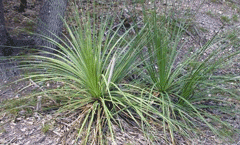
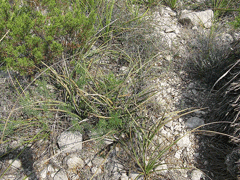
Texas sotol is a useful dryland food reserve and an excellent ornamental desert plant. Its main value lies in the flowering stalk and crown, with the stalk serving as a better renewable food source for modern, responsible use. Growing Conditions. This species prefers full sun, excellent drainage, and low to moderate moisture. It tolerates heat, drought, and poor soils very well and performs best where humidity is low and drainage is sharp. Habitat & Range. Texas sotol occurs primarily in southern Texas in the Chihuahuan Desert and adjacent dry scrub habitats. It is associated with rocky ground, limestone, and open arid slopes. Size & Landscape Performance. It forms a handsome, symmetrical, architectural rosette, especially useful in xeriscapes and native desert gardens. It is somewhat more compact and greener than common sotol, giving it a slightly softer visual effect. Cultivation (Horticulture). Texas sotol is well-suited to drought-tolerant landscapes and requires little maintenance once established. It should be planted in full sun with fast drainage and minimal irrigation. Overwatering and winter wet are the principal horticultural hazards. Pests & Problems. This species is generally durable and pest-resistant. Crown rot is the main issue in poorly drained soils. Leaf tips and margins can be hazardous during maintenance and pruning. Identification & Habit. Texas sotol is a shrub-like, basal-rosette perennial with long, narrow, bright green leaves armed with marginal teeth and a terminal spine. Flower stalks emerge from the center and carry many small unisexual flowers. Plants are dioecious and polycarpic. Pollinators. Likely pollinated by generalist insects, including bees, flies, and beetles, that visit the numerous small flowers borne on the tall stalks. Flowering displays are conspicuous and probably important to local insect communities when in bloom.
References Carbon Farming Information and Carbon Sequestration Information
Temperature Converter
Type a value in the Celsius field to convert the value to Fahrenheit:
Fahrenheit:
The PFAF Bookshop
Plants For A Future have a number of books available in paperback and digital form. Book titles include Edible Plants, Edible Perennials, Edible Trees,Edible Shrubs, Woodland Gardening, and Temperate Food Forest Plants. Our new book is Food Forest Plants For Hotter Conditions (Tropical and Sub-Tropical).
Shop Now
Plant Propagation
Propagation is primarily by seed. Germination is usually best in warm, well-drained media. Growth is relatively slow, especially in the early stages.
Other Names
If available other names are mentioned here
Texas sotol. Dasylirion texanum var. aberrans Trel.
Native Range
NORTHERN AMERICA: United States (Texas (south)), Mexico (Coahuila de Zaragoza)
Weed Potential
Right plant wrong place. We are currently updating this section.
Please note that a plant may be invasive in one area but may not in your area so it's worth checking.
Texas sotol has very low weed potential and is not known to spread aggressively.
Conservation Status
IUCN Red List of Threatened Plants Status : Not listed.
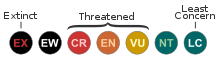
Growth: S = slow M = medium F = fast. Soil: L = light (sandy) M = medium H = heavy (clay). pH: A = acid N = neutral B = basic (alkaline). Shade: F = full shade S = semi-shade N = no shade. Moisture: D = dry M = Moist We = wet Wa = water.
Now available:
Food Forest Plants for Mediterranean Conditions
350+ Perennial Plants For Mediterranean and Drier Food Forests and Permaculture Gardens.
[Paperback and eBook]
This is the third in Plants For A Future's series of plant guides for food forests tailored to
specific climate zones. Following volumes on temperate and tropical ecosystems, this book focuses
on species suited to Mediterranean conditions—regions with hot, dry summers and cool, wet winters,
often facing the added challenge of climate change.
Read More
Expert comment
Author
Scheele.
Botanical References
200270
Links / References
For a list of references used on this page please go here
Readers comment
| Add a comment |
|
If you have important information about this plant that may help other users please add a comment or link below. Only comments or links that are felt to be directly relevant to a plant will be included. If you think a comment/link or information contained on this page is inaccurate or misleading we would welcome your feedback at [email protected]. If you have questions about a plant please use the Forum on this website as we do not have the resources to answer questions ourselves.
* Please note: the comments by website users are not necessarily those held by PFAF and may give misleading or inaccurate information.
|
Subject : Dasylirion texanum
|
|
|
|