 |
|
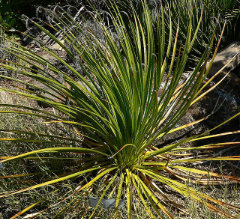
Stan Shebs Creative Commons Attribution-Share Alike 3.0 |
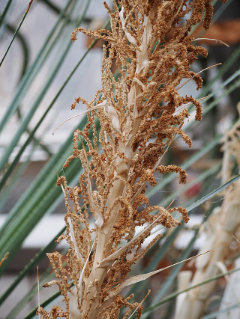 |
| Agnieszka Kwiecien, Nova Creative Commons Attribution-Share Alike 4.0 |
Translate this page:
Summary
Taxonomic Note: This genus was formerly classified in the family Agavaceae. Modern classifications include it within the Asparagaceae.
Green sotol is a rugged, long-lived desert plant valued historically for its edible crown, sap, and flowering stalks, and potentially for its flowers by close analogy with common sotol. It differs from other southwestern sotols most clearly in the orientation of the marginal teeth on the leaves, which point backward toward the leaf bases rather than forward toward the tips. This is an important field mark and one of the easiest ways to separate it from the other U.S. species. Like other sotols, it stores food in a large woody caudex that sits mostly below ground and sends up a dense globe of narrow, toothed leaves. Its food value lies in durability and seasonality: crowns are available year-round, flowering stalks are highly useful when young, and the plant survives in harsh country where few other substantial foods persist.
Physical Characteristics

 Dasylirion leiophyllum is an evergreen Shrub growing to 1.5 m (5ft) by 2 m (6ft) at a slow rate.
See above for USDA hardiness. It is hardy to UK zone 8 and is frost tender. The flowers are pollinated by Bees, Insects.
Suitable for: light (sandy), medium (loamy) and heavy (clay) soils, prefers well-drained soil and can grow in nutritionally poor soil. Suitable pH: neutral soils and can grow in very alkaline soils.
It cannot grow in the shade. It prefers dry or moist soil and can tolerate drought.
UK Hardiness Map
US Hardiness Map
Synonyms
Dasylirion heteracanthum I.M.Johnst. Dasylirion stewartii I.M.Johnst. Dasylirion stewartii var. glaucum I.M.Johnst.
Plant Habitats
Edible Uses
The principal edible parts are the sap, caudex or crown, and young flowering stalk. Based on the comparative information you supplied, green sotol can be used in essentially the same ways as common sotol. The crown is the most substantial food reserve, though harvesting it kills the plant. The young flowering stalk is the best renewable food because it can be harvested without killing the plant and because sotols are polycarpic, meaning they can flower more than once in a lifetime [2-3]. Edible Uses & Rating. Green sotol ranks as a useful desert survival and traditional-use plant rather than a casual everyday vegetable. The edible crown is substantial but destructive to collect. The stalk is a much better renewable resource and should be considered the primary practical food part for modern foragers. Sap has secondary utility, especially from more mature stalks or damaged tissues. If flowers are used as in Dasylirion wheeleri, they may also represent an excellent but seasonally brief resource, though direct species-specific confirmation in your source material is lacking. Overall, green sotol ranks as a high-value desert food plant when harvested and processed correctly, especially in landscapes with few alternatives [2-3]. Taste, Processing & Kitchen Notes. Green sotol can be utilized like common sotol; the best culinary expectation is that young flower stalks will be sweet, asparagus-like, and mildly soapy, with the soapy note becoming more acceptable after cooking. Young inner tissues should be more tender than outer tissues, and upper stalk sections should remain edible longer than lower sections. The crown should be treated as a roasting and pit-cooking food rather than a raw one. Sotol crowns, like agave hearts, are traditionally associated with slow cooking that converts stored carbohydrates into sweeter, more digestible food. Sap can be consumed fresh or reduced, though it is usually a secondary product rather than the main food. If flowers are used, they are likely best cooked to remove insects, soften texture, and concentrate sweetness [2-3]. Seasonality (Phenology). Sotols typically bloom from May to July, although flowering can occur later when rainfall is favorable. Crowns are present all year and represent the most seasonally stable food reserve. Flower stalks emerge rapidly and are best harvested while still young, green, and before they become woody. Flowers are available for a relatively short period after stalk elongation. Seeds, where used in the genus, follow flowering and fruit maturation later in the season. Safety & Cautions (Food Use). The leaves are heavily armed with stout marginal teeth and a hard terminal spine, making harvest physically hazardous without gloves, eye protection, and careful positioning. Crowns are large and often embedded in rocky soils, so extraction requires heavy effort. Harvesting the crown kills the plant and should therefore be reserved for genuine necessity or deliberate, legal management. Flower stalks are the most sustainable edible part because cutting them does not kill the plant. Flowers often contain many insects and should be inspected and preferably cooked. As with many desert plants, collection should be avoided from contaminated roadsides, industrial sites, or protected populations. Harvest & Processing Workflow. For sustainable use, the best approach is to locate a plant producing a young flowering stalk and harvest only the tender, green portions before the tissues become woody. Outer layers can be stripped away if fibrous, leaving softer inner tissues. Cooking by roasting, boiling, or steaming improves flavor and texture. If the crown is being used, it must be excavated, cleaned, and usually slow-roasted or pit-cooked to soften fibers and bring out sweetness. Sap may be collected from cut or woody stalk tissue. If flowers are gathered, they should be shaken or rinsed to remove insects, then toasted, steamed, or added to cooked dishes. [2-3]. Cultivar/Selection Notes. There are no known food cultivars of green sotol in common use. Selection in horticulture is mainly for drought tolerance, foliage color, and architectural form rather than food quality. For practical edible use, the best “selection” is simply choosing vigorous plants producing thick, tender flowering stalks. Look-Alikes & Confusion Risks. The main look-alikes are other sotols, agaves, yuccas, and nolinas. Green sotol is best separated from the other U.S. sotols by its backward-pointing leaf teeth. Agaves differ in having inferior ovaries, yuccas in having bisexual flowers, and nolinas in having smoother or only finely serrated leaves. In the field, the combination of a globe of ribbon-like toothed leaves, dioecious flowering, and a long flowering stalk usually makes the genus clear once seen closely. Traditional/Indigenous Use Summary. Green sotol can be used like common sotol, meaning the use of sap, crown, and flowering stalks in traditional desert food systems. Although detailed species-specific ethnographic notes were not supplied for green sotol itself, its inclusion among the edible U.S. sotols supports its role as a traditional desert staple or supplementary food where available [2-3]. The spongy interior of the trunks and leaf bases are rich in sugars and have been found to be an excellent food, especially in times of need. The plants were formerly much used for food by the natives of the arid regions and are still so used to some extent[411 ]. The leaves are trimmed off the plant, and the remaining head is roasted or boiled. The sweet pith and the leaf bases can then be eaten[411 ]. The heads were traditionally baked for about 24 hours in pits dug in the ground[411 ]. Once roasted, the trunks can be fermented and distilled to obtain a highly esteemed intoxicating drink known as ‘sotol’, a potent, colourless beverage of penetrating odour and peculiar taste[411, 1438 ]. The alcohol has been extracted from sotol plants on a commercial scale[411 ].
References More on Edible Uses
Medicinal Uses
Plants For A Future can not take any responsibility for any adverse effects from the use of plants. Always seek advice from a professional before using a plant medicinally.
None known
References More on Medicinal Uses
The Bookshop: Edible Plant Books
Our Latest books on Perennial Plants For Food Forests and Permaculture Gardens in paperback or digital formats.
Edible Tropical Plants
Food Forest Plants for Hotter Conditions: 250+ Plants For Tropical Food Forests & Permaculture Gardens.
More
Edible Temperate Plants
Plants for Your Food Forest: 500 Plants for Temperate Food Forests & Permaculture Gardens.
More
More Books
PFAF have eight books available in paperback and digital formats. Browse the shop for more information.
Shop Now
Other Uses
Green sotol forms a bold, spherical rosette that makes an excellent structural accent in arid landscapes. Mature plants are highly architectural, and the towering flowering stalks create strong vertical drama in bloom years. It is particularly effective in xeriscapes, desert gardens, and restoration plantings where a coarse, dramatic form is desired. The tough leaves contain a fibre suitable for making rough cordage. This fibre also seems to be suitable for the manufacture of paper[411, 1438 ]. The leaves are often used in weaving, making baskets, rough hats, mats, handicrafts, etc.[411, 1438 ]. The leaves are also much used for thatching[411 ]. When one of the plants, covered with dead leaves, is set on fire, it will burn for some time, and the burned stumps are a familiar sight in regions where the plants occur. When removed from the trunk, the leaf bases remaining on such burned plants make very satisfactory beds upon camping expeditions, for they are elastic and not uncomfortably hard[411 ]. The trunks are used frequently in constructing traditional houses[411 ]. The trunks are used for fuel[411 ]. Green sotol contributes structure, shelter, and seasonal nectar resources to desert ecosystems. Its dense rosette can provide cover for small animals, and the tall flowering stalks attract pollinating insects. Like other sotols, it is an important native component of dry upland habitats and helps stabilize thin rocky soils. It is especially well suited to limestone and other sharply drained desert slopes.
Special Uses
References More on Other Uses
Cultivation details
Green sotol is a resilient and important desert food plant with strong survival value and clear traditional-use potential. Its greatest modern usefulness lies in the renewable harvest of young flowering stalks and possibly flowers, while the crown remains a high-value but destructive food reserve. For anyone interested in desert ethnobotany or low-rainfall edible landscapes, it is one of the more significant perennial monocots of the Chihuahuan region. Growing Conditions: Green sotol prefers full sun, excellent drainage, and mineral or rocky soils. It is highly drought-tolerant once established and performs best in low-humidity, high-light, and minimal-summer-irrigation landscapes. It is especially well-suited to limestone and other sharply drained desert slopes. Habitat & Range: This species is found primarily in southern New Mexico and western Texas, especially in the Chihuahuan Desert on dry rocky slopes and uplands. It is associated with desert scrub, rocky hillsides, and lower mountain habitats. Size & Landscape Performance: Green sotol forms a bold, spherical rosette that makes an excellent structural accent in arid landscapes. Mature plants are highly architectural, and the towering flowering stalks create strong vertical drama in bloom years. It is particularly effective in xeriscapes, desert gardens, and restoration plantings where a coarse, dramatic form is desired. Cultivation (Horticulture): This is a strong ornamental for desert and xeric planting design. It should be planted in full sun with exceptional drainage and minimal organic enrichment. Once established, it requires very little irrigation. It is slow to moderate in growth, highly heat tolerant, and long-lived. Overwatering and poor winter drainage are the main causes of failure in cultivation. Pests & Problems: Green sotol is generally tough and resistant to most pests. The most common problems are crown or root rot in poorly drained soils, physical damage from incorrect pruning, and cold injury in wet winters. The leaf teeth also make maintenance awkward and potentially hazardous. Identification & Habit: Green sotol is a shrub-like perennial monocot with a mostly subterranean woody caudex and a dense basal rosette of long, narrow, ribbon-like leaves. The leaves are armed with stout marginal teeth that point backward toward the base, a key identifying feature. Flowering stalks arise from the center and bear large clusters of small unisexual flowers. Plants are dioecious and polycarpic. Pollinators: Sotol flowers are likely visited by a wide range of small bees, flies, beetles, and other nectar- or pollen-seeking insects. Because flowers are produced in large dense clusters on tall stalks, they can function as highly visible seasonal nectar resources in desert landscapes. Insect pollination is the most likely principal mode. Green sotol (Dasylirion leiophyllum) belongs to the asparagus family (Asparagaceae) and the genus Dasylirion. Common names include green sotol. It is a perennial desert monocot adapted to arid and semi-arid landscapes of the northern Chihuahuan Desert. In cultivation it is best suited to approximately USDA Hardiness Zones 7–10, depending on drainage, winter moisture, and local cold exposure. Mature plants typically form a basal rosette about 0.8–1.5 m tall and 1–2 m across, with flowering stalks rising dramatically above the foliage, often to several meters.
References Carbon Farming Information and Carbon Sequestration Information
Temperature Converter
Type a value in the Celsius field to convert the value to Fahrenheit:
Fahrenheit:
The PFAF Bookshop
Plants For A Future have a number of books available in paperback and digital form. Book titles include Edible Plants, Edible Perennials, Edible Trees,Edible Shrubs, Woodland Gardening, and Temperate Food Forest Plants. Our new book is Food Forest Plants For Hotter Conditions (Tropical and Sub-Tropical).
Shop Now
Plant Propagation
Seed—sow in spring in a greenhouse. When they are large enough to handle, prick the seedlings out into individual pots and grow them in the greenhouse for at least their first winter. After the last expected frosts, plant them out into their permanent positions in late spring or early summer.
Other Names
If available other names are mentioned here
Green sotol, Dasylirion leiophyllum
Native Range
Native to: Mexico Northeast, New Mexico, Texas.
Weed Potential
Right plant wrong place. We are currently updating this section.
Please note that a plant may be invasive in one area but may not in your area so it's worth checking.
A slow-growing native species that does not spread aggressively and is not regarded as invasive or weedy. Its natural distribution is limited to desert and semi-desert regions, where it is an integral part of the native flora.
Conservation Status
IUCN Red List of Threatened Plants Status : Not available

Growth: S = slow M = medium F = fast. Soil: L = light (sandy) M = medium H = heavy (clay). pH: A = acid N = neutral B = basic (alkaline). Shade: F = full shade S = semi-shade N = no shade. Moisture: D = dry M = Moist We = wet Wa = water.
Now available:
Food Forest Plants for Mediterranean Conditions
350+ Perennial Plants For Mediterranean and Drier Food Forests and Permaculture Gardens.
[Paperback and eBook]
This is the third in Plants For A Future's series of plant guides for food forests tailored to
specific climate zones. Following volumes on temperate and tropical ecosystems, this book focuses
on species suited to Mediterranean conditions—regions with hot, dry summers and cool, wet winters,
often facing the added challenge of climate change.
Read More
Expert comment
Author
Engelm. ex Trel.
Botanical References
Links / References
For a list of references used on this page please go here
A special thanks to Ken Fern for some of the information used on this page.
Readers comment
| Add a comment |
|
If you have important information about this plant that may help other users please add a comment or link below. Only comments or links that are felt to be directly relevant to a plant will be included. If you think a comment/link or information contained on this page is inaccurate or misleading we would welcome your feedback at [email protected]. If you have questions about a plant please use the Forum on this website as we do not have the resources to answer questions ourselves.
* Please note: the comments by website users are not necessarily those held by PFAF and may give misleading or inaccurate information.
|
Subject : Dasylirion leiophyllum
|
|
|
|