 |
|
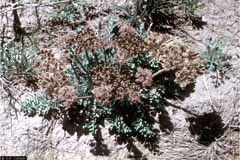
G.A. Cooper @ USDA-NRCS PLANTS Database |
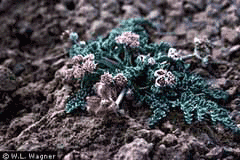 |
| W.L. Wagner @ USDA-NRCS PLANTS Database |
Translate this page:
Summary
Purple wavywing is a “balanced” wavywing in your notes: leaves can be mild enough for salads more often than in some other species, while roots are usable but not always as starchy or as clean-textured as the top-tier root species. Cymopterus purpureus (Purple springparsley) is a perennial wildflower native to the arid regions of the southwestern United States, specifically in Arizona, Colorado, New Mexico, Nevada, and Utah. Natural Habitat and Ecology Location: It thrives in arid and semi-arid environments, including desert shrublands, rocky canyons, and pinyon-juniper woodlands. Elevation: It is generally found at elevations between 1,200 and 2,100 meters (approx. 3,900 to 6,900 feet). Soil: The species prefers well-drained soil, often found in sandy, rocky, or gravelly locations. Conditions: It is adapted to dry conditions and is typically seen flowering in early spring, from March to June. Note: This species is sometimes referred to as Vesper purpureus in recent botanical classifications, and is a distinct species from the similar-looking C. purpurascens (Widewing springparsley).
Physical Characteristics

 Cymopterus purpureus is a PERENNIAL growing to 0.3 m (1ft) by 0.3 m (1ft in).
See above for USDA hardiness. It is hardy to UK zone 5. The species is hermaphrodite (has both male and female organs) and is pollinated by Bees, insects.
It is noted for attracting wildlife.
Suitable for: light (sandy), medium (loamy) and heavy (clay) soils and can grow in nutritionally poor soil. Suitable pH: mildly acid, neutral and basic (mildly alkaline) soils. It can grow in semi-shade (light woodland) or no shade. It prefers moist soil and can tolerate drought.
UK Hardiness Map
US Hardiness Map
Synonyms
Aulospermum purpureum. (S.Wats.)Coult.&Rose.
Plant Habitats
Cultivated Beds;
Edible Uses
Leaves can be a workable spring green, sometimes even raw; roots are a solid secondary edible that often benefits from careful cooking method choice [2-3]. Edible Uses & Rating. Leaves rate decent to good when mild locally; roots rate fair to good, sometimes moderately fibrous compared with the best wavywing roots[2-3]. Taste, Processing & Kitchen Notes. Leaves may carry a resinous flavor that becomes more pronounced with simmering, sometimes producing a “parsley + vegetables + air freshener” aroma profile, and occasionally a foul edge. When leaves are mild, they can be eaten fresh; when resinous, blanching and using them in mixed dishes is wiser. Roots are improved by peeling; steaming is often better than boiling if you want to preserve flavor, because boiling can wash it out, while baking can toughen texture in this species profile. The traditional steam/earth-oven approach you described is a particularly good match for roots that need moisture retention and gentle heat[2-3]. Seasonality (Phenology). Early season, with timing pushed later at higher elevations; leaves are best while young and hydrated. Safety & Cautions (Food Use). Genus-level phototoxin cautions apply, and you noted allergic reactions may be an issue in some wavywings. If you are new to this plant, start with small tastings, prefer cooked forms, and avoid intense sun exposure after heavy handling if you are sensitive. Harvest & Processing Workflow. Harvest young leaves early, wash thoroughly, and sample a small portion before gathering a meal’s worth. For roots, dig carefully, wash, peel, then steam or gently cook to preserve flavor and avoid toughening. Cultivar/Selection Notes. No cultivars; select mild-leaf colonies and thicker roots with less fibrous chew. Look-Alikes & Confusion Risks. Apiaceae family risk remains the major issue; confirm by fruit wings typical of Cymopterus. Do not use uncertain spring-parsleys [2-3]. Traditional/Indigenous Use Summary. The usefulness of wavywings broadly and even describes traditional steaming approaches that fit the roots of this type; purple wavywing fits a “good, not perfect, but dependable” traditional root/green role [2-3]. Leaves - cooked[46, 61, 105, 161]. Used as a potherb to season soups etc[161].
References More on Edible Uses
Medicinal Uses
Plants For A Future can not take any responsibility for any adverse effects from the use of plants. Always seek advice from a professional before using a plant medicinally.
Cymopterus purpureus (Purple springparsley) has limited, mostly anecdotal, medicinal uses reported in traditional contexts, with some sources mentioning its use in treating skin diseases and wounds. Based on botanical databases, here are the details: Traditional Uses: While some Cymopterus species have documented ethnobotanical uses by Native American tribes (such as for food, flavoring, and medicine), specific documented medicinal applications for C. purpureus are scarce. Potential Similarities: Other closely related Cymopterus species, such as C. newberryi, have been used as a wash or lotion for wounds. General Profile: It is considered edible (often eaten as greens or roots), but unlike some medicinal herbs, it does not have a widely recognized, high-value, or clinically validated medicinal application.
References More on Medicinal Uses
The Bookshop: Edible Plant Books
Our Latest books on Perennial Plants For Food Forests and Permaculture Gardens in paperback or digital formats.
Edible Tropical Plants
Food Forest Plants for Hotter Conditions: 250+ Plants For Tropical Food Forests & Permaculture Gardens.
More
Edible Temperate Plants
Plants for Your Food Forest: 500 Plants for Temperate Food Forests & Permaculture Gardens.
More
More Books
PFAF have eight books available in paperback and digital formats. Browse the shop for more information.
Shop Now
Other Uses
Cultivation (Horticulture). Rare; potentially suitable to native dryland/rock gardens with careful seed establishment. Early-season nectar/pollen platform and a tough, persistent member of arid spring plant communities. Umbels attract a broad suite of small bees, flies, and wasps.
Special Uses
References More on Other Uses
Cultivation details
Purple wavywing is a worthwhile wavywing where it grows: leaves can be surprisingly usable, and roots can contribute real food if cooked in a way that respects their moderate fiber and flavor wash-out tendencies. Growing Conditions. Poor soils, often open and dry, with reliance on early moisture. Habitat & Range. You described it as widespread across the greater Intermountain Region in poor-quality soils. Size & Landscape Performance. Small, resilient spring perennial with good performance in marginal ground. Cultivation (Horticulture). Rare; potentially suitable to native dryland/rock gardens with careful seed establishment. Pests & Problems. Resinous/foul leaf notes in some populations; moderate root fiber; sand in leaves. Identification & Habit. Small perennial spring-parsley; dissected leaves; umbels; winged fruits confirm. Pollinators. Umbels attract a broad suite of small bees, flies, and wasps. Cymopterus purpureus (Purple springparsley) is a perennial wildflower native to the arid regions of the southwestern United States, specifically in Arizona, Colorado, New Mexico, Nevada, and Utah. Natural Habitat and Ecology Location: It thrives in arid and semi-arid environments, including desert shrublands, rocky canyons, and pinyon-juniper woodlands. Elevation: It is generally found at elevations between 1,200 and 2,100 meters (approx. 3,900 to 6,900 feet). Soil: The species prefers well-drained soil, often found in sandy, rocky, or gravelly locations. Conditions: It is adapted to dry conditions and is typically seen flowering in early spring, from March to June. Note: This species is sometimes referred to as Vesper purpureus in recent botanical classifications, and is a distinct species from the similar-looking C. purpurascens (Widewing springparsley). Purple Wavywing (Cymopterus purpureus). Family: Apiaceae. Genus: Cymopterus. Common names: Purple wavywing, purple spring-parsley. USDA Hardiness Zones: approximately Zones 4–8 (broad Intermountain cold tolerance; published zone data is sparse, and PFAF’s record for this species group does not provide a finished hardiness value). ? Approximate size: often 10–25 cm tall in flower, 10–25 cm spread.
References Carbon Farming Information and Carbon Sequestration Information
Temperature Converter
Type a value in the Celsius field to convert the value to Fahrenheit:
Fahrenheit:
The PFAF Bookshop
Plants For A Future have a number of books available in paperback and digital form. Book titles include Edible Plants, Edible Perennials, Edible Trees,Edible Shrubs, Woodland Gardening, and Temperate Food Forest Plants. Our new book is Food Forest Plants For Hotter Conditions (Tropical and Sub-Tropical).
Shop Now
Plant Propagation
Seed with cold stratification; establishment depends heavily on spring moisture timing.
Other Names
If available other names are mentioned here
Purple springparsley, Purple Wavywing.
Native Range
NORTHERN AMERICA: United States (Colorado, New Mexico (north), Arizona (north), Utah)
Weed Potential
Right plant wrong place. We are currently updating this section.
Please note that a plant may be invasive in one area but may not in your area so it's worth checking.
Low.
Conservation Status
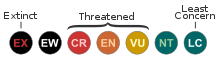
IUCN Red List of Threatened Plants Status : Not listed.
Growth: S = slow M = medium F = fast. Soil: L = light (sandy) M = medium H = heavy (clay). pH: A = acid N = neutral B = basic (alkaline). Shade: F = full shade S = semi-shade N = no shade. Moisture: D = dry M = Moist We = wet Wa = water.
Now available:
Food Forest Plants for Mediterranean Conditions
350+ Perennial Plants For Mediterranean and Drier Food Forests and Permaculture Gardens.
[Paperback and eBook]
This is the third in Plants For A Future's series of plant guides for food forests tailored to
specific climate zones. Following volumes on temperate and tropical ecosystems, this book focuses
on species suited to Mediterranean conditions—regions with hot, dry summers and cool, wet winters,
often facing the added challenge of climate change.
Read More
Expert comment
Author
S.Watson.
Botanical References
Links / References
For a list of references used on this page please go here
Readers comment
| Add a comment |
|
If you have important information about this plant that may help other users please add a comment or link below. Only comments or links that are felt to be directly relevant to a plant will be included. If you think a comment/link or information contained on this page is inaccurate or misleading we would welcome your feedback at [email protected]. If you have questions about a plant please use the Forum on this website as we do not have the resources to answer questions ourselves.
* Please note: the comments by website users are not necessarily those held by PFAF and may give misleading or inaccurate information.
|
Subject : Cymopterus purpureus
|
|
|
|