 |
|
http://flickr.com/photos/bryanto/ |
 |
|
Translate this page:
Summary
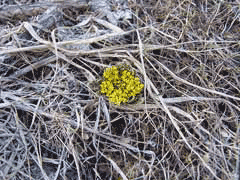
Longstalk wavywing is an Intermountain spring-parsley whose long flower stalks can make it more visible than many stemless relatives. Longstalk wavywing tracks close to the “good-root” profile of other high-quality species, with leaves that can be more acrid depending on population and form.
Physical Characteristics

 Cymopterus longipes is a PERENNIAL growing to 0.3 m (1ft) by 0.2 m (0ft 8in).
See above for USDA hardiness. It is hardy to UK zone 5. The species is hermaphrodite (has both male and female organs).
It is noted for attracting wildlife.
Suitable for: light (sandy), medium (loamy) and heavy (clay) soils and can grow in nutritionally poor soil. Suitable pH: mildly acid, neutral and basic (mildly alkaline) soils. It can grow in semi-shade (light woodland) or no shade. It prefers moist soil.
UK Hardiness Map
US Hardiness Map
Synonyms
Aulospermum longipes. (S.Wats.)Coult.&Rose.
Plant Habitats
Cultivated Beds;
Edible Uses
Root-first plant; leaves are secondary and more variable, often better cooked [2-3]. Edible Uses & Rating. Roots rate good to excellent depending on site and individual plant; leaves rate fair to good when mild, and fair when acrid [2-3]. Taste, Processing & Kitchen Notes. Roots can be agreeable, with the parsnip-like direction common to the genus, though you noted they can run chewier than the very best species. Leaves may carry more acridity, so a blanch-and-cook approach is the practical default. When roots are on the sweeter/milder end, they reward simple boiling, steaming, or sautéing [2-3]. Seasonality (Phenology). Early season, timing shaped by elevation; higher sites push bloom later, sometimes into “summer-parsley” timing [2-3]. Safety & Cautions (Food Use). Same genus-level furanocoumarin caution; prefer water-based processing if uncertain, and avoid heavy sun exposure after handling if you’re sensitive. Harvest & Processing Workflow. Dig carefully, clean, peel if skins are bitter, blanch/boil, then finish cook. Trial a small piece first because population-to-population flavor can differ [2-3]. Cultivar/Selection Notes. No cultivars; practical selection is choosing plants with thicker, less fibrous roots and milder foliage. Look-Alikes & Confusion Risks. Apiaceae misidentification risk; confirm by winged fruit form typical of Cymopterus where possible. Traditional/Indigenous Use Summary. Genus-level notes indicate broad Native American use of spring-parsleys; longstalk wavywing fits the same seasonal niche in its range. Leaves - cooked[46, 61, 105, 161]. Boiled and used as greens[257].
References More on Edible Uses
Medicinal Uses
Plants For A Future can not take any responsibility for any adverse effects from the use of plants. Always seek advice from a professional before using a plant medicinally.
Cymopterus longipes (Longstalk Spring Parsley) has historically been used in traditional medicine, particularly by Indigenous Peoples in North America. Reported Medicinal and Traditional Uses: Wound Care: The plant has been used in traditional medicine to treat skin diseases and wounds. Cultural Significance: It is recognized as a culturally significant plant to Indigenous Peoples, including the Goshute and Ute nations. Potential Hazards and Considerations: Toxicity: The seeds of Cymopterus longipes are known to contain furanocoumarins (isoimperatorin and oxypeucedanin), which have shown toxicity to chicks. Photosensitization: Some Cymopterus species, specifically Cymopterus watsonii, are known to cause photosensitization, where the plant causes severe reactions to sunlight. Note: While some species in the Cymopterus genus are used for various remedies, information specifically on C. longipes is limited to traditional uses rather than clinical trials.
References More on Medicinal Uses
The Bookshop: Edible Plant Books
Our Latest books on Perennial Plants For Food Forests and Permaculture Gardens in paperback or digital formats.
Edible Tropical Plants
Food Forest Plants for Hotter Conditions: 250+ Plants For Tropical Food Forests & Permaculture Gardens.
More
Edible Temperate Plants
Plants for Your Food Forest: 500 Plants for Temperate Food Forests & Permaculture Gardens.
More
More Books
PFAF have eight books available in paperback and digital formats. Browse the shop for more information.
Shop Now
Other Uses
Early-season insect forage and a hardy component of spring flora in dry regions. Umbels attract small bees and flies; typical for Apiaceae. Cultivation (Horticulture). Rare; would likely require lean soil, drainage, and cold-winter stratification for seed.
Special Uses
References More on Other Uses
Cultivation details
A respectable wavywing where present, best treated as an early root resource rather than a reliable raw green. Growing Conditions. Open, well-drained soils, often sandy to gravelly, with early moisture. Habitat & Range. Centered in northern Utah and adjacent Idaho/Colorado/Wyoming areas, with forms differing in flower color. Size & Landscape Performance. Small base with prominent stalks; visually more apparent during bloom. Cultivation (Horticulture). Rare; would likely require lean soil, drainage, and cold-winter stratification for seed. Pests & Problems. Root chewiness/fiber variability; leaf acridity; grit contamination. Identification & Habit. Small perennial with basal dissected leaves and long-stalked umbels; winged fruits confirm. Pollinators. Umbels attract small bees and flies; typical for Apiaceae. Longstalk Wavywing (Cymopterus longipes). Family: Apiaceae. Genus: Cymopterus. Common names: Longstalk wavywing, longstalk spring-parsley. USDA Hardiness Zones: approximately Zones 4–8. Approximate size: often 10–30 cm tall in flower (long peduncles), typically 10–25 cm spread as a basal plant.
References Carbon Farming Information and Carbon Sequestration Information
Temperature Converter
Type a value in the Celsius field to convert the value to Fahrenheit:
Fahrenheit:
The PFAF Bookshop
Plants For A Future have a number of books available in paperback and digital form. Book titles include Edible Plants, Edible Perennials, Edible Trees,Edible Shrubs, Woodland Gardening, and Temperate Food Forest Plants. Our new book is Food Forest Plants For Hotter Conditions (Tropical and Sub-Tropical).
Shop Now
Plant Propagation
Seed with winter cold exposure; fall sowing is most natural.
Other Names
If available other names are mentioned here
Longstalk wavywing, longstalk spring-parsley.
Native Range
NORTHERN AMERICA: United States (Colorado (west), Idaho (south), Oregon (s.e. (Malheur Co.)), Wyoming, Nevada, Utah)
Weed Potential
Right plant wrong place. We are currently updating this section.
Please note that a plant may be invasive in one area but may not in your area so it's worth checking.
Low.
Conservation Status
IUCN Red List of Threatened Plants Status : Not listed.

Growth: S = slow M = medium F = fast. Soil: L = light (sandy) M = medium H = heavy (clay). pH: A = acid N = neutral B = basic (alkaline). Shade: F = full shade S = semi-shade N = no shade. Moisture: D = dry M = Moist We = wet Wa = water.
Now available:
Food Forest Plants for Mediterranean Conditions
350+ Perennial Plants For Mediterranean and Drier Food Forests and Permaculture Gardens.
[Paperback and eBook]
This is the third in Plants For A Future's series of plant guides for food forests tailored to
specific climate zones. Following volumes on temperate and tropical ecosystems, this book focuses
on species suited to Mediterranean conditions—regions with hot, dry summers and cool, wet winters,
often facing the added challenge of climate change.
Read More
Expert comment
Author
S.Watson.
Botanical References
Links / References
For a list of references used on this page please go here
Readers comment
© 2010, Plants For A Future. Plants For A Future is a charitable company limited by guarantee, registered in England and Wales. Charity No. 1057719, Company No. 3204567.