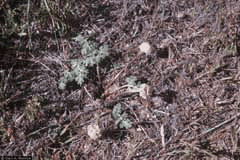
 |
|
Gary A. Monroe@ USDA-NRCS PLANTS Database |
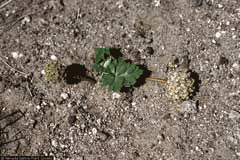 |
| Margaret Williams @ USDA-NRCS PLANTS Database |
Translate this page:
Summary
Globe wavywing is a Great Basin–leaning spring-parsley notable for its compact, globe-shaped flower/seed heads, a trait that can make it easier to recognize than many other Cymopterus when in bloom or fruit.
Physical Characteristics

 Cymopterus globosus is a PERENNIAL growing to 0.2 m (0ft 8in) by 0.2 m (0ft 8in).
See above for USDA hardiness. It is hardy to UK zone 5. The species is hermaphrodite (has both male and female organs) and is pollinated by Insects. The plant is self-fertile.
Suitable for: light (sandy) and medium (loamy) soils, prefers well-drained soil and can grow in nutritionally poor soil. Suitable pH: mildly acid, neutral and basic (mildly alkaline) soils. It cannot grow in the shade. It prefers dry or moist soil.
UK Hardiness Map
US Hardiness Map
Synonyms
C. montanus var. globosus S.Watson
Plant Habitats
Cultivated Beds;
Edible Uses
Edible Parts: Leaves Root
Edible Uses:
Traditionally used as a root-and-leaf plant in parts of its range, but individual palatability and safety should be approached conservatively because the genus can be chemically variable [2-3]. Edible Uses & Rating. Ethnobotanically reported as a root and leaf food; practical rating is “promising but proceed cautiously” unless you have strong local confirmation and careful identification by fruit [2-3]. Taste, Processing & Kitchen Notes. Your project notes emphasize that Cymopterus roots typically resemble parsnip with earthy/resinous/alkaline accents, while leaves can range from salad-suitable to strongly challenging. For globe wavywing specifically, treat roots as the primary target and leaves as secondary, and favor boiling or soaking to reduce phototoxic and resinous components [2-3]. Seasonality (Phenology). Typically, very early in its region, often April to May, flowering in the Great Basin context, with usable roots available whenever plants are actively growing and hydrated [2-3]. Safety & Cautions (Food Use). Same genus-level cautions apply: potential furanocoumarins and possible dermatitis/photosensitivity; water-based processing is the conservative strategy, and handling large quantities in the sun should be done with care [2-3]. Harvest & Processing Workflow. Dig roots carefully, wash, peel if bitterness/minerality concentrates in skins, then boil or blanch before further cooking. Leaves, if used, should be washed thoroughly and blanched, and only eaten if a small sample proves mild and non-irritating [2-3]. Cultivar/Selection Notes. No cultivars; site selection matters—healthier, sandier, well-drained valley/foothill plants are often easier to harvest and clean. Look-Alikes & Confusion Risks. Apiaceae confusion risk is high; confirm by fruiting characteristics typical of Cymopterus (winged schizocarps), and avoid uncertain look-alikes. Traditional/Indigenous Use Summary. You noted Paiute use (roots and leaves; name “yaditsi”), which strongly supports the idea that—at least in some places—this species was a recognized seasonal food [2-3]. Root - raw or cooked[46, 61, 105]. A pleasant taste[161]. Leaves[46, 61, 105]. No further details, but they are probably used cooked and are likely to be aromatic.
References More on Edible Uses
Medicinal Uses
Plants For A Future can not take any responsibility for any adverse effects from the use of plants. Always seek advice from a professional before using a plant medicinally.
Cymopterus globosus (Globe Springparsley) is primarily recognized for its edible roots and leaves rather than documented medicinal uses. While some Cymopterus species have traditional uses, there are no well-documented or widely recognized medical benefits specifically for Cymopterus globosus, and it is often noted to have no known medicinal applications.
References More on Medicinal Uses
The Bookshop: Edible Plant Books
Our Latest books on Perennial Plants For Food Forests and Permaculture Gardens in paperback or digital formats.

Edible Tropical Plants
Food Forest Plants for Hotter Conditions: 250+ Plants For Tropical Food Forests & Permaculture Gardens.
More

Edible Temperate Plants
Plants for Your Food Forest: 500 Plants for Temperate Food Forests & Permaculture Gardens.
More

More Books
PFAF have eight books available in paperback and digital formats. Browse the shop for more information.
Shop Now
Other Uses
Insecticide
A decoction of the roots has been used as an insecticide[257]. Conceptually suited to lean, well-drained rock-garden conditions with winter cold and spring moisture. Early nectar/pollen support and a modest early-season herb layer component in sandy basin habitats.
Special Uses
References More on Other Uses
Cultivation details
Globe wavywing is a culturally attested spring root/green with a distinctive head form, best treated as a root-first plant and prepared with water-based methods to manage risk. Growing Conditions. Often sandy soils in valleys and foothills, exploiting early moisture and cool temperatures. Habitat & Range. Primarily Great Basin, with early-season growth timing shaped by colder basin winters and later spring release. Size & Landscape Performance. Low, early, and brief; a classic “spring flash” plant. Cultivation (Horticulture). Rare, but conceptually suited to lean, well-drained rock-garden conditions with winter cold and spring moisture. Pests & Problems. The main issues are grit contamination of foliage and variability in flavor/irritation potential. Identification & Habit. Small perennial, mostly basal foliage, and the notable globe-like umbel heads; confirm with fruit. Pollinators. Generalist small bees and flies commonly work Apiaceae umbels, and globe heads provide accessible forage surfaces. Globe Wavywing (Cymopterus globosus). Family: Apiaceae. Genus: Cymopterus. Common names: Globe wavywing, globe spring-parsley. USDA Hardiness Zones: approximately Zones 4–8. Approximate size: often 5–20 cm tall in flower, with a low basal spread around 10–25 cm.
References Carbon Farming Information and Carbon Sequestration Information
Temperature Converter
Type a value in the Celsius field to convert the value to Fahrenheit:
Fahrenheit:
The PFAF Bookshop
Plants For A Future have a number of books available in paperback and digital form. Book titles include Edible Plants, Edible Perennials, Edible Trees,Edible Shrubs, Woodland Gardening, and Temperate Food Forest Plants. Our new book is Food Forest Plants For Hotter Conditions (Tropical and Sub-Tropical).
Shop Now
Plant Propagation
Seed - we have no information on this species but suggest sowing the seed in a cold frame as soon as it is ripe if this is possible. Sow stored seed as early in the year as possible in a greenhouse. As soon as they are large enough to handle, prick the seedlings out into individual pots and grow them on in the greenhouse for at least their first winter. Plant them out into their permanent positions in late spring or early summer, after the last expected frosts. Division in spring or autumn might be possible.
Other Names
If available other names are mentioned here
Globe wavywing, globe spring-parsley.
Native Range
US. USA. California, Nevada, Utah.
Weed Potential
Right plant wrong place. We are currently updating this section.
Please note that a plant may be invasive in one area but may not in your area so it's worth checking.
Low.
Conservation Status
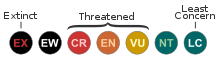
IUCN Red List of Threatened Plants Status : Not listed.
Growth: S = slow M = medium F = fast. Soil: L = light (sandy) M = medium H = heavy (clay). pH: A = acid N = neutral B = basic (alkaline). Shade: F = full shade S = semi-shade N = no shade. Moisture: D = dry M = Moist We = wet Wa = water.
Now available:
Food Forest Plants for Mediterranean Conditions
350+ Perennial Plants For Mediterranean and Drier Food Forests and Permaculture Gardens.
[Paperback and eBook]
This is the third in Plants For A Future's series of plant guides for food forests tailored to
specific climate zones. Following volumes on temperate and tropical ecosystems, this book focuses
on species suited to Mediterranean conditions—regions with hot, dry summers and cool, wet winters,
often facing the added challenge of climate change.
Read More
Expert comment
Author
S.Watson.
Botanical References
71
Links / References
For a list of references used on this page please go here
Readers comment
| Add a comment |
|
If you have important information about this plant that may help other users please add a comment or link below. Only comments or links that are felt to be directly relevant to a plant will be included. If you think a comment/link or information contained on this page is inaccurate or misleading we would welcome your feedback at [email protected]. If you have questions about a plant please use the Forum on this website as we do not have the resources to answer questions ourselves.
* Please note: the comments by website users are not necessarily those held by PFAF and may give misleading or inaccurate information.
|
Subject : Cymopterus globosus
|
|
|
|