 |
|
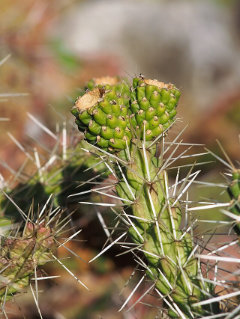
Scott Wylie. Creative Commons Attribution 2.0 |
 |
| Agnieszka Kwiecien, Nova. Creative Commons Attribution-Share Alike 4.0 |
Translate this page:
Summary
Whipple’s cholla is a compact, cold-hardy cactus of the interior Southwest, recognized for its relatively restrained stature and often bluish-green stem coloration. Compared with larger tree-like chollas, it presents a lower profile but remains equally formidable due to dense glochids. Both flower buds and fruits are edible after proper processing, making it one of the more useful high-desert chollas. Its ability to tolerate colder climates also broadens its ecological importance beyond strictly hot desert environments.
Physical Characteristics

 Cylindropuntia whipplei is an evergreen Shrub growing to 1 m (3ft 3in) by 2 m (6ft) at a medium rate.
See above for USDA hardiness. It is hardy to UK zone 6. The flowers are pollinated by Bees, Insects.
It is noted for attracting wildlife.
Suitable for: light (sandy) and medium (loamy) soils, prefers well-drained soil and can grow in nutritionally poor soil. Suitable pH: neutral and basic (mildly alkaline) soils. It cannot grow in the shade. It prefers dry soil and can tolerate drought.
UK Hardiness Map
US Hardiness Map
Synonyms
Grusonia whipplei (Engelm. & J.M.Bigelow) G.D.Rowley. Opuntia whipplei Engelm. & J.M.Bigelow
Plant Habitats
Edible Uses
Flower buds provide the most dependable edible resource, while fruits offer supplemental nourishment once carefully processed. As with all chollas, success depends largely on proper spine removal and preparation [2-3]. Edible Uses & Rating: The flower buds and fruits are the primary edible parts. Flower buds function as a traditional cactus vegetable once properly cleaned. Fruits offer pulp and seeds, though the latter are not widely documented as food and should be approached conservatively. Overall rating: Good seasonal wild vegetable with reliable spring harvest potential [2-3]. Taste, Processing & Kitchen Notes: Prepared flower buds are mild and vegetable-like, comparable to other edible chollas. Traditional pit roasting improves texture while reducing vegetal harshness. The fruits contain fleshy pulp with modest sweetness and minimal bitterness. Texture can lean toward sticky or mucilaginous, but cooking typically moderates this. As always with chollas, processing effort determines culinary success. Abrasion, burning, or sieving is essential to remove glochids before cooking. Straining cooked pulp through cloth is often the safest way to ensure a spine-free product [2-3]. Seasonality (Phenology): Whipple’s cholla blooms May through July, somewhat later than lower-elevation species. Fruits mature from August through November, providing a useful late-season food source in upland deserts. Flower buds are harvested before bloom to achieve optimal texture [2-3]. Safety & Cautions (Food Use): Glochids are the dominant hazard and remain dangerous even after cooking. Always use tools — never bare hands — when harvesting or processing. Seeds are not well-documented as edible, so caution is recommended [2-3]. Harvest & Processing Workflow: Harvest flower buds in spring before opening. Remove spines using abrasion techniques such as brushing, agitation in baskets, or controlled burning. Cook thoroughly before consumption. Fruits should be opened carefully to prevent glochids from contaminating pulp. Straining cooked material is strongly recommended. Traditional / Indigenous Use Summary: Cholla buds were widely harvested by Indigenous peoples across the Southwest as dependable spring vegetables. While species-specific records for Whipple’s cholla are limited, its similarity to commonly utilized chollas strongly suggests comparable traditional use patterns. Cultivar/Selection Notes: No cultivars exist. Natural variation occurs primarily in spine density and stem coloration. Look-Alikes & Confusion Risks: Often confused with cane or tree chollas, though typically shorter and more cold-adapted. Flower color and geographic location are helpful distinguishing traits. Fortunately, confusion among chollas rarely presents toxicological risk — only handling challenges.
References More on Edible Uses
Medicinal Uses
Plants For A Future can not take any responsibility for any adverse effects from the use of plants. Always seek advice from a professional before using a plant medicinally.
Cylindropuntia whipplei (commonly known as Whipple cholla) has documented traditional medical uses, primarily within Indigenous American practices. Traditional Medicinal Uses: Diarrhea Treatment: The roots are used medicinally, often chewed, or crushed and boiled to make a tea for treating diarrhea. Topical Application: As with other Cholla species, plant parts have traditionally been used for their anti-inflammatory properties to treat joint pain. Other Uses: Cholla species have generally been used for their edible fruits and buds, but C. whipplei specifically is known for root-based remedies. Important Safety Information: C. whipplei is not generally considered toxic to humans or pets, but it possesses glochids (tiny, barbed spines) that can cause moderate skin irritation. While some species of Opuntia are used for diabetes and cholesterol management, care should be taken to confirm that any remedy is specifically for Cylindropuntia whipplei. Note: This information is for historical and informational purposes. Always seek professional medical advice for treating health conditions.
References More on Medicinal Uses
The Bookshop: Edible Plant Books
Our Latest books on Perennial Plants For Food Forests and Permaculture Gardens in paperback or digital formats.

Edible Tropical Plants
Food Forest Plants for Hotter Conditions: 250+ Plants For Tropical Food Forests & Permaculture Gardens.
More

Edible Temperate Plants
Plants for Your Food Forest: 500 Plants for Temperate Food Forests & Permaculture Gardens.
More

More Books
PFAF have eight books available in paperback and digital formats. Browse the shop for more information.
Shop Now
Other Uses
An excellent choice for cold-desert gardens. Once established, it requires virtually no irrigation. Whipple’s cholla provides protective nesting habitat for small birds and refuge for desert wildlife. Fruits may serve as emergency forage during dry periods. Its structural complexity enhances biodiversity in otherwise open landscapes.
Special Uses
References More on Other Uses
Cultivation details
Whipple’s cholla is a resilient high-desert cactus offering ornamental value, ecological benefits, and practical food potential for knowledgeable foragers. Its cold tolerance and manageable size make it especially notable within the genus. Growing Conditions: This species thrives in full sun with sharply drained soils and is notably tolerant of winter cold compared with many chollas. It performs well in gravelly slopes, rocky soils, and high-desert conditions where temperature swings can be dramatic. Overwatering is the primary cultivation mistake. Habitat & Range: Whipple’s cholla is found primarily in northern Arizona, northern New Mexico, southern Utah, and southern Nevada, occupying plateaus, open woodlands, and desert grasslands. Its presence in colder regions distinguishes it from many strictly Sonoran relatives. Size & Landscape Performance: Typically reaching 0.5–1.5 meters tall, this species often spreads wider than its height, forming dense structural clumps. Its compact form makes it particularly effective in xeriscapes where a smaller cactus is desired without sacrificing visual impact. Cultivation (Horticulture): An excellent choice for cold-desert gardens. Once established, it requires virtually no irrigation. Provide maximum sunlight and excellent drainage. Avoid rich soils, which can weaken structural integrity. Placement away from walkways is strongly advised. Pollinators: The bright yellow flowers attract native solitary bees, especially cactus-specialist species. Beetles are also common floral visitors, and occasional butterflies may assist with pollination. Because it blooms later than some desert cacti, Whipple’s cholla can provide valuable nectar during transitional seasonal windows. Pests & Problems: Generally resistant to pests and diseases. Root rot remains the primary threat in poorly drained soils. Mechanical breakage from freeze-thaw cycles or animals can occur but often results in natural propagation. Identification & Habit: This species forms a low to moderately upright shrub composed of cylindrical stem joints that may appear slightly bluish or gray-green depending on light and wax coatings. Spine density varies, but glochids are always present and must be respected. The branching pattern is often compact, giving the plant a dense, clustered appearance. Yellow flowers provide a bright seasonal display, followed by fleshy yellow fruits that may appear deceptively harmless due to reduced long spines — though glochids remain. Overall, Whipple’s cholla tends to look sturdier and more cold-adapted than many Sonoran species. Family: Cactus family (Cactaceae). Genus: Cylindropuntia. Common names: Whipple’s cholla, blue diamond cholla. USDA Hardiness Zones: Approx. Zones 5–9 (notably more cold-tolerant than many desert chollas). Typical Height: 0.5–1.5 m. Typical Spread: 1–2.5 m. Cylindropuntia species (commonly known as Cholla) generally exhibit a moderate growth rate compared to other cacti, typically growing between 6 to 12 inches (15–30 cm) per year under optimal conditions. While some specific species are categorized as slow-growing, the genus as a whole is recognized as one of the faster-growing types of cacti in desert landscapes.
References Carbon Farming Information and Carbon Sequestration Information
Temperature Converter
Type a value in the Celsius field to convert the value to Fahrenheit:
Fahrenheit:
The PFAF Bookshop
Plants For A Future have a number of books available in paperback and digital form. Book titles include Edible Plants, Edible Perennials, Edible Trees,Edible Shrubs, Woodland Gardening, and Temperate Food Forest Plants. Our new book is Food Forest Plants For Hotter Conditions (Tropical and Sub-Tropical).
Shop Now
Plant Propagation
Detached joints root readily after callusing. Natural propagation frequently occurs when segments fall and establish nearby. Seed propagation is slower but viable.
Other Names
If available other names are mentioned here
Whipple’s cholla, Blue diamond cholla
Native Range
US. USA. Arizona, California, Colorado, Nevada, New Mexico, Utah.
Weed Potential
Right plant wrong place. We are currently updating this section.
Please note that a plant may be invasive in one area but may not in your area so it's worth checking.
Low. Colonies expand gradually and rarely become invasive.
Conservation Status
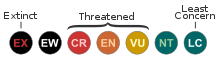
IUCN Red List of Threatened Plants Status : Least Concern.
Growth: S = slow M = medium F = fast. Soil: L = light (sandy) M = medium H = heavy (clay). pH: A = acid N = neutral B = basic (alkaline). Shade: F = full shade S = semi-shade N = no shade. Moisture: D = dry M = Moist We = wet Wa = water.
Now available:
Food Forest Plants for Mediterranean Conditions
350+ Perennial Plants For Mediterranean and Drier Food Forests and Permaculture Gardens.
[Paperback and eBook]
This is the third in Plants For A Future's series of plant guides for food forests tailored to
specific climate zones. Following volumes on temperate and tropical ecosystems, this book focuses
on species suited to Mediterranean conditions—regions with hot, dry summers and cool, wet winters,
often facing the added challenge of climate change.
Read More
Expert comment
Author
(Engelm. & J.M.Bigelow) F.M.Knuth
Botanical References
Links / References
For a list of references used on this page please go here
Readers comment
| Add a comment |
|
If you have important information about this plant that may help other users please add a comment or link below. Only comments or links that are felt to be directly relevant to a plant will be included. If you think a comment/link or information contained on this page is inaccurate or misleading we would welcome your feedback at [email protected]. If you have questions about a plant please use the Forum on this website as we do not have the resources to answer questions ourselves.
* Please note: the comments by website users are not necessarily those held by PFAF and may give misleading or inaccurate information.
|
Subject : Cylindropuntia whipplei
|
|
|
|