 |
|
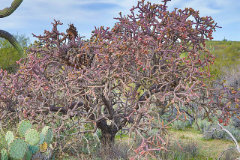
Fluff Berger. Creative Commons Attribution-Share Alike 4.0. |
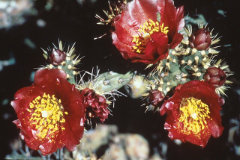 |
| Public domain |
Translate this page:
Summary
Please note Cylindropuntia versicolor (Engelm. ex J.M.Coult.) F.M.Knuth is a synonym of Cylindropuntia thurberi subsp. versicolor. Staghorn cholla is a distinctive branching cactus restricted primarily to southeastern Arizona, where it occupies desert uplands and transitional habitats. Named for its antler-like branching structure, this species is notable among chollas for offering multiple edible parts, including stems, flower buds, and fruits. While all chollas require careful handling due to glochids, staghorn cholla compares favorably with several relatives because its fruits are fleshy and often less heavily armored with large spines. Historically, plants of this type supported desert foragers, though — as always with chollas — processing effort determines their practical value.
Physical Characteristics

 Cylindropuntia thurberi subsp. versicolor is an evergreen Shrub growing to 1 m (3ft 3in) by 1.5 m (5ft) at a medium rate.
See above for USDA hardiness. It is hardy to UK zone 9. The flowers are pollinated by Bees, Insects.
It is noted for attracting wildlife.
Suitable for: light (sandy) and medium (loamy) soils, prefers well-drained soil and can grow in nutritionally poor soil. Suitable pH: neutral and basic (mildly alkaline) soils. It cannot grow in the shade. It prefers dry soil and can tolerate drought.
UK Hardiness Map
US Hardiness Map
Synonyms
Cylindropuntia versicolor (Engelm. ex J.M.Coult.) F.M.Knuth. Grusonia versicolor (Engelm. ex J.M.Coult.) G.D.Rowley. Opuntia arborescens var. versicolor (Engelm. ex J.M.Coult.) Dams. Opuntia thurberi subsp. versicolor (Engelm. ex J.M.Coult.) Felger. Opuntia versicolor Engelm. ex J.M.Coult.
Plant Habitats
Edible Uses
Flower buds are the standout edible portion, functioning as a reliable desert vegetable. Fruits provide supplemental nourishment, while seeds are usable when ground. Like all chollas, the plant is best approached with preparation, patience, and respect [2-3]. Edible Uses & Rating: The stems, flower buds, and fruits are all considered edible once properly de-spined [2-3]. Flower buds represent the most dependable vegetable resource, while fruits provide pulp and seeds that can supplement desert diets. Overall rating: Good traditional cactus vegetable with moderate food value but high processing demands [2-3]. Taste, Processing & Kitchen Notes: Prepared flower buds resemble those of buckhorn cholla and can be pit-roasted, boiled, or dried for storage. Their flavor is mild and vegetable-like once cooked. Fruits contain fleshy pulp that is generally more substantial than that of many chollas. Expect a slightly tangy profile with mild sweetness depending on ripeness. As with most cholla fruits, slime may be present but is usually manageable when cooked. Seeds are abundant but extremely hard. Grinding into meal is preferable to chewing whole seeds. The central rule remains absolute: glochids must be removed before any culinary use [2-3]. Seasonality (Phenology): Staghorn cholla blooms primarily from April through June. Fruits typically mature late summer into early autumn, aligning with the seasonal pattern seen across many Sonoran Desert cacti. Flower buds are harvested in spring before opening. Safety & Cautions (Food Use): Glochids remain the primary hazard. Even fruits that appear smooth can embed nearly invisible spines into skin or food. Use tongs, gloves, and thorough cleaning methods. Cooking does not neutralize glochids. As with many wild cactus foods, moderation is prudent until tolerance is understood. Harvest & Processing Workflow: Harvest buds while still tight in spring. Remove spines using abrasion methods such as brushing, burning, or agitation in a sieve-like container. For fruits, split carefully to avoid dragging glochids into the pulp. Straining cooked material through cloth is often the safest preparation technique. Grinding seeds improves usability [2-3]. Traditional / Indigenous Use Summary: Although species-level documentation is limited, chollas similar to staghorn were widely utilized by Indigenous peoples of the Southwest, particularly for spring vegetable harvests from flower buds. Their reliability during dry seasons made them valuable subsistence plants. Cultivar/Selection Notes: No cultivated varieties exist. Natural variation occurs primarily in flower color and spine density. Look-Alikes & Confusion Risks: May be confused with buckhorn cholla or other branching species. Flower color and geographic range help refine identification. Fortunately, confusion among chollas rarely creates food safety issues — only handling challenges.
References More on Edible Uses
Medicinal Uses
Plants For A Future can not take any responsibility for any adverse effects from the use of plants. Always seek advice from a professional before using a plant medicinally.
Staghorn Cholla and related cholla species have traditional, nutritional, and potential medicinal uses. Specifically, the fruit and buds are high in calcium (up to 3,200 mg per 100 g of buds) and have been used to support bone health, including in the treatment of osteoporosis. They have historically been used to manage blood glucose levels in individuals with diabetes. Traditional Medicine: Indigenous peoples, including the Tohono O'odham, have used various plant parts to treat inflammation and joint pain.Nutritional Value: The buds and fruit are highly nutritious, often eaten for their high calcium content, particularly to support nursing mothers. Active Compounds: Studies on related Cylindropuntia species indicate potential antimicrobial and antioxidant properties. While Staghorn Cholla is often mentioned in the context of edible and medicinal cholla, it is important to handle these plants carefully, as they are known for their barbed spines.
References More on Medicinal Uses
The Bookshop: Edible Plant Books
Our Latest books on Perennial Plants For Food Forests and Permaculture Gardens in paperback or digital formats.
Edible Tropical Plants
Food Forest Plants for Hotter Conditions: 250+ Plants For Tropical Food Forests & Permaculture Gardens.
More
Edible Temperate Plants
Plants for Your Food Forest: 500 Plants for Temperate Food Forests & Permaculture Gardens.
More
More Books
PFAF have eight books available in paperback and digital formats. Browse the shop for more information.
Shop Now
Other Uses
An excellent xeriscape plant requiring virtually no irrigation once established. It performs best in native soils and should never be overwatered. Placement away from foot traffic is strongly recommended. Staghorn cholla provides shelter for birds, reptiles, and small mammals. Fallen joints can create microhabitats, while fruits may serve as opportunistic food for wildlife during dry periods. The plant contributes significantly to desert structural diversity.
Special Uses
References More on Other Uses
Cultivation details
Staghorn cholla stands as a classic multipurpose desert cactus: structurally striking, ecologically valuable, and capable of providing food with sufficient effort. While not effortless to process, it rewards knowledgeable foragers with dependable seasonal harvests. Growing Conditions: This cactus thrives in full sun with sharply drained mineral soils. It tolerates intense heat, drought, and reflective desert conditions with ease. Cold tolerance is moderate for a cactus but sufficient for many high-desert environments. Habitat & Range: Staghorn cholla is largely confined to southeastern Arizona, where it grows on rocky slopes, desert flats, and open scrublands. Its somewhat limited distribution makes it less universally useful than more widespread cholla species but highly relevant within its native range. Size & Landscape Performance: Typically reaching 0.8–1.8 meters tall, staghorn cholla often spreads wider than it grows tall, forming irregular thickets that create strong structural interest. Its sculptural branching makes it highly valued in desert landscape design. Cultivation (Horticulture): An excellent xeriscape plant requiring virtually no irrigation once established. It performs best in native soils and should never be overwatered. Placement away from foot traffic is strongly recommended. Pollinators: The vividly colored flowers attract native solitary bees, particularly cactus-specialist bees, along with pollen-collecting beetles and occasional butterflies. Blooming during a season when nectar sources may be limited enhances its ecological importance. Pests & Problems: Generally resilient. Excess moisture presents the greatest threat, potentially leading to rot. Mechanical damage from animals or storms can result in detached segments. Identification & Habit: Staghorn cholla grows as a low, spreading shrub with irregular branching that resembles deer antlers. Stem joints are cylindrical and tuberculate, with areoles bearing glochids and occasionally longer spines. Compared with more heavily armored species, the spine load is sometimes lighter, though never absent. Flowers vary widely in color — a trait reflected in the species name versicolor, meaning “variously colored.” Blossoms may range from greenish-yellow to bronze, orange, or reddish-purple. Fruits are typically greenish-yellow when immature and often develop reddish or purplish tones later. Many appear “spineless” at a glance, but this only means large spines are reduced; glochids remain present. Family: Cactus family (Cactaceae). Genus: Cylindropuntia. Common names: Staghorn cholla. USDA Hardiness Zones: Approx. Zones 8–10. Typical Height: 0.8–1.8 m. Typical Spread: 1–3 m. Cylindropuntia species (commonly known as Cholla) generally exhibit a moderate growth rate compared to other cacti, typically growing between 6 to 12 inches (15–30 cm) per year under optimal conditions. While some specific species are categorized as slow-growing, the genus as a whole is recognized as one of the faster-growing types of cacti in desert landscapes.
References Carbon Farming Information and Carbon Sequestration Information
Temperature Converter
Type a value in the Celsius field to convert the value to Fahrenheit:
Fahrenheit:
The PFAF Bookshop
Plants For A Future have a number of books available in paperback and digital form. Book titles include Edible Plants, Edible Perennials, Edible Trees,Edible Shrubs, Woodland Gardening, and Temperate Food Forest Plants. Our new book is Food Forest Plants For Hotter Conditions (Tropical and Sub-Tropical).
Shop Now
Plant Propagation
Detached joints root readily when allowed to callus before planting. Natural vegetative spread often occurs when joints fall and establish new plants. Seed propagation is possible but slower.
Other Names
If available other names are mentioned here
Cylindropuntia versicolor (Engelm. ex J.M.Coult.) F.M.Knuth is a synonym of Cylindropuntia thurberi subsp. versicolor.
Native Range
US. USA. Arizona, Mexico Northeast, Mexico Northwest.
Weed Potential
Right plant wrong place. We are currently updating this section.
Please note that a plant may be invasive in one area but may not in your area so it's worth checking.
Low. Although vegetative propagation is easy, colonies typically expand gradually rather than aggressively.
Conservation Status
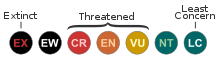
IUCN Red List of Threatened Plants Status : Least Concern.
Growth: S = slow M = medium F = fast. Soil: L = light (sandy) M = medium H = heavy (clay). pH: A = acid N = neutral B = basic (alkaline). Shade: F = full shade S = semi-shade N = no shade. Moisture: D = dry M = Moist We = wet Wa = water.
Now available:
Food Forest Plants for Mediterranean Conditions
350+ Perennial Plants For Mediterranean and Drier Food Forests and Permaculture Gardens.
[Paperback and eBook]
This is the third in Plants For A Future's series of plant guides for food forests tailored to
specific climate zones. Following volumes on temperate and tropical ecosystems, this book focuses
on species suited to Mediterranean conditions—regions with hot, dry summers and cool, wet winters,
often facing the added challenge of climate change.
Read More
Expert comment
Author
(Engelm. ex J.M.Coult.) M.A.Baker
Botanical References
Links / References
For a list of references used on this page please go here
Readers comment
| Add a comment |
|
If you have important information about this plant that may help other users please add a comment or link below. Only comments or links that are felt to be directly relevant to a plant will be included. If you think a comment/link or information contained on this page is inaccurate or misleading we would welcome your feedback at [email protected]. If you have questions about a plant please use the Forum on this website as we do not have the resources to answer questions ourselves.
* Please note: the comments by website users are not necessarily those held by PFAF and may give misleading or inaccurate information.
|
Subject : Cylindropuntia thurberi subsp. versicolor
|
|
|
|