 |
|
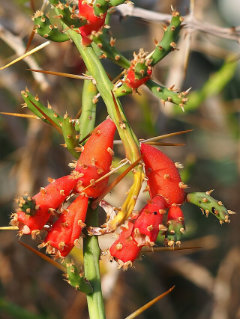
Agnieszka Kwiecien, Nova. Creative Commons Attribution-Share Alike 4.0 |
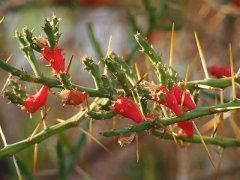 |
| Agnieszka Kwiecien, Nova. Creative Commons Attribution-Share Alike 4.0 |
Translate this page:
Summary
Christmas cholla is one of the most recognizable winter-fruiting cacti of the Southwest, named for the festive contrast created by its bright red fruits against green stems. Unlike many chollas whose fruits are dry or bland, this species produces juicy, pleasantly sweet fruits that persist into the colder months — a rare and valuable seasonal resource in desert ecosystems. While glochids remain a serious hazard, the fruit itself is among the better-tasting cholla offerings and can be processed into excellent cactus juice or syrup.
Physical Characteristics

 Cylindropuntia leptocaulis is an evergreen Shrub growing to 2 m (6ft) by 2 m (6ft) at a medium rate.
See above for USDA hardiness. It is hardy to UK zone 8. The flowers are pollinated by Bees, Insects.
It is noted for attracting wildlife.
Suitable for: light (sandy) and medium (loamy) soils, prefers well-drained soil and can grow in nutritionally poor soil. Suitable pH: neutral and basic (mildly alkaline) soils. It cannot grow in the shade. It prefers dry soil and can tolerate drought.
UK Hardiness Map
US Hardiness Map
Synonyms
Grusonia leptocaulis (DC.) G.D.Rowley. Opuntia leptocaulis DC.
Plant Habitats
Edible Uses
A genuinely useful desert food once properly processed. Fruits are sweet and versatile, seeds are soft, and the plant provides nourishment at a time of year when alternatives are scarce [2-3]. Edible Uses & Rating: The fruits are edible and notably superior to those of many related species. Seeds are naturally soft and require no special preparation to chew. Overall rating: Moderate-to-good wild food, particularly valuable because it ripens when few other fruits are available [2-3. Taste, Processing & Kitchen Notes: Christmas cholla fruits are juicy, slightly mucilaginous, and pleasantly sweet without strong bitterness. The texture is firm yet workable after proper cleaning. Removing glochids is the primary challenge. Brushing fruits in moving water is generally the least ineffective method, though perfection is rarely achieved. One highly effective preparation involves mashing whole fruits, boiling them, and carefully straining the liquid. This produces a rich cactus juice that can be further reduced into syrup. The flavor is clean and surprisingly refined compared with most chollas [2-3. Cooking is not required for seed softening, making the fruit unusually convenient once cleaned. Fruit - raw or cooked[1990 ]. The red to yellow fruits are tasty, though they are possibly hallucinogenic[1438 ]. The obovoid, yellow to scarlet (rarely green, sometimes tinged purple, becoming yellow) fruit is free of spines; it is around 9 - 27mm long and 6 - 12mm in diameter, occasionally proliferating to form a chain of fruits[270 ]. Seasonality (Phenology): Christmas cholla blooms in spring to early summer, while fruits mature in late summer and persist into winter — sometimes remaining available when nearly all other desert fruits are gone. This extended persistence dramatically increases its foraging value. Safety & Cautions (Food Use): Glochids can embed deeply in skin and are difficult to remove. Protective gloves, tools, and careful straining during processing are essential. Always filter juices thoroughly to prevent hidden glochids from entering the final product [2-3. Harvest & Processing Workflow: Harvest fruits with tongs. Remove glochids by brushing in flowing water or controlled burning. Mash fruits, boil, and strain through fine cloth to produce glochid-free juice. Reduce the liquid if syrup is desired. Leaving some fruit ensures benefits for wildlife and plant regeneration. Traditional / Indigenous Use Summary: While many chollas were staple seasonal foods for Southwestern Indigenous peoples, winter-fruiting species like Christmas cholla likely served as opportunistic resources when other foods were scarce. Documentation is less extensive than for flower-bud–harvested species, but the plant clearly fits within traditional desert food systems. Cultivar/Selection Notes: No formal cultivars exist. Wild forms vary slightly in fruit abundance and spine density, traits sometimes favored in landscape selection. Look-Alikes & Confusion Risks: May be confused with other slender chollas, but the persistent red fruits provide a reliable distinguishing feature. As with all chollas, handling precautions remain identical regardless of species.
References More on Edible Uses
Medicinal Uses
Plants For A Future can not take any responsibility for any adverse effects from the use of plants. Always seek advice from a professional before using a plant medicinally.
The plant is used medicinally[1990]. Cylindropuntia leptocaulis (Christmas cactus or Desert Christmas Cholla) has traditional medicinal uses, particularly among Indigenous peoples, for treating fractures and wounds using stem poultices, while the roots have been used as an emetic. The fruits, while sometimes considered intoxicating, are also consumed, and the plant has shown potential for treating inflammation and, in related species, managing diabetes. Traditional and Potential Medical Uses: Wound and Bone Care: Poultices created from the stem have been used to help repair broken bones. Anti-inflammatory: It has been used to treat general inflammation. Digestive and Other Ailments: Traditionally used for rheumatism, mumps, and digestive issues. Emetic: Boiled roots have been used as an emetic to treat snake bites and for treating infertility. Potential Health Benefits: Like other Opuntia species, it is studied for its potential in managing diabetes, high cholesterol, and obesity. Important Considerations: Hallucinogenic/Intoxicating: The red berries of Cylindropuntia leptocaulis are known to have an intoxicating or hallucinogenic effect when consumed, with some reports indicating they can cause dizziness. Spines: The plant possesses very sharp, brittle, and minutely barbed spines (glochids) that require careful handling. Safety: While used in traditional medicine, scientific evidence on the safety and efficacy of C. leptocaulis is limited compared to other, more common cactus species.
References More on Medicinal Uses
The Bookshop: Edible Plant Books
Our Latest books on Perennial Plants For Food Forests and Permaculture Gardens in paperback or digital formats.
Edible Tropical Plants
Food Forest Plants for Hotter Conditions: 250+ Plants For Tropical Food Forests & Permaculture Gardens.
More
Edible Temperate Plants
Plants for Your Food Forest: 500 Plants for Temperate Food Forests & Permaculture Gardens.
More
More Books
PFAF have eight books available in paperback and digital formats. Browse the shop for more information.
Shop Now
Other Uses
This cactus is low-maintenance once established. It performs best when treated as a true desert plant — minimal irrigation, abundant sun, and excellent drainage. Its winter fruit display makes it especially valuable in xeriscape design. Placement should consider spine hazards near walkways. Christmas cholla plays an important ecological role by providing shelter for birds and small mammals. Persistent fruits offer seasonal food for wildlife during otherwise lean winter months. The plant’s branching structure creates microhabitats that reduce predation risk for nesting birds.
Special Uses
References More on Other Uses
Cultivation details
Christmas cholla stands out among chollas for its flavorful fruit and exceptional winter availability. Though glochids complicate harvesting, the plant rewards careful foragers with one of the better cactus fruits in North American deserts. Growing Conditions: This species thrives in full sun with sharply drained soils. It tolerates prolonged drought and performs well in sandy or gravelly substrates typical of desert plains. Moderate cold tolerance allows survival through light frosts, though it is less hardy than tree cholla. Habitat & Range: Christmas cholla is widely distributed across the Chihuahuan Desert and adjoining regions, including Texas, New Mexico, Arizona, and northern Mexico. It favors desert flats, rocky slopes, grasslands, and open shrublands. Size & Landscape Performance: Typically reaching 0.5–2 meters tall with a broader spread, Christmas cholla creates a semi-open structure that provides year-round visual interest. Its winter fruit display makes it especially valuable in xeriscape design. Placement should consider spine hazards near walkways. Cultivation (Horticulture): This cactus is low-maintenance once established. Overwatering is the most common cause of failure. It performs best when treated as a true desert plant — minimal irrigation, abundant sun, and excellent drainage. Pollinators: Flowers attract native solitary bees, cactus bees, and occasionally bumble bees. Beetles may also visit blooms. Because flowering occurs during warm months when insect activity is high, pollination rates tend to be reliable. Pests & Problems: Extremely resilient. Root rot from excessive moisture is the primary threat. Physical damage from freezing is uncommon but possible in colder margins of its range. Handling injuries from glochids remain the most immediate concern for humans. Its ornamental fruit makes it desirable for wildlife gardens and naturalistic desert plantings. Identification & Habit: Christmas cholla forms a shrub-like cactus with many slender, cylindrical stems that create an airy, sometimes tangled silhouette. The stems are segmented and moderately armed with spines and dense glochids. Its defining feature is the bright red fruit, which often remains on the plant well into winter. The flesh inside is pale, contrasting with greenish-brown seeds. During fruiting, the red-and-green color combination is striking and unmistakable across desert landscapes. Flowers are generally greenish-yellow to bronze, smaller and less showy than those of many other chollas. Family: Cactus family (Cactaceae). Genus: Cylindropuntia. Common names: Christmas cholla, desert Christmas cactus, pencil cholla (regional), tasajillo. USDA Hardiness Zones: Approx. Zones 7–11. Typical Height: 0.5–2 m. Typical Spread: 1–3 m. Native to: Arizona, Mexico Central, Mexico Gulf, Mexico Northeast, Mexico Northwest, Mexico Southwest, New Mexico, Oklahoma, Texas. Introduced into: Cape Provinces, Northern Provinces, Spain. Cylindropuntia species (commonly known as Cholla) generally exhibit a moderate growth rate compared to other cacti, typically growing between 6 to 12 inches (15–30 cm) per year under optimal conditions. While some specific species are categorized as slow-growing, the genus as a whole is recognized as one of the faster-growing types of cacti in desert landscapes.
References Carbon Farming Information and Carbon Sequestration Information
Temperature Converter
Type a value in the Celsius field to convert the value to Fahrenheit:
Fahrenheit:
The PFAF Bookshop
Plants For A Future have a number of books available in paperback and digital form. Book titles include Edible Plants, Edible Perennials, Edible Trees,Edible Shrubs, Woodland Gardening, and Temperate Food Forest Plants. Our new book is Food Forest Plants For Hotter Conditions (Tropical and Sub-Tropical).
Shop Now
Plant Propagation
Propagation is most easily achieved through stem segments that root after detaching. Seeds are viable but slower to establish.
Other Names
If available other names are mentioned here
Christmas cholla, desert Christmas cactus, pencil cholla (regional), tasajillo
Native Range
US. USA. Arizona, Mexico Central, Mexico Gulf, Mexico Northeast, Mexico Northwest, Mexico Southwest, New Mexico, Oklahoma, Texas.
Weed Potential
Right plant wrong place. We are currently updating this section.
Please note that a plant may be invasive in one area but may not in your area so it's worth checking.
Not invasive. Detached joints may root locally but expansion is generally slow and manageable.
Conservation Status
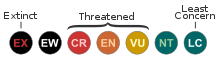
IUCN Red List of Threatened Plants Status : Least Concern.
Growth: S = slow M = medium F = fast. Soil: L = light (sandy) M = medium H = heavy (clay). pH: A = acid N = neutral B = basic (alkaline). Shade: F = full shade S = semi-shade N = no shade. Moisture: D = dry M = Moist We = wet Wa = water.
Now available:
Food Forest Plants for Mediterranean Conditions
350+ Perennial Plants For Mediterranean and Drier Food Forests and Permaculture Gardens.
[Paperback and eBook]
This is the third in Plants For A Future's series of plant guides for food forests tailored to
specific climate zones. Following volumes on temperate and tropical ecosystems, this book focuses
on species suited to Mediterranean conditions—regions with hot, dry summers and cool, wet winters,
often facing the added challenge of climate change.
Read More
Expert comment
Author
(DC.) F.M.Knuth
Botanical References
Links / References
For a list of references used on this page please go here
Readers comment
| Add a comment |
|
If you have important information about this plant that may help other users please add a comment or link below. Only comments or links that are felt to be directly relevant to a plant will be included. If you think a comment/link or information contained on this page is inaccurate or misleading we would welcome your feedback at [email protected]. If you have questions about a plant please use the Forum on this website as we do not have the resources to answer questions ourselves.
* Please note: the comments by website users are not necessarily those held by PFAF and may give misleading or inaccurate information.
|
Subject : Cylindropuntia leptocaulis
|
|
|
|