 |
|
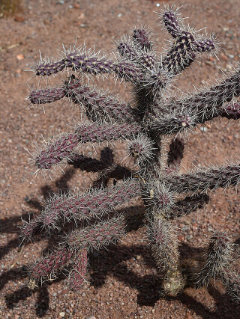
Agnieszka Kwiecien, Nova. Creative Commons Attribution-Share Alike 4.0 |
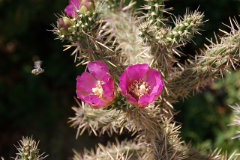 |
| Brian Gautreau from Colorado Springs, USA. Creative Commons Attribution-Share Alike 2.0 |
Translate this page:
Summary
Cane cholla is one of the more conspicuous shrubby chollas of the American Southwest, recognizable for its upright, cane-like stems and branching structure. Despite its formidable appearance, it has historically been regarded as a usable desert food plant, particularly for its fruits and seeds. While the fleshy portions are somewhat unappealing, the seeds — though not widely documented as edible — possess remarkable flavor and caloric potential. As with all chollas, however, the plant’s defensive spines and glochids impose serious handling challenges. Cylindropuntia spinosior (Engelm.) F.M.Knuth is a synonym of Cylindropuntia imbricata subsp. spinosior.
Physical Characteristics

 Cylindropuntia imbricata subsp. spinosior is an evergreen Shrub growing to 2 m (6ft) by 2 m (6ft) at a medium rate.
See above for USDA hardiness. It is hardy to UK zone 8. The flowers are pollinated by Bees, Insects.
It is noted for attracting wildlife.
Suitable for: light (sandy) and medium (loamy) soils, prefers well-drained soil and can grow in nutritionally poor soil. Suitable pH: neutral and basic (mildly alkaline) soils. It cannot grow in the shade. It prefers dry soil and can tolerate drought.
UK Hardiness Map
US Hardiness Map
Synonyms
Cylindropuntia imbricata var. spinosior (Engelm.) M.A.Baker, Cloud-H. & Majure. Cylindropuntia spinosior (Engelm.) F.M.Knuth. Grusonia spinosior (Engelm.) G.D.Rowley. Opuntia spinosior (Engelm.) Toumey. Opuntia whipplei var. spinosior Engelm.
Plant Habitats
Edible Uses
Fruits are edible but texturally challenging. Seeds are flavorful and calorie-dense, potentially ranking among the better cactus seed foods — though limited documentation warrants cautious consumption [2-3]. Edible Uses & Rating: The fruits are widely reported to be edible, though they are difficult to use effectively. Seeds appear to be the most promising food resource based on flavor and texture, yet formal documentation of their traditional consumption is limited [2-3]. Overall rating: Moderate survival food; potentially valuable seed source but labor-intensive [2-3]. Taste, Processing & Kitchen Notes: The pulp resembles squash in both texture and mild sweetness. Acrid and bitter notes are typically minimal, but the heavy slime reduces culinary appeal. Seeds are exceptional in flavor, described as reminiscent of movie-theater popcorn when toasted. Unfortunately, the hard seed coats prevent them from popping, leaving a product closer to toasted kernels. Cracking the seeds prior to eating greatly improves chewability. Grinding into meal is another viable approach. Because glochids readily contaminate the pulp, careful extraction is essential [2-3]. Seasonality (Phenology): Cane cholla blooms from mid-spring through summer, typically April to August. Seeds mature in autumn and often remain available well into winter, offering a valuable late-season resource when other foods are scarce. Safety & Cautions (Food Use): Glochids embed easily in skin and are extremely difficult to remove. Protective gloves and tools are mandatory. Because glochids are unaffected by cooking, all edible material must be carefully cleaned or strained. Although seeds taste excellent, the absence of comprehensive safety data suggests moderation. Harvest & Processing Workflow: Harvest fruits using tongs. Remove spines through brushing, burning, or abrasion methods, recognizing that none are perfectly effective. Split fruits carefully to prevent glochid contamination. Extract seeds, crack or grind them, then toast lightly to enhance flavor. Alternatively, process into meal for broader culinary use. Expect significant labor relative to yield. Traditional / Indigenous Use Summary: While specific documentation is limited, unidentified yellow-fruited chollas used by the White Mountain Apache were likely this species. This suggests that seeds may have played a localized dietary role even if written ethnobotanical references remain sparse. Cultivar/Selection Notes: No cultivated varieties are recognized. Wild plants vary in spine density and flower coloration. Look-Alikes & Confusion Risks: Often confused with tree cholla due to its similar stature and fruit coloration. Cane cholla typically has more shrub-like branching rather than a single trunk. Regardless of species, all chollas require careful handling.
References More on Edible Uses
Medicinal Uses
Plants For A Future can not take any responsibility for any adverse effects from the use of plants. Always seek advice from a professional before using a plant medicinally.
Cylindropuntia imbricata subsp. spinosior (Cane Cholla, often referred to as Cylindropuntia spinosior or Opuntia spinosior) has several traditional and potential medicinal uses, largely stemming from its use by Native American cultures in the Southwest. Traditional and Medicinal Uses: Bone Health: The flower buds are considered a significant source of calcium (with two tablespoons potentially exceeding the calcium in a glass of milk) and are consumed to help prevent osteoporosis. Diabetes Management: The buds are high in soluble fibers and pectins, which may help regulate blood sugar levels. Anti-inflammatory & Wound Healing: The sap of the plant has been used for its anti-inflammatory properties, and in some related species (such as C. cholla), roots and stems are used in traditional medicine for wounds, burns, and to reduce swelling. Digestive Aid: The buds are believed to act as a natural, mild laxative. Kidney Health: The roots have been traditionally used to help prevent kidney stones. Respiratory & Aches: Dried stem pith has been applied to treat earaches. Nutritional Support: The fruit and buds were historically used as a food source during times of scarcity. Important Notes: Preparation: The plant is covered in small, dangerous thorns (glochids) that must be removed (often by burning or using gloves/tongs) before consumption. Safety: Consuming too much raw material may cause side effects, including mild fever, chills, and stomach cramps. Usage: These uses are primarily based on traditional, indigenous, and ethnobotanical knowledge rather than modern FDA-approved clinical trials.
References More on Medicinal Uses
The Bookshop: Edible Plant Books
Our Latest books on Perennial Plants For Food Forests and Permaculture Gardens in paperback or digital formats.
Edible Tropical Plants
Food Forest Plants for Hotter Conditions: 250+ Plants For Tropical Food Forests & Permaculture Gardens.
More
Edible Temperate Plants
Plants for Your Food Forest: 500 Plants for Temperate Food Forests & Permaculture Gardens.
More
More Books
PFAF have eight books available in paperback and digital formats. Browse the shop for more information.
Shop Now
Other Uses
An excellent xeriscape candidate requiring little maintenance once established. It is particularly valued in desert gardens for seasonal flower color and wildlife habitat. Gardeners should provide ample space and avoid overhead irrigation. Cane cholla provides nesting sites for birds and refuge for small mammals and reptiles. Fruits may be consumed opportunistically by wildlife during dry seasons. The plant plays an important role in desert structural ecology.
Special Uses
References More on Other Uses
Cultivation details
Please note Cylindropuntia spinosior (Engelm.) F.M.Knuth is a synonym of Cylindropuntia imbricata subsp. spinosior. Cane cholla represents a paradox among desert food plants: physically daunting yet nutritionally promising. Its seeds alone justify its familiarity to serious foragers, though the effort required ensures that it remains a secondary rather than a primary food source. Growing Conditions: This species thrives in full desert sun and sharply drained soils. It tolerates drought, heat, and large temperature fluctuations, demonstrating notable cold tolerance compared with many cacti. Poor drainage is the primary threat to cultivated plants. Habitat & Range: Cane cholla is common across Arizona and New Mexico, extending into parts of northern Mexico. It occupies desert grasslands, scrublands, rocky slopes, and transitional upland habitats. Its presence often signals classic Chihuahuan or Sonoran desert vegetation zones. Size & Landscape Performance: Typically reaching 1–2.5 meters tall, cane cholla creates a bold structural presence in desert landscapes. The upright stems provide strong vertical contrast against low shrubs and grasses. Its spiny architecture makes it ideal as a defensive planting but unsuitable near pathways. Cultivation (Horticulture): An excellent xeriscape candidate requiring little maintenance once established. It is particularly valued in desert gardens for its seasonal flower color and as a wildlife habitat. Gardeners should provide ample space and avoid overhead irrigation. Pollinators: The vivid flowers attract native bees, particularly solitary desert bees, along with occasional beetles and other pollen-feeding insects. Like many chollas, it serves as a dependable nectar source during bloom periods when floral resources may be limited. Pests & Problems: Generally robust and pest-resistant. Overwatering can cause root rot, while physical damage may invite localized fungal issues. Human encounters with spines remain the most common hazard. Identification & Habit: Cane cholla forms a woody-based cactus with erect, cylindrical joints that create a loosely branching shrub. The stems are thick relative to pencil-type chollas and heavily armed with long spines, accompanied by smaller glochids. Flowers are typically purple to magenta, occasionally tending toward reddish tones, creating vivid spring displays. The fruits are yellow inside and out, often coated with spines, and contain numerous hard seeds embedded in slimy pulp. Its strong vertical habit often makes the plant appear taller than it truly is. Family: Cactus family (Cactaceae). Genus: Cylindropuntia. Common names: Cane cholla, walkingstick cactus. USDA Hardiness Zones: Approx. Zones 7–10. Typical Height: 1–2.5 m. Typical Spread: 1–3 m. Native to: Arizona, Mexico Northeast, Mexico Northwest, New Mexico. Introduced into: Spain. Cylindropuntia species (commonly known as Cholla) generally exhibit a moderate growth rate compared to other cacti, typically growing between 6 to 12 inches (15–30 cm) per year under optimal conditions. While some specific species are categorized as slow-growing, the genus as a whole is recognized as one of the faster-growing types of cacti in desert landscapes.
References Carbon Farming Information and Carbon Sequestration Information
Temperature Converter
Type a value in the Celsius field to convert the value to Fahrenheit:
Fahrenheit:
The PFAF Bookshop
Plants For A Future have a number of books available in paperback and digital form. Book titles include Edible Plants, Edible Perennials, Edible Trees,Edible Shrubs, Woodland Gardening, and Temperate Food Forest Plants. Our new book is Food Forest Plants For Hotter Conditions (Tropical and Sub-Tropical).
Shop Now
Plant Propagation
Propagation is simple via detached stem joints, which root readily in dry soil. Allowing cuttings to callus before planting greatly improves success. Seed propagation is slower but possible.
Other Names
If available other names are mentioned here
Cylindropuntia spinosior (Engelm.) F.M.Knuth is a synonym of Cylindropuntia imbricata subsp. spinosior. Cane cholla, walkingstick cactus
Native Range
US. USA. Arizona, Mexico Northeast, Mexico Northwest, New Mexico.
Weed Potential
Right plant wrong place. We are currently updating this section.
Please note that a plant may be invasive in one area but may not in your area so it's worth checking.
Low to moderate. Detached joints can root where they fall, occasionally forming small colonies, but the plant is not aggressively invasive.
Conservation Status
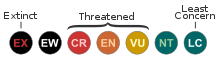
IUCN Red List of Threatened Plants Status : Least Concern.
Growth: S = slow M = medium F = fast. Soil: L = light (sandy) M = medium H = heavy (clay). pH: A = acid N = neutral B = basic (alkaline). Shade: F = full shade S = semi-shade N = no shade. Moisture: D = dry M = Moist We = wet Wa = water.
Now available:
Food Forest Plants for Mediterranean Conditions
350+ Perennial Plants For Mediterranean and Drier Food Forests and Permaculture Gardens.
[Paperback and eBook]
This is the third in Plants For A Future's series of plant guides for food forests tailored to
specific climate zones. Following volumes on temperate and tropical ecosystems, this book focuses
on species suited to Mediterranean conditions—regions with hot, dry summers and cool, wet winters,
often facing the added challenge of climate change.
Read More
Expert comment
Author
(Engelm.) M.A.Baker, Cloud-H. & Majure
Botanical References
Links / References
For a list of references used on this page please go here
Readers comment
| Add a comment |
|
If you have important information about this plant that may help other users please add a comment or link below. Only comments or links that are felt to be directly relevant to a plant will be included. If you think a comment/link or information contained on this page is inaccurate or misleading we would welcome your feedback at [email protected]. If you have questions about a plant please use the Forum on this website as we do not have the resources to answer questions ourselves.
* Please note: the comments by website users are not necessarily those held by PFAF and may give misleading or inaccurate information.
|
Subject : Cylindropuntia imbricata subsp. spinosior
|
|
|
|